New to climate change?
Fossil Fuels
Fossil fuels—coal, oil, and natural gas—are the energy-rich remains of prehistoric life. Over millions of years, underground heat and pressure transformed wetland forests (for coal) and algae and plankton (for oil and natural gas) into chemical forms that can be burned for energy. The wide use of these fuels has underpinned two centuries of worldwide economic growth, making possible new forms of manufacturing, transportation, electric power, agriculture, and heating and cooling. Fossil fuels still provide around 80% of the world’s energy today.1
This energy comes at a cost. Chemically, fossil fuels are mostly carbon and hydrogen. When burned, their carbon forms carbon dioxide (CO2), the main heat-trapping greenhouse gas driving climate change. To date, humans have burned enough fossil fuels to emit roughly 2 trillion tons of CO2 into the atmosphere,2 warming the planet, raising sea levels, and creating dangerous new weather patterns. Fossil fuels also emit air pollutants that cause millions of early deaths each year.3
Today, clean alternatives to fossil fuels power a growing share of the world economy, a trend that is helping to control pollution and slow climate change. But there is no smooth path to ending fossil fuel use. The communities and workers who rely on coal, oil, and natural gas for their economic security need new chances to thrive in a clean energy future. And fossil fuels—cheap, widely available, and easy to store and transport—remain useful for nearly every task we need energy for. To address the harms that come with their use, we’ll have to think creatively about how to fill the many roles these fuels have played for hundreds of years.
Coal
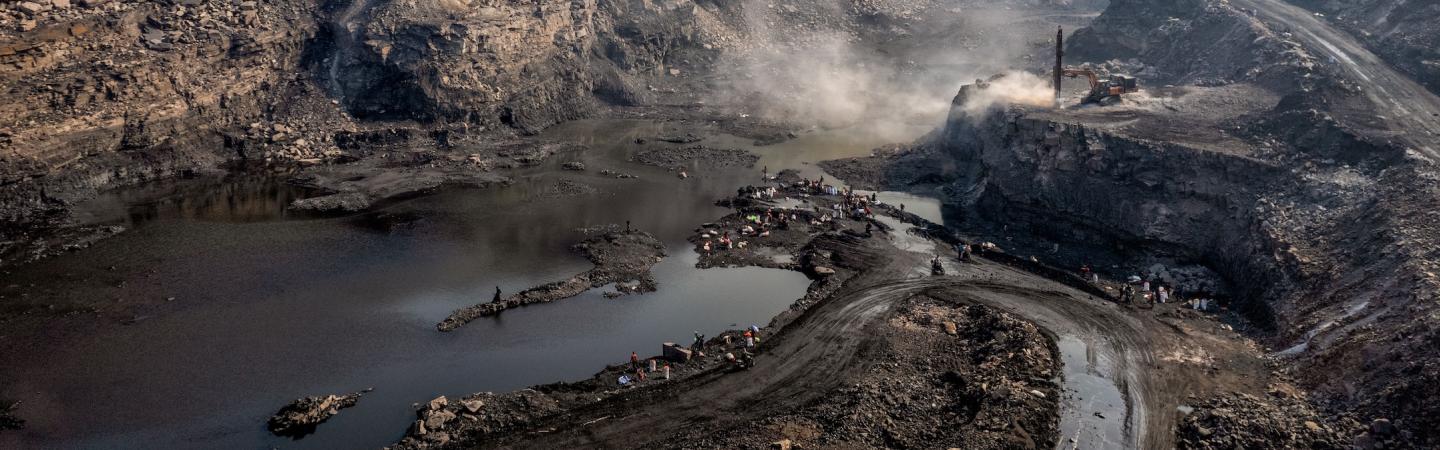
The first widely-used fossil fuel, coal powered the factories, trains, and steamboats of the early Industrial Revolution. It is an especially strong climate pollutant, creating roughly twice as much CO2 as natural gas to provide the same energy.4 Burning coal also emits abundant soot and other pollutants, causing serious health problems in areas that depend heavily on coal power.
About two-thirds of the world’s coal use takes place in power plants,1 supplying more electricity than any other single energy source.5 But coal plants face growing competition, especially from solar and wind energy, which are generally cheaper, quicker to build, and now the world’s fastest-growing sources of electricity.1
Replacing coal with wind and solar can be complicated, because a smoothly functioning electric grid must balance different types of power:
- Firm or baseload power is the grid’s workhorse, supplying electricity around the clock to meet our predictable needs. This is what coal is best at.
- Dispatchable power ramps up quickly to meet spikes in demand, like when people crank their air conditioners in a heatwave. Coal is less good at this, because coal plants are slow to start and stop.
- Intermittent or variable power, like solar and wind, changes with the weather. As these sources make up a bigger share of the energy mix, they need backstops for when the weather is unfavorable. That can include more dispatchable power (often natural gas), batteries to store energy for when gaps arise, or more transmission to share wind and solar across a wider area and smooth out their bumps.
It is possible, and increasingly affordable, to replace firm coal with variable wind and solar, but it requires bigger changes to the grid. These challenges get harder as the amount of firm power shrinks. Most experts agree that the cheapest clean energy mix must include other firm substitutes for coal, like nuclear energy, hydropower, and geothermal.
Today, coal use is falling in the United States and Europe, where it is often cheaper to retire and replace coal plants than keep them running. Meanwhile, China and India are still adding new coal power: Coal is the only fossil fuel these countries have rich reserves of, and they have leaned on it heavily to reduce their dependence on foreign markets. Both countries are building extraordinary amounts of wind and solar, but still need firm power to meet their growing electricity needs.
Outside of electricity, coal’s biggest uses are in mining and manufacturing, especially steelmaking.
Oil
As an energy-dense liquid, easy to store and transport, oil is a superb vehicle fuel. In its processed forms, including gasoline, diesel, and jet fuel, it provides around 90% of the world’s energy for transportation.6
Recently, this dominance has started to wane. Electric vehicles (EVs) are quickly improving their cost, range, and fueling speed, leading more people to choose electricity for travel. EV use is growing almost everywhere, especially in China, where EVs account for more than half of car sales.7
The challenge for electric transportation is weight. Even the lightest batteries don’t pack as much energy per pound as oil, and the more energy a vehicle needs to move, the greater this barrier becomes. Buses have been the first heavy vehicles to electrify at scale, because their predictable routes let them recharge regularly. More recently, electric freight trucks are entering the market. But large ships and planes need liquid fuels for their long journeys, and while cleaner alternatives to oil exist, like certain biofuels, they are not yet competitive at scale.
Oil is also sometimes used to heat buildings, and rarely for electricity. Neither is a large share of the world oil market, because many cheaper and less polluting alternatives exist, but oil does play an important role on islands and in remote areas where importing liquid fuel is easier than running power lines.
The fastest-growing use of oil is in the chemicals industry.8 Oil is a feedstock for plastics, pesticides, cleaners, medicines, and much more. This, too, produces climate-warming CO2.
The world’s oil reserves are fairly concentrated, and a few producing countries—notably the United States, Russia, and several countries in the Middle East—play an outsized role in oil markets. This power imbalance is increasingly pushing major importers like China to wean themselves off oil dependence.
Natural gas
Natural gas, sometimes called fossil gas or methane gas, produces the least CO2 of any fossil fuel.4 That’s because its main ingredient is methane, low in carbon and rich in hydrogen.
But its chemical makeup is a double-edged sword. Methane is a powerful greenhouse gas, and if allowed to escape into the air—through leaks or venting in wells, refineries, or pipelines—it warms the planet much more, pound for pound, than CO2. Natural gas’s impact on the climate depends crucially on how well these methane releases are controlled.
Natural gas is a keystone of the energy system in countries with rich reserves, like the United States, Russia, and Iran, where it provides cheap, dispatchable electricity and ready heat for buildings. In the United States and Europe, natural gas has helped smooth the way for the fast deployment of wind and solar, as a dispatchable source that can quickly ramp up to make up for periods of low wind and sun. (That said, China’s example shows that, while natural gas is helpful in supporting wind and solar, it is far from necessary.)
For all its advantages, natural gas is the least-used fossil fuel worldwide,9 in large part because it is hard to store and transport. It is mainly used in the countries where it’s produced and nearby neighbors who can be connected by pipeline.
Like oil, natural gas is also used to make chemicals—in particular, fertilizers, another significant source of CO2 and methane pollution.
A fossil-free future?
The world’s dependence on fossil fuels is wavering. Globally, both coal use10 and oil use8 seem to be nearing their peaks, and could decline in the near future. Most new electricity generation capacity comes from solar and wind, and the world’s share of fossil electricity is steadily falling.11 Meanwhile, more homes are switching from fossil fuel furnaces to electric heat, for both cost and comfort.
Since electricity and heating account for roughly half of fossil fuels’ CO2 pollution,12 this trend is good news for minimizing the harms of climate change. Real challenges remain, like replacing a large stock of fossil power plants at a time of rising energy demand. But increasingly, economics favors a path to clean heat and electricity.
How the world might eliminate the other half of fossil CO2 emissions is harder to say. A fully clean transportation system will need new fuels or widespread changes in how people and goods get around. To deal with the pollution from products like steel, plastics, and fertilizer, we need to develop new ways to make them, find workable replacements, or reduce how much we use.
But electricity, too, once looked daunting to provide without fossil fuels. The past 20 years have shown that energy markets rapidly pick up clean technologies as soon as the price is right. The mounting risks of climate change are a strong motivation to keep investing in clean energy, as we search for an energy system that can build on the progress fossil fuels have enabled, while protecting a stable climate for generations to come.
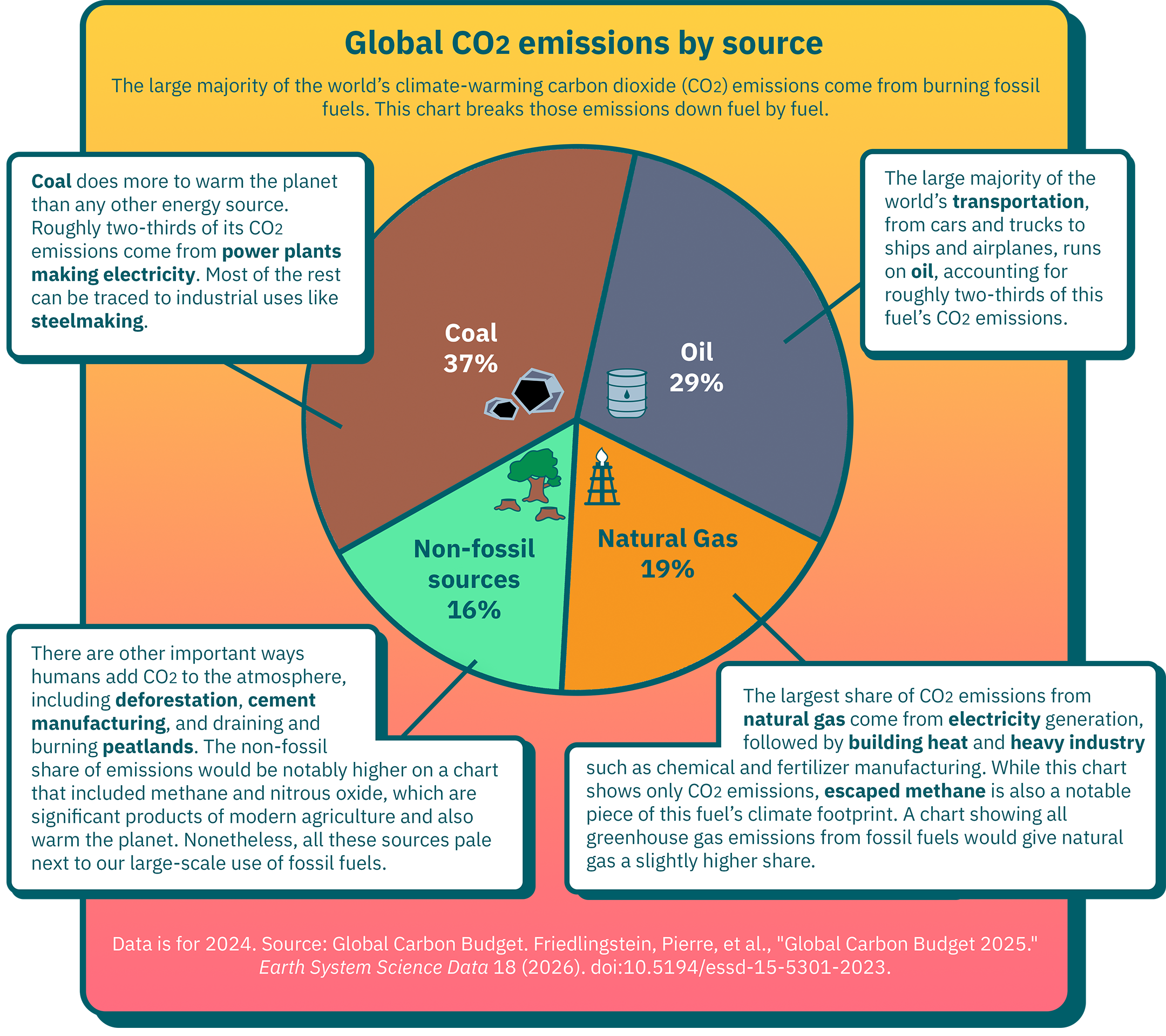
Click here to see information from the infographic above in a table.
| Source | Percent of global CO2 emissions | Description |
|---|---|---|
| Coal | 37% | Coal does more to warm the planet than any other energy source. Roughly two-thirds of its CO2 emissions come from power plants making electricity. Most of the rest can be traced to industrial uses like steelmaking. |
| Oil | 29% | The large majority of the world’s transportation, from cars and trucks to ships and airplanes, runs on oil, accounting for roughly two-thirds of this fuel’s CO2 emissions. |
| Natural gas | 19% | The largest share of CO2 emissions from natural gas come from electricity generation, followed by building heat and heavy industry such as chemical and fertilizer manufacturing. While this chart shows only CO2 emissions, escaped methane is also a notable piece of this fuel’s climate footprint. A chart showing all greenhouse gas emissions from fossil fuels would give natural gas a slightly higher share. |
| Non-fossil sources | 16% | There are other important ways humans add CO2 to the atmosphere, including deforestation, cement manufacturing, and draining and burning peatlands. The non-fossil share of emissions would be notably higher on a chart that included methane and nitrous oxide, which are significant products of modern agriculture and also warm the planet. Nonetheless, all these sources pale next to our large-scale use of fossil fuels. |
Published August 27, 2026
1 International Energy Agency: Global Energy Review 2025.
2 Friedlingstein, Pierre, et al. "Global Carbon Budget 2025." Earth System Science Data 18 (2025). https://doi.org/10.5194/essd-18-3211-2026.
3 See, e.g., Fuller, Richard, et al. “Pollution and health: A progress update.” The Lancet Planetary Health 6 (2022). https://doi.org/10.1016/S2542-5196(22)00090-0. Lelieveld, Johannes, et al. “Effects of fossil fuel and total anthropogenic emission removal on public health and climate.” Proceedings of the National Academy of Sciences 116 (2019). https://doi.org/10.1073/pnas.1819989116. Vohra, Karn, et al. “Global mortality from outdoor fine particle pollution generated by fossil fuel combustion: Results from GEOS-Chem.” Environmental Research 195 (2021). https://doi.org/10.1016/j.envres.2021.110754.
4 This is true whether you consider the raw energy output of each fuel by weight (see U.S. Environmental Protection Agency, GHG Emission Factors Hub, updated January 2025) or the entire lifecycle of a coal versus natural gas power plant (see National Laboratory of the Rockies, Life Cycle Emissions Factors for Electricity Generation Technologies, updated May 2026), although emissions can vary widely and the “dirtiest” natural gas plants may be more climate-polluting than the “cleanest” coal plants.
5 Ember Energy: Yearly Electricity Data. Accessed August 27, 2026.
6 International Energy Agency: Transport. Accessed August 27, 2026.
7 International Energy Agency: Global EV Outlook 2026.
8 International Energy Agency: Oil 2025.
9 Energy Institute: Statistical Review of World Energy 2026.
10 International Energy Agency: Coal 2025.
11 Ember Energy: Global Electricity Review 2026.
12 International Energy Agency: Greenhouse Gas Emissions from Energy Data Explorer. Updated August 26, 2026.





More Resources for Learning
Want to learn more?
Listen to this episode of the Ask MIT Climate podcast featuring Dr. John Reilly.
Keep exploring
With more Explainers from our library: