New to Climate Change?

Solar Energy

Solar energy is a form of renewable energy, in which sunlight is turned into electricity, heat, or other forms of energy we can use. It is a “carbon-free” energy source that, once built, produces none of the greenhouse gas emissions that are driving climate change.
 
Solar is the fastest-growing energy source in the world, adding 270 terawatt-hours of new electricity generation in 20221: enough to power a midsize state like North Carolina or Michigan,2 or a small wealthy country like Denmark or Ireland.3

The solar photovoltaic effect

There are several ways to turn sunlight into usable energy, but almost all solar energy today comes from “solar photovoltaics (PV).”
 
Solar PV relies on a natural property of “semiconductor” materials like silicon, which can absorb the energy from sunlight and turn it into electric current. When light hits a semiconductor, it knocks the electrons in the semiconductor’s atoms loose. The electrons then move freely until they find another atom that can take them in, generating an electric field that forces electrons to flow in a specific direction.
 
The solar panels (“modules”) you see on homes and in solar farms are made of many “cells” of silicon or other types of semiconductor, which constantly absorb light and release electrons. The cells are specially treated and arranged so the free electrons, the “electric charge,” all move in the same direction. This creates an electrical current that can be used to power homes, electric vehicles, and anything that runs on electricity.
 
The first solar panels were built in the 1950s. They were expensive to make and turned less than 10% of the sunlight that reached them into electricity, making them useful only in situations where no other fuel could be had—like in satellites and spacecraft. But over time, engineers learned to build more efficient panels and invented cheaper PV chemistries, and factories began making solar panels at a huge scale. As a result, the price of solar energy has fallen over 500-fold since 1975 and around 90% just since 2010.4

Solar in the larger energy system

Today, solar PV is one of the cheapest sources of new energy being built, second only to wind energy.5 The International Energy Agency forecasts that solar will be the largest source of energy in the world before the end of this decade, and rates it as the only energy-generating technology whose growth is “on track” to meet the world’s climate goals.1
 
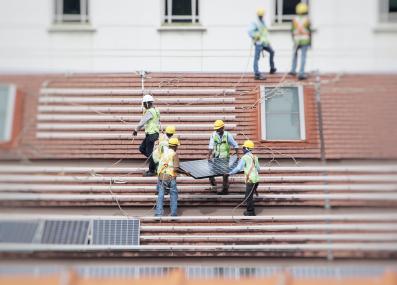
A unique advantage of solar PV is that it’s easy to scale up or down. The same panels work equally well in an immense solar farm providing energy to the electric grid, or on a rooftop powering a single house.6 Homeowners looking to save on their energy bills, remote hospitals in low-income countries who can’t rely on the electric grid, and communities who want a backstop during blackouts all value solar energy because it can be built in small, local installations that would be impractical with other energy technologies.
 
Nonetheless, solar energy, on its own, can’t be relied on around the clock. It is a “variable” energy source that generates more electricity on sunny days, less on cloudy days, and none at night. An electric grid with lots of solar power must pair it with other technologies for reliability: energy sources like hydropower that can be powered up and down at will, energy storage (like batteries) to save up solar energy when it’s plentiful, and/or long-distance transmission to move electricity from the sunniest spots to where it’s needed.
 
Scientists and engineers also continue to improve solar technology. Many focus on making solar PV cells thinner, lighter, flexible, and transparent. This could let users install solar PV in new places, like on windows. It could also drive down costs. Already, solar panels themselves account for less than half the cost of large solar farms and a tiny fraction of the cost of small rooftop projects,7 so lightweight technologies that save on labor, transportation, and land use costs could make solar energy even cheaper and more accessible.
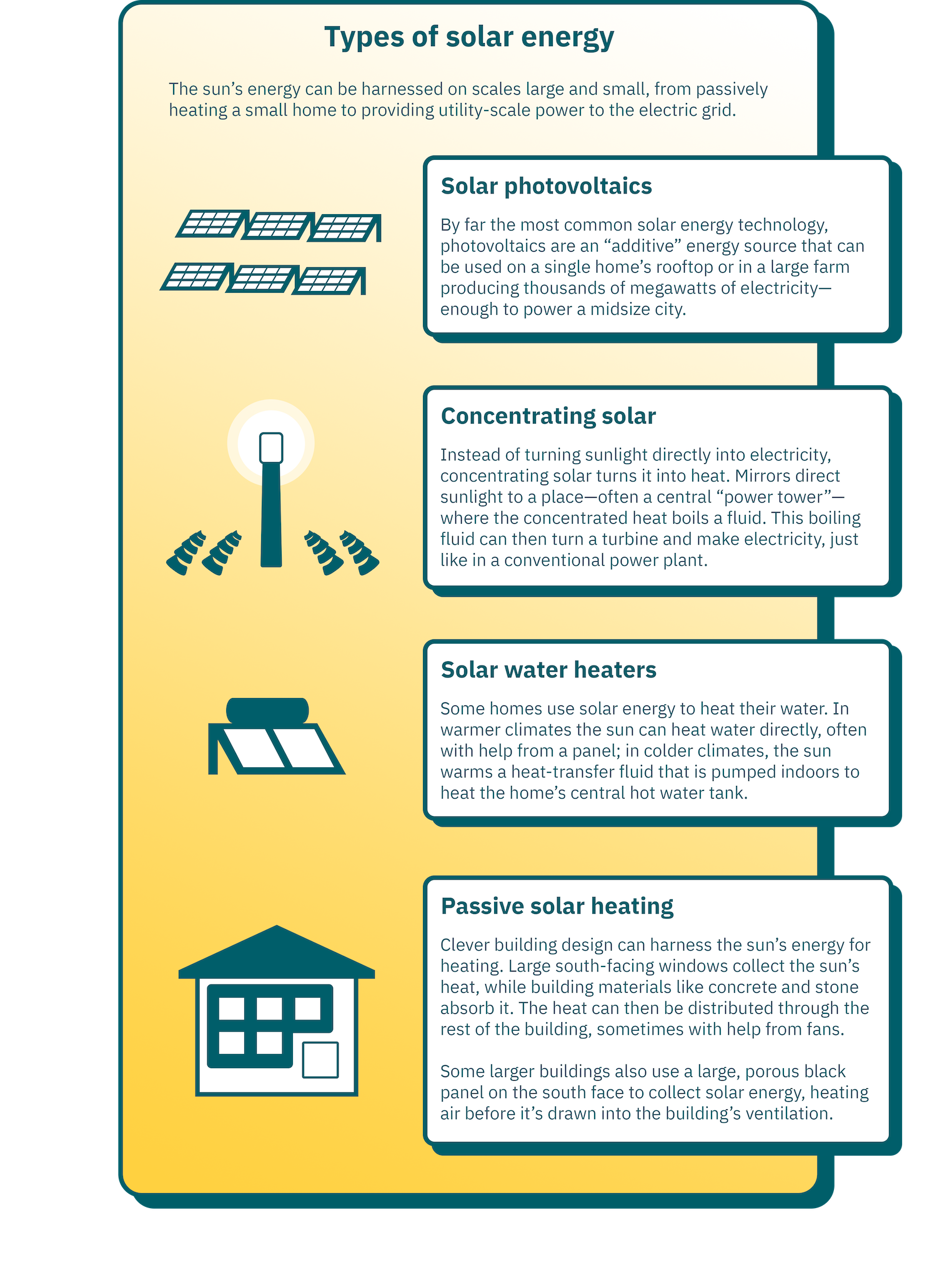
 

Types of solar energy: The sun’s energy can be harnessed on scales large and small, from passively heating a small home to providing utility-scale power to the electric grid.
Click here to see information from the infographic above in a table.
Type of solar energyDescription
Solar photovoltaicsBy far the most common solar energy technology, photovoltaics are an “additive” energy source that can be used on a single home’s rooftop or in a large farm producing thousands of megawatts of electricity—enough to power a midsize city.
Concentrating solarInstead of turning sunlight directly into electricity, concentrating solar turns it into heat. Mirrors direct sunlight to a place—often a central “power tower”—where the concentrated heat boils a fluid. This boiling
fluid can then turn a turbine and make electricity, just like in a conventional power plant.
Solar water heatersSome homes use solar energy to heat their water. In warmer climates the sun can heat water directly, often with help from a panel; in colder climates, the sun warms a heat-transfer fluid that is pumped indoors to heat the home’s central hot water tank.
Passive solar heating

Clever building design can harness the sun’s energy for heating. Large south-facing windows collect the sun’s heat, while building materials like concrete and stone absorb it. The heat can then be distributed through the rest of the building, sometimes with help from fans.

Some larger buildings also use a large, porous black panel on the south face to collect solar energy, heating air before it’s drawn into the building’s ventilation.


Published August 29, 2023.


Creative Commons Attribution-NonCommercial-ShareAlike 4.0 International license (CC BY-NC-SA 4.0).
Photo Credit
Prashanth Vishwanathan | International Water Management Institute via Flickr
Footnotes

1 International Energy Agency: Solar PV. Updated July 11, 2023.

2 U.S. Energy Information Administration: U.S. States: Total End-Use Sector Energy Consumption Estimates, 2021.

3 U.S. Energy Information Administration: International: Total Energy Consumption. Data from 2021.

4 International Energy Agency: Evolution of solar PV module cost by data source, 1970-2020. Updated July 2, 2020.

5 International Energy Agency: Projected Costs of Generating Electricity 2020.

6 Solar farms do typically make more energy per panel than rooftop installations, because they can be sited and angled to get the maximum amount of sunlight.

7 National Renewable Energy Laboratory: U.S. Solar Photovoltaic System and Energy Storage Cost Benchmark: Q1 2020. 2021.


Want to learn more?

Listen to this episode of MIT's "Today I Learned: Climate" podcast on wind and solar power.

Transcriptions

Laur Hesse Fisher: [00:00:00] Hello and welcome to Today I Learned: Climate, the show where you learn about climate change from scientists and experts. I’m Laur Hesse Fisher from the MIT Environmental Solutions Initiative, recording from my home due to the coronavirus pandemic. If you’re listening to this while self-isolating, be well to yourself and others during this tough time.

You’re joining our energy and climate series, which we’re running in collaboration with the MIT Energy Initiative. We’re now going to start digging into, what will it take to generate the electricity our society needs, without generating carbon emissions?

For the rest of the season, we’re going to be exploring our clean energy options -- wind, solar, storage, nuclear and others -- and the benefits and drawbacks that come with each of these technologies.

It might not be a surprise that we’re kicking it off with a conversation about wind and solar power. And to do this, we spoke with Dr. Magdalena Klemun.

Magdalena Klemun: [00:01:09] My name is Magdalena Klemun, and I'm a postdoc at the Institute for Data Systems and Society here at MIT. I'm interested in the fundamental mechanisms of innovation and how they affect different clean energy technologies and lead to improvement over time.

Laur Hesse Fisher: [00:01:26] And wind and solar power have improved a lot in the last few decades -- but we’ll get to that in a minute . Wind power and solar power are very different kinds of energy sources than coal, oil, natural gas, and even nuclear power. First, they are renewable.

Magdalena Klemun: [00:01:44] Instead of burning a fuel that contains carbon renewable technologies convert either the kinetic energy in air or in water -- in the case of wind and hydro -- into electricity, or they convert light into electricity. That would be photovoltaics.

Laur Hesse Fisher: [00:01:59] Photovoltaics are probably what you think of when you hear about “solar energy.” These are the blueish panels that you might have seen on roofs of buildings or in big rows on land. Sunlight is absorbed by the solar panel, which causes a process that dislodges electrons and creates an electric charge.

As we’ve covered in a previous episode, fossil fuels like coal, oil, and natural gas are burned to create steam and turn a turbine. Wind and hydro power also involve turning a turbine, but they do so using the force -- or kinetic energy as Dr. Klemun called it -- of the wind or flowing water. So that means you don’t need to burn anything to turn the turbine and generate the electricity.

Magdalena Klemun: [00:02:40] And since we live in a world where what we're really trying to get rid of is carbon. That's a pretty convincing proposition.

Laur Hesse Fisher: [00:02:47] Wind and solar power are appealing ways to generate electricity for a lot of other reasons, too.

Magdalena Klemun: [00:02:53] The economics are different across locations, but also every single country on this planet has direct access to solar and wind energy. And so that's pretty unique for an energy source. If you consider, for example, that 70% of global resources of natural gas are concentrated in five countries.

 And then another reason is that renewable energy technologies have proven easy to scale. So all we need to do to build a megawatt scale solar photovoltaic plant instead of a small rooftop system is to put more solar panels in a row and more rows next to each other.

So in other words, we scale by repetition, and that's relatively easy.

Laur Hesse Fisher: [00:03:33] This is relative to coal, natural gas, and nuclear power plants, which require a lot of infrastructure to build.

Magdalena Klemun: [00:03:40] And in addition to that, renewables are abundant in the sense that there's enough wind and sunlight and kinetic energy to supply all of our electricity needs.

Laur Hesse Fisher: [00:03:48] Right, our planet has no lack of wind or sunlight and there’s no fear that we're going to run out any time soon.

In 2019, renewable energy generated about 18% of our electricity in the United States. ... In just this past year, wind power actually overtook hydropower as the United States’ top renewable electricity source. In fact, in some states, like Kansas, Iowa and Oklahoma, over a third of the electricity that the state produces comes from wind power alone.

Magdalena Klemun: [00:04:25] Looking back in time, both solar photovoltaics and wind have grown rapidly, actually faster than expected by many international organizations and also by academic researchers. Wind and solar capacity have doubled approximately every three years over the past 30 years. So that's a significant growth trajectory.

And that growth has been driven by a couple of interrelated factors. In the 1960s and 1970s,

a lot of investment and policy support in renewables was driven by concerns about energy security. Particularly in the area of fossil fuels, the US relied heavily on imports from other countries. And then over time these policies supported significant investments in research and development to, for instance, increase the efficiency of solar panels. And that made the technology better. It also made it more reliable and cheaper.

At a high level, most renewable energy sources are competitive or cheaper than fossil generation across different locations. And solar photovoltaics is also increasingly cost competitive.

A solar panel now will cost about 1% of what it cost in 1980 and that's a really significant change.

Laur Hesse Fisher: [00:05:44] All of this is sounding like really good news for wind and solar power… But, there’s a catch.

Magdalena Klemun: [00:05:51] Wind and solar electricity are available when the wind blows and when the sun shines. But that's sometimes, but not always when consumers demand energy.

Laur Hesse Fisher: [00:06:01] This is a huge difference from fossil fuels and also from nuclear energy. As long as we have the oil, natural gas, uranium, we can use it pretty much whenever we want to generate electricity. But we can’t always produce electricity from wind turbines and solar panels.

Remember how in episode 1, Harvey Michaels spoke about how the electric grid needs to always be in balance? Here he is from that episode:

Harvey Michaels: [00:06:29] The complexity of the grid is that there needs to be exactly the right amount of power put into the wires to serve all the instantaneous needs of all the people on the system. It doesn't really have the ability to store electricity in the wires themselves.

Laur Hesse Fisher: [00:06:47] That means that if you want lights at night, having solar power during the day doesn't help you. Same with when the wind’s not blowing.

There are ways to help with this problem.

Magdalena Klemun: [00:06:59] The term energy storage refers to a class of technologies that capture energy available at one point in time to make it available at another point in time.

Laur Hesse Fisher: [00:07:08] To give a few examples, there are large-scale batteries, like the lithium ion batteries that are in electric cars. Another is something called pumped hydropower, which creates a flow of water when we need it.

Magdalena Klemun: [00:07:23] Pumped hydro essentially means that when we have excess electricity in the grid, we use this electricity to pump water up on a mountain. And then we release it through a turbine and the generator to generate electricity when prices are high, and we want to make money.

Laur Hesse Fisher: [00:07:41] The thing is, all this energy storage costs money, and when you factor in the cost of these storage technologies, that adds to the cost of wind and solar power.

Magdalena Klemun: [00:07:52] For each unit of electricity generated by a wind turbine or by a solar panel, you also need to factor in the cost of the amount of storage that you need to make sure the electricity is available on demand. And when we do that, renewables are cost competitive only in some locations and for some storage technologies.

Laur Hesse Fisher: [00:08:14] So a big question is, will energy storage become cheap enough for wind and solar to provide most of our electricity? And if so, when?

Well, it turns out that this could be possible more quickly if we bring in some other technologies as well.

Magdalena Klemun: [00:08:33] In the absence of significant breakthroughs that can reduce the cost of energy storage -- and these breakthroughs might very well happen, but we don't know -- in the absence of these breakthroughs, a good pathway is one where both wind and solar grows significantly, and storage does as well. But then we also expand transmission infrastructure, and we invest in demand side management so we don’t expect energy storage to do 100% of the job.LHF: Demand side management means we change when we use electricity, and how much of it we use.

Laur Hesse Fisher: [00:09:08] So in this scenario, Dr. Klemun is saying that if our electric grid could more easily move electricity across locations or shift it over time, that could partially replace the need for energy storage, because these things also help smooth out the variability of wind and solar.

Magdalena Klemun: [00:09:27] Renewable electricity costs with storage would be half as expensive if we use [these?] other technologies to meet demand during the hours where wind and solar are not available.

Laur Hesse Fisher: [00:09:39] There’s another way to provide clean electricity on demand.

Magdalena Klemun: [00:09:44] If you look at the scenarios that allow us to stabilize CO2 concentrations in the atmosphere, most of these scenarios actually assume that there is a mix of wind and solar, as well as other clean technologies, such as nuclear and fossil generation with carbon capture and sequestration. If we can commercialize it.

Laur Hesse Fisher: [00:10:06] Real quickly, carbon capture is when you burn fossil fuels but capture and permanently store the CO2 before it enters the atmosphere. As Dr. Klemun just said, carbon capture isn’t commercially viable yet. There’s still a lot of research and market development that’s needed for carbon capture to be adopted at a large scale.

Magdalena Klemun: [00:10:28] Technologies like nuclear and fossil generation with carbon capture and sequestration can supply energy on demand. By keeping these technologies in the mix, we at least keep the option alive to use these technologies rather than artificially constraining our options. It’s like you’re putting a lot of very important eggs in very few baskets.

Laur Hesse Fisher: [00:10:49] This is why we’re going to spend the next several episodes looking at these technologies. We’ll cover energy efficiency, and how it can help us in the clean energy transition; and we’ll dig into nuclear power, carbon capture and storage, and even fusion energy.

But if you’re interested in learning more about renewable energy, then you’re in luck: the MIT Energy Initiative has a bunch of episodes that explore batteries and storage, solar power, and how the cost of energy technologies change over time. Google MIT Energy podcast or check out the links in our show notes. We’ll also include links to Dr. Klemun’s own research at the group she works with, the Trancik Lab at MIT."

Feel free to send us your questions over email: tilclimate@mit.edu or on Twitter, @tilclimate

Thank you to Dr. Magdalena Klemun for speaking with us, and as always, thank you for listening.