New to Climate Change?

Renewable Energy

Renewable energy is energy from sources we cannot run out of. Some types of renewable energy, like wind and solar power, come from sources that are not depleted when used. Others, like biomass, come from sources that can be replenished. Common types of renewable energy are wind, solar, hydropower, biomass and geothermal.

Renewable energy has two advantages over the fossil fuels that provide most of our energy today. First, there is a limited amount of fossil fuel resources (like coal, oil and natural gas) in the world, and if we use them all we cannot get any more in our lifetimes. Second, renewable energy produces far less carbon dioxide (CO2) and other harmful greenhouse gases and pollutants. Most types of renewable energy produce no CO2 at all once they are running. For this reason, renewable energy is widely viewed as playing a central role in climate change mitigation and a clean energy transition.


Renewable vs. carbon-free

Most kinds of renewable energy are also “carbon-free”: they do not emit CO2 or other greenhouse gases into the atmosphere. Because of this, and because renewables like wind and solar power are so popular in climate activism, the terms “renewable energy” and “carbon-free energy” are sometimes confused. But not all renewable energy is carbon-free, and not all carbon-free energy is renewable.

Biofuels and bioenergy are renewable: we can regrow plants that we burn for fuel. But they are not necessarily carbon-free. Growing plants absorbs CO2; burning plants releases CO2. The total impact on CO2 in the atmosphere depends on how sustainably the bioenergy is produced.

Nuclear energy is carbon-free: a nuclear power plant does not emit any CO2, or any other greenhouse gases. But it is not renewable. Nuclear reactors use uranium, and if we run out of uranium, we can never get it back.


Transforming the electric grid

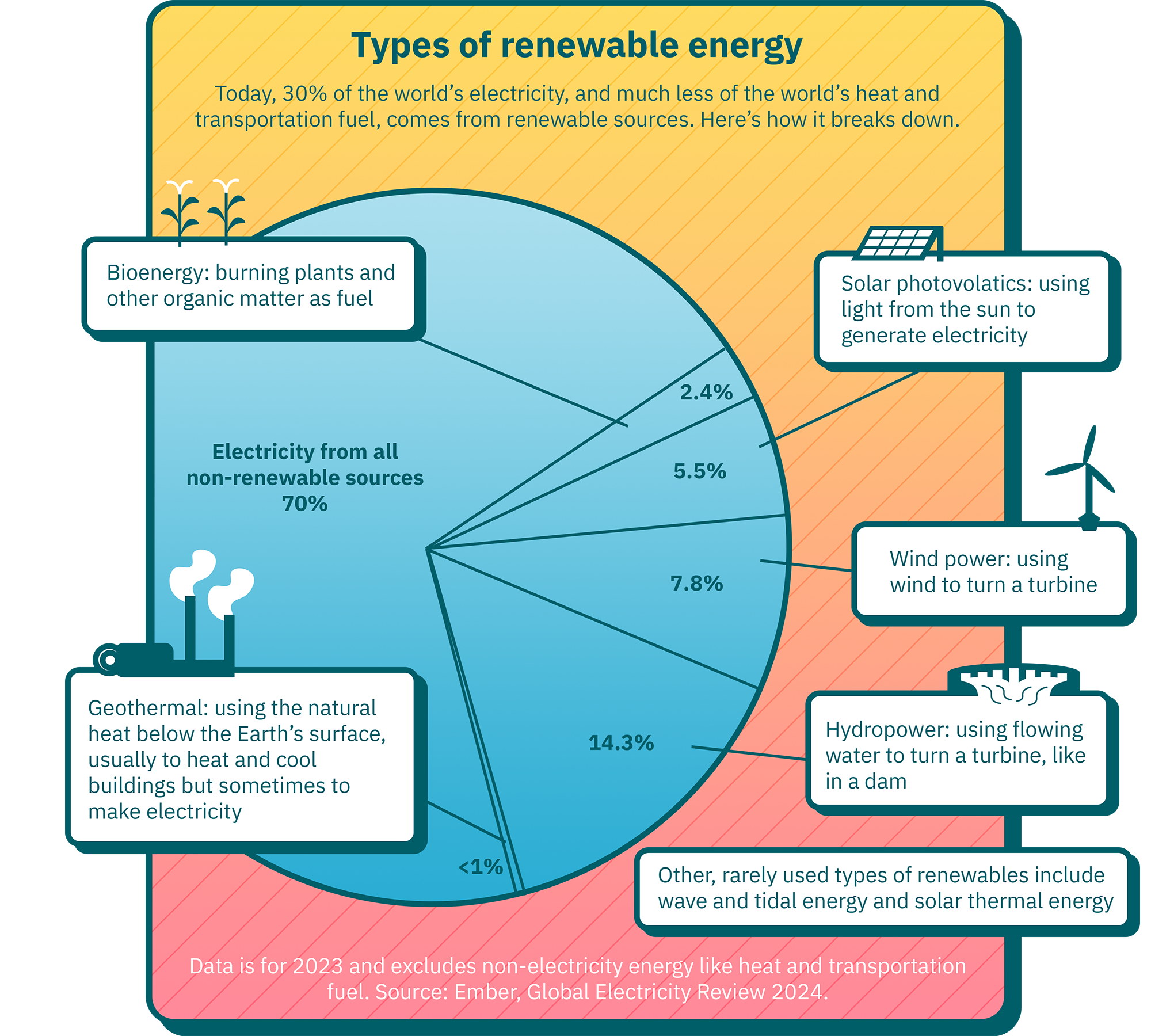
Some types of renewable energy can provide fuel for transportation (e.g. biofuels) or heating and cooling for buildings (e.g. geothermal). However, most renewable energy is used to make electricity. In 2023, renewable energy sources made up over 30% of the world’s electricity, and that number is rising every year.1 Around 50% of renewable electricity worldwide comes from hydropower, which has been widely used since the invention of the electric grid, but today wind and solar power are growing fastest.1

Renewable energy presents great challenges and opportunities for electricity generation. Some renewable energy sources, such as wind and solar, are “variable,” meaning the amount of electricity they make changes depending on the amount of wind or sunlight available. This can cause problems for system operators, particularly when there is a mismatch between the amount of electricity demanded and the amount of wind or sun available. Another challenge is that the best places to generate renewable energy are often far away from the areas that use that electricity. For these reasons, adding much more renewable energy to our electric grid will require other changes, including more energy storage, backup generation, strategies to match electricity use with times of high power generation, and infrastructure for long-distance power transmission.


A growing source of energy

Renewable energy also needs to compete with well-established and cheap fossil fuels. Renewable energy has grown quickly over the last decade, driven by policy support (tax incentives, R&D funding and mandates requiring the use of renewables) and falling costs (especially in solar photovoltaics and wind turbines). Globally, renewables now represent a majority of all new electricity built each year.1 Wind and solar have grown from making just 2% of the world's electricity in 20002 to over 13% today1: over 3,900 terawatt-hours worldwide in 2023,3,4 which would be nearly enough to power the entire United States.5 As societies work to lower their greenhouse gas emissions, renewable energy is expected to play a large role, especially if we switch more heating and transportation to run on electric power and solve the problem of affordable, large-scale energy storage. How much of our energy we ultimately get from renewables will also depend on their ability to compete with other low-carbon technologies, such as nuclear, carbon capture and storage and hydrogen.
 

Types of renewable energy
Click here to see data from the infographic above in a table.
Type of energyDescriptionPercent of global electricity production
Electricity from all non-renewable sourcesincludes fossil fuels like coal, oil and natural gas, as well as nuclear power70%
HydropowerUsing flowing water to turn a turbine, like in a dam14.3%
Wind powerUsing wind to turn a turbine7.8%
Solar photovoltaicsUsing light from the sun to generate electricity5.5%
BioenergyBurning plants and other organic matter as fuel2.4%
Geothermal energyUsing the natural heat below the Earth’s surface, usually to heat and cool buildings but sometimes to make electricityless than 1%
Other, rarely used types of renewablesIncludes wave and tidal energy and solar thermal energyless than 1%


Updated July 25, 2025.

Creative Commons Attribution-NonCommercial-ShareAlike 4.0 International license (CC BY-NC-SA 4.0).
Photo Credit
Justin Lim via Unsplash
Footnotes

1 International Energy Agency: "Electricity 2024: Analysis and Forecast to 2026."

2 International Energy Agency: "World Energy Outlook 2000."

3 International Energy Agency: Solar PV. Updated February 3, 2025.

4 International Energy Agency: Wind. Updated February 25, 2025.

5 U.S. Energy Information Administration: U.S. total energy statistics. Updated May 7, 2024.

Want to learn more?

Listen to this episode of MIT's "Today I Learned: Climate" podcast on wind and solar power.

Transcriptions

Laur Hesse Fisher: [00:00:00] Hello and welcome to Today I Learned: Climate, the show where you learn about climate change from scientists and experts. I’m Laur Hesse Fisher from the MIT Environmental Solutions Initiative, recording from my home due to the coronavirus pandemic. If you’re listening to this while self-isolating, be well to yourself and others during this tough time.

You’re joining our energy and climate series, which we’re running in collaboration with the MIT Energy Initiative. We’re now going to start digging into, what will it take to generate the electricity our society needs, without generating carbon emissions?

For the rest of the season, we’re going to be exploring our clean energy options -- wind, solar, storage, nuclear and others -- and the benefits and drawbacks that come with each of these technologies.

It might not be a surprise that we’re kicking it off with a conversation about wind and solar power. And to do this, we spoke with Dr. Magdalena Klemun.

Magdalena Klemun: [00:01:09] My name is Magdalena Klemun, and I'm a postdoc at the Institute for Data Systems and Society here at MIT. I'm interested in the fundamental mechanisms of innovation and how they affect different clean energy technologies and lead to improvement over time.

Laur Hesse Fisher: [00:01:26] And wind and solar power have improved a lot in the last few decades -- but we’ll get to that in a minute . Wind power and solar power are very different kinds of energy sources than coal, oil, natural gas, and even nuclear power. First, they are renewable.

Magdalena Klemun: [00:01:44] Instead of burning a fuel that contains carbon renewable technologies convert either the kinetic energy in air or in water -- in the case of wind and hydro -- into electricity, or they convert light into electricity. That would be photovoltaics.

Laur Hesse Fisher: [00:01:59] Photovoltaics are probably what you think of when you hear about “solar energy.” These are the blueish panels that you might have seen on roofs of buildings or in big rows on land. Sunlight is absorbed by the solar panel, which causes a process that dislodges electrons and creates an electric charge.

As we’ve covered in a previous episode, fossil fuels like coal, oil, and natural gas are burned to create steam and turn a turbine. Wind and hydro power also involve turning a turbine, but they do so using the force -- or kinetic energy as Dr. Klemun called it -- of the wind or flowing water. So that means you don’t need to burn anything to turn the turbine and generate the electricity.

Magdalena Klemun: [00:02:40] And since we live in a world where what we're really trying to get rid of is carbon. That's a pretty convincing proposition.

Laur Hesse Fisher: [00:02:47] Wind and solar power are appealing ways to generate electricity for a lot of other reasons, too.

Magdalena Klemun: [00:02:53] The economics are different across locations, but also every single country on this planet has direct access to solar and wind energy. And so that's pretty unique for an energy source. If you consider, for example, that 70% of global resources of natural gas are concentrated in five countries.

 And then another reason is that renewable energy technologies have proven easy to scale. So all we need to do to build a megawatt scale solar photovoltaic plant instead of a small rooftop system is to put more solar panels in a row and more rows next to each other.

So in other words, we scale by repetition, and that's relatively easy.

Laur Hesse Fisher: [00:03:33] This is relative to coal, natural gas, and nuclear power plants, which require a lot of infrastructure to build.

Magdalena Klemun: [00:03:40] And in addition to that, renewables are abundant in the sense that there's enough wind and sunlight and kinetic energy to supply all of our electricity needs.

Laur Hesse Fisher: [00:03:48] Right, our planet has no lack of wind or sunlight and there’s no fear that we're going to run out any time soon.

In 2019, renewable energy generated about 18% of our electricity in the United States. ... In just this past year, wind power actually overtook hydropower as the United States’ top renewable electricity source. In fact, in some states, like Kansas, Iowa and Oklahoma, over a third of the electricity that the state produces comes from wind power alone.

Magdalena Klemun: [00:04:25] Looking back in time, both solar photovoltaics and wind have grown rapidly, actually faster than expected by many international organizations and also by academic researchers. Wind and solar capacity have doubled approximately every three years over the past 30 years. So that's a significant growth trajectory.

And that growth has been driven by a couple of interrelated factors. In the 1960s and 1970s,

a lot of investment and policy support in renewables was driven by concerns about energy security. Particularly in the area of fossil fuels, the US relied heavily on imports from other countries. And then over time these policies supported significant investments in research and development to, for instance, increase the efficiency of solar panels. And that made the technology better. It also made it more reliable and cheaper.

At a high level, most renewable energy sources are competitive or cheaper than fossil generation across different locations. And solar photovoltaics is also increasingly cost competitive.

A solar panel now will cost about 1% of what it cost in 1980 and that's a really significant change.

Laur Hesse Fisher: [00:05:44] All of this is sounding like really good news for wind and solar power… But, there’s a catch.

Magdalena Klemun: [00:05:51] Wind and solar electricity are available when the wind blows and when the sun shines. But that's sometimes, but not always when consumers demand energy.

Laur Hesse Fisher: [00:06:01] This is a huge difference from fossil fuels and also from nuclear energy. As long as we have the oil, natural gas, uranium, we can use it pretty much whenever we want to generate electricity. But we can’t always produce electricity from wind turbines and solar panels.

Remember how in episode 1, Harvey Michaels spoke about how the electric grid needs to always be in balance? Here he is from that episode:

Harvey Michaels: [00:06:29] The complexity of the grid is that there needs to be exactly the right amount of power put into the wires to serve all the instantaneous needs of all the people on the system. It doesn't really have the ability to store electricity in the wires themselves.

Laur Hesse Fisher: [00:06:47] That means that if you want lights at night, having solar power during the day doesn't help you. Same with when the wind’s not blowing.

There are ways to help with this problem.

Magdalena Klemun: [00:06:59] The term energy storage refers to a class of technologies that capture energy available at one point in time to make it available at another point in time.

Laur Hesse Fisher: [00:07:08] To give a few examples, there are large-scale batteries, like the lithium ion batteries that are in electric cars. Another is something called pumped hydropower, which creates a flow of water when we need it.

Magdalena Klemun: [00:07:23] Pumped hydro essentially means that when we have excess electricity in the grid, we use this electricity to pump water up on a mountain. And then we release it through a turbine and the generator to generate electricity when prices are high, and we want to make money.

Laur Hesse Fisher: [00:07:41] The thing is, all this energy storage costs money, and when you factor in the cost of these storage technologies, that adds to the cost of wind and solar power.

Magdalena Klemun: [00:07:52] For each unit of electricity generated by a wind turbine or by a solar panel, you also need to factor in the cost of the amount of storage that you need to make sure the electricity is available on demand. And when we do that, renewables are cost competitive only in some locations and for some storage technologies.

Laur Hesse Fisher: [00:08:14] So a big question is, will energy storage become cheap enough for wind and solar to provide most of our electricity? And if so, when?

Well, it turns out that this could be possible more quickly if we bring in some other technologies as well.

Magdalena Klemun: [00:08:33] In the absence of significant breakthroughs that can reduce the cost of energy storage -- and these breakthroughs might very well happen, but we don't know -- in the absence of these breakthroughs, a good pathway is one where both wind and solar grows significantly, and storage does as well. But then we also expand transmission infrastructure, and we invest in demand side management so we don’t expect energy storage to do 100% of the job.LHF: Demand side management means we change when we use electricity, and how much of it we use.

Laur Hesse Fisher: [00:09:08] So in this scenario, Dr. Klemun is saying that if our electric grid could more easily move electricity across locations or shift it over time, that could partially replace the need for energy storage, because these things also help smooth out the variability of wind and solar.

Magdalena Klemun: [00:09:27] Renewable electricity costs with storage would be half as expensive if we use [these?] other technologies to meet demand during the hours where wind and solar are not available.

Laur Hesse Fisher: [00:09:39] There’s another way to provide clean electricity on demand.

Magdalena Klemun: [00:09:44] If you look at the scenarios that allow us to stabilize CO2 concentrations in the atmosphere, most of these scenarios actually assume that there is a mix of wind and solar, as well as other clean technologies, such as nuclear and fossil generation with carbon capture and sequestration. If we can commercialize it.

Laur Hesse Fisher: [00:10:06] Real quickly, carbon capture is when you burn fossil fuels but capture and permanently store the CO2 before it enters the atmosphere. As Dr. Klemun just said, carbon capture isn’t commercially viable yet. There’s still a lot of research and market development that’s needed for carbon capture to be adopted at a large scale.

Magdalena Klemun: [00:10:28] Technologies like nuclear and fossil generation with carbon capture and sequestration can supply energy on demand. By keeping these technologies in the mix, we at least keep the option alive to use these technologies rather than artificially constraining our options. It’s like you’re putting a lot of very important eggs in very few baskets.

Laur Hesse Fisher: [00:10:49] This is why we’re going to spend the next several episodes looking at these technologies. We’ll cover energy efficiency, and how it can help us in the clean energy transition; and we’ll dig into nuclear power, carbon capture and storage, and even fusion energy.

But if you’re interested in learning more about renewable energy, then you’re in luck: the MIT Energy Initiative has a bunch of episodes that explore batteries and storage, solar power, and how the cost of energy technologies change over time. Google MIT Energy podcast or check out the links in our show notes. We’ll also include links to Dr. Klemun’s own research at the group she works with, the Trancik Lab at MIT."

Feel free to send us your questions over email: tilclimate@mit.edu or on Twitter, @tilclimate

Thank you to Dr. Magdalena Klemun for speaking with us, and as always, thank you for listening.