New to Climate Change?

Carbon Capture

Carbon capture and storage (CCS) refers to a collection of technologies that can help address climate change by reducing carbon dioxide (CO2emissions. The idea behind CCS is to capture the climate-warming CO2 generated by burning fossil fuels before it is released to the atmosphere. The question is then: What to do with the captured CO2? Most CCS strategies call for the injection of CO2 deep underground. This forms a “closed loop”, where the carbon is extracted from the Earth as fossil fuels and then is returned to the Earth as CO2.

How does CCS work?

Today, CCS projects are storing over 50 million tons of CO2 every year1: about the amount emitted by a small country like Greece or Peru.2 Capture generally takes place at large stationary sources of CO2, like power plants. Most current carbon capture projects use a liquid to chemically remove the CO2 before it goes out the smokestack, but several new capture processes are under development.

The captured CO2 gas is then compressed so it becomes liquid-like and transported to a storage site, generally through a pipeline. Once at the storage site, the CO2 is pumped more than 2,500 feet down wells into geological formations like used-up oil and gas reservoirs, as well as formations that contain unusable, salty water.

The storage challenge

Choosing the right place to store captured CO2 is important. In the wrong geology, CO2 could escape back to the surface, or the injection process could cause earthquakes. Geologists look for sites with porous rock that large quantities of CO2 can seep into, with a solid “cap rock” above, and where there are no nearby fault lines.

There is no shortage of sites like this, even if we were to use vastly more CCS than we do today. But care must be taken in both injecting and transporting CO2 to minimize risks.

Fortunately, we have a lot of experience with similar challenges. The oil and gas industry maintains millions of miles of pipelines and injects hundreds of billions of gallons of wastewater into the earth each year, a scale that dwarfs CCS today. And unlike oil and gas, CO2 is not toxic or flammable.


Utilization

We emit so much CO2 into the atmosphere that, if carbon capture is going to play any significant part in addressing climate change, we will have to store most of the captured CO2 underground. But “utilization”—selling the CO2 as a valuable product—could help create markets for carbon capture, and make it cheaper for companies to invest in capturing their CO2 emissions.

The main use for CO2 today is enhanced oil recovery: pumping CO2 into oil wells to help flush out hard-to-extract oil. Pure CO2 is also used in greenhouses to grow plants. Most CO2 used for these purposes today is extracted from the earth, but captured CO2 works just as well.

CO2 could also be made into useful products. Companies and labs are working on turning CO2 into plastics, building materials like cement and concrete, fuels, futuristic materials like carbon fibers and graphene, and even household products like baking soda, bleach, antifreeze, inks and paints. Some of these products are already being sold, but none in very large amounts.

Or we could use the CO2 to grow algae or bacteria. This can then be the basis for making biofuels, fertilizers, or animal feed.


Carbon capture economics

Carbon capture has been successfully demonstrated in many industries that produce CO2, including coal power, steel and cement manufacturing, and production of ammonia, ethanol, and other chemicals.1 But simple economics has kept CCS from widespread use. In any industry, adding CCS is an extra cost, and generally a substantial one: In a coal or gas power plant, it has been estimated to as much as double the cost of electricity. While costs may fall with experience, they will not fall to zero.

This means CCS can only compete with government intervention. That could take the form of subsidies for CCS, a carbon tax that charges polluters for the CO2 they put into the atmosphere, or legal limits on how much CO2 industries can emit. In effect, CCS will only be used to the extent we are willing to pay to prevent further climate change.

Where and how CCS might be most useful is hard to predict. In some industries, like cement, CCS is one of the only plausible options for dealing with CO2 emissions. In other sectors, CCS must compete with other mature technologies. Solar and wind power, for example, are plainly cheaper sources of clean electricity than coal or gas with CCS. Yet even here, one can imagine CCS filling a crucial niche. Some other power source must pick up the slack when weather conditions are poor for solar and wind. In the United States today, that is typically gas; in the future, it may be gas with carbon capture.

Capturing CO2 from the air

There has also been considerable interest in using CCS technologies to remove CO2 from the atmosphere, reversing some of the damage we have done to the climate. One option is bioenergy with CCS (BECCS), where biomass (like wood or grasses) removes CO2 from the air through photosynthesis as it grows. The biomass is then harvested and burned in a power plant to produce energy, with the CO2 being captured and stored.

Another option is called direct air capture (DAC). In a typical DAC plant, huge fans funnel air into machines where CO2 is removed using a chemical process. However, the concentration of CO2 in the air is about 300 times less than in a smokestack, making it much less efficient to capture. Because of this, DAC uses a great deal of energy and is quite expensive today.
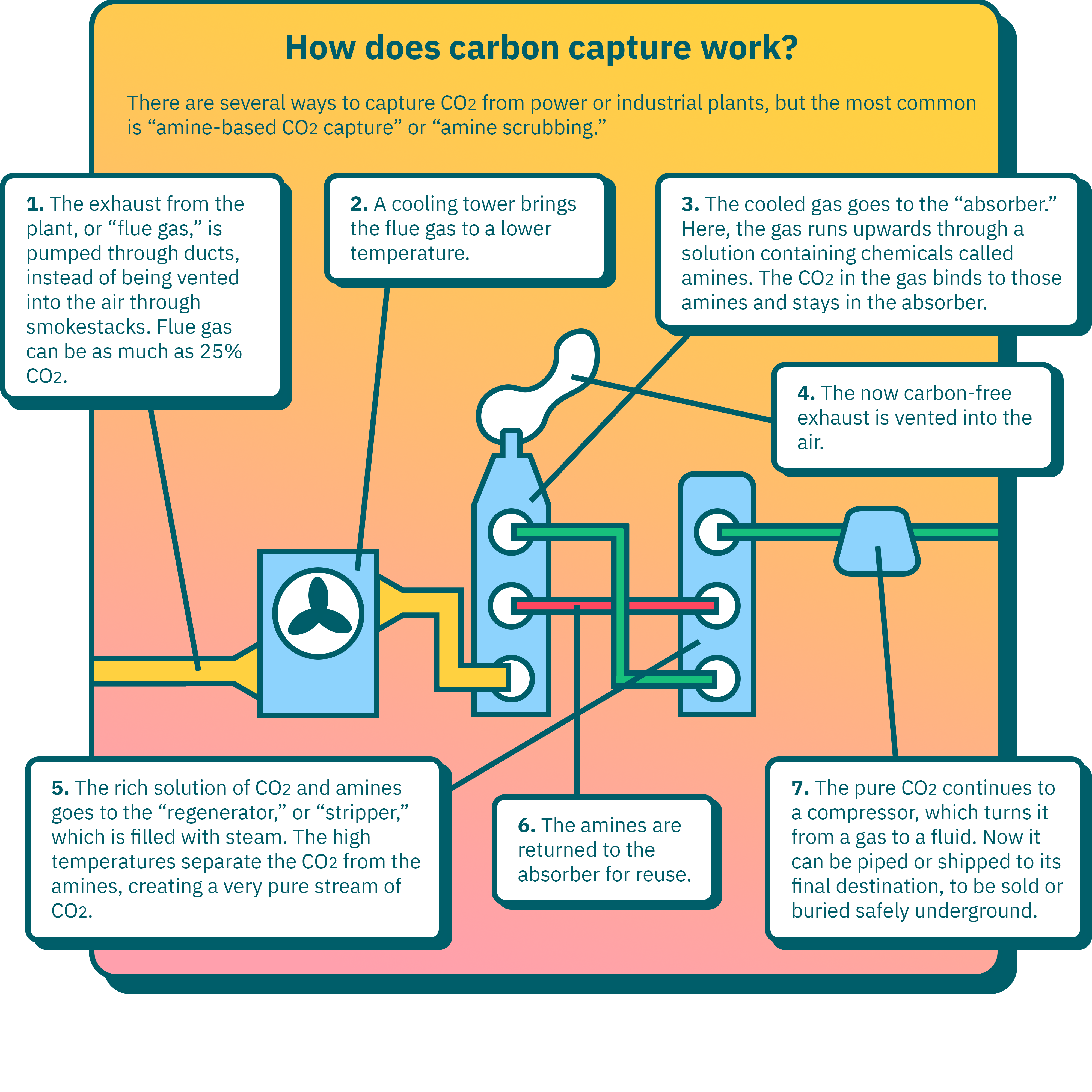
 

Infographic: How does carbon capture work? There are several ways to capture CO2 from power or industrial plants, but the most common is “amine-based CO2 capture” or “amine scrubbing.” 1. The exhaust from the plant, or “flue gas,” is pumped through ducts, instead of being vented into the air through smokestacks. Flue gas can be as much as 25% CO2. 2. A cooling tower brings the flue gas to a lower temperature. 3. The cooled gas goes to the “absorber.” Here, the gas runs upwards through a solution containing chemicals called amines. The CO2 in the gas binds to those amines and stays in the absorber. 4. The now carbon-free exhaust is vented into the air. 5. The rich solution of CO2 and amines goes to the “regenerator,” or “stripper,” which is filled with steam. The high temperatures separate the CO2 from the amines, creating a very pure stream of CO2. 6. The amines are returned to the absorber for reuse. 7. The pure CO2 continues to a compressor, which turns it from a gas to a fluid. Now it can be piped or shipped to its final destination, to be sold or buried safely underground.


Our readers have sent in many questions about carbon capture and storage. You can read some of these questions and their answers below:


Updated August 8, 2025.


Creative Commons Attribution-NonCommercial-ShareAlike 4.0 International license (CC BY-NC-SA 4.0).
Photo Credit
Suleyman Naumov via Unsplash
Footnotes

1 According to the Global CCS Institute, an industry-supported think tank which advocates for and collects data on worldwide carbon capture projects. Global CCS Institute: Global Status of CCS 2024.

2 Friedlingstein, Pierre, et al.. "Global Carbon Budget 2024." Earth System Science Data 17 (2025). https://doi.org/10.5194/essd-17-965-2025.

Want to learn more?

Listen to this episode of MIT's "Today I Learned: Climate" podcast on carbon capture.

Transcriptions

LHF: [00:00:00] Hello and welcome to TILclimate, the podcast where you learn about climate change from real scientists and experts. I’m your host, Laur Hesse Fisher, with the MIT Environmental Solutions Initiative. We’re back with the next episode in our series on energy and climate in partnership with the MIT Energy Initiative.

So far this season, we’ve talked about ways our electricity system could burn fewer fossil fuels, so the carbon trapped in coal, oil or natural gas stays underground where it can’t warm our atmosphere. But today, we’ll be talking with two members of the MIT Energy Initiative about a technology that actually doesn’t try to replace fossil fuels. 

HH: [00:00:50] My name is Howard Herzog. I'm a senior research engineer in the MIT Energy Initiative. In about a month's time I'll be celebrating my 30th anniversary at the Energy Initiative or its predecessor the Energy Lab.

BH: [00:01:05] I'm Brad Hager. I'm a professor of earth, atmospheric and planetary sciences. … And, in addition to being a- a professor, I'm the co-director of the MIT Energy Initiative's Low Carbon Energy Center on Carbon Capture, Utilization and Storage.

LHF: [00:01:21] That’s right, they both work on something called carbon capture, utilization and storage—abbreviated as “CCUS”, or sometimes just called carbon capture, like we’ll call it today . 

HH: [00:01:36] The problem for climate change is the emission of CO2 into the atmosphere. So when you burn fossil fuels, you create CO2. The idea in carbon capture is that CO2 that's created by the burning of fossil fuels, you stop from going into the atmosphere. And you do that by capturing it and then you put it somewhere other than the atmosphere.

LHF: [00:02:06] So, why would we even consider this? Well, as we’ve heard earlier in this series, adding clean energy sources like solar, wind, and nuclear, comes with a lot of complications that we need to work out. In theory, carbon capture let’s us use the energy system that we have now, but removes the CO2 emissions from that system. 

HH: [00:02:29] The problem with climate change isn't fossil fuels. The problem is the buildup of greenhouse gases in the atmosphere, and so what we want to do is look at solutions that reduce the amount of greenhouse gases we're putting into the atmosphere. If we do that by using less fossil fuels, which I think is going to be part of the solution, so be it, but it doesn't mean that we can't continue to use fossil fuels if we have the technology to use them without putting their emissions into the atmosphere.

LHF: [00:02:58] So today, we’re diving into how carbon capture works, what we’re supposed to do with all this CO2 once we capture it, and just how realistic this is as a way to help slow climate change.

But let’s start with the basics. Because power plants and factories emit so much carbon dioxide in one place, most carbon capture happens there: from the "flue gas" that comes out of their smokestacks. Here’s Prof. Hager.

BH: [00:03:27]  The method of capturing carbon dioxide that has been used for the longest is to, run, the flue gas, through a solution of chemicals called amines. The carbon dioxide dissolves in the amines.

HH: [00:03:41]  Then you compress it to turn it into basically a liquid, a high pressure liquid. It's technically it's called a super critical fluid but it basically acts like a liquid. and then you can put it in a pipeline and you can put it down a well into the earth. And the place that right now is the biggest opportunity to store the CO2 is in deep underground formations.

LHF: [00:04:08] Engineers look for just the right places to do this so the CO2 can’t leak back into the atmosphere or into our groundwater.

BH: [00:04:17]  So we can think of a good reservoir, candidate for storing this stuff as being a layer of shale, called the caprock, to keep the fluids in place. And then underneath it, a layer of sandstone to provide empty space to put the CO2 in.

LHF: [00:04:32] Originally, I imagined these underground caves that the fluid CO2 was poured into. But actually, it’s injected into a rock, which kind of absorbs the CO2.

HH: [00:04:46]  The way to think of it is, think of you're at the beach and you have a bucket of sand, and you can put water into it and the water goes in the pores between the sand. 

LHF: [00:04:57] The CO2 then sits there, in the same way that oil has been sitting in these kinds of spaces underground naturally for millions of years.

And if this sounds like science fiction, well, actually, it’s already happening. There are around 20 facilities using carbon capture and storage around the world, although most of them aren’t power plants: they’re other industrial plants, like natural gas processors or steel or fertilizer plants. Some of them have been running for a long time.

BH: [00:05:32] The first really serious project is called Sleipner, run by the Norwegians. So in 1996, they started producing sour gas, cleaning it up, removing the carbon dioxide, and injecting it into the subsurface underneath the North Sea. And for the last 23 years, since the plant started, they have been injecting about a million tons of carbon dioxide a year into the subsurface.

LHF: [00:06:03] A million tons of CO2 is about the same amount 200,000 U.S. cars emit in a year. But burying this CO2 is not our only option for dealing with it. 

BH: [00:06:16] Recently, there's been a lot of interest in using the carbon dioxide as an intermediate product. It can be used to make plasti cs, make feed stocks for plastics, and it can even be combined with hydrogen to make, for example, jet fuel.

LHF: [00:06:33] The more useful stuff we can make out of CO2, the more reason that companies will have to capture it. Because right now, there isn’t really a big market for this captured CO2. 

HH: [00:06:48]  The amount of CO2 that we are producing from energy use will - basically is so much larger than markets for a lot of the products people are thinking of that at best it's going to be a niche solution, and you're still going to need to put it in underground reservoirs if carbon capture is going to be adopted on large scale.

LHF: [00:07:05] What does “large scale” really mean? Let’s imagine that we only capture and store one tenth of the CO2 we’re emitting today. That would be about as much liquid as all the oil consumed worldwide—a massive industry served by huge tankers, storage depots, and hundreds of thousands of miles of pipelines.

It would take a lot to repurpose or build new infrastructure for moving around CO2, and if you’re a power company, or a steel manufacturer, you might be wondering why you would pay for it. Which brings us to one of the big challenges for carbon capture: it’s pretty expensive.

BH: [00:07:56] There's additional expense that you need to build the facility to do this. And then it takes energy to do it. So the, increase in, you know, cost of electricity coming down the power line to the consumer, is on the order of 30 to 50%.

LHF: [00:08:13] At the moment, there’s not enough of an incentive for power companies to take on that extra cost. 

BH: [00:08:20] In order to promote the capture of carbon dioxide, you need some sort of economic incentive to do that. So you can have a carrot or you can have a stick. And the carrot, which is being held out right now, is the, basically tax rebates.

LHF: [00:08:36] Yeah, actually, here in the U.S., we offer companies a tax credit for capturing their carbon emissions. Right now it's about $50/ton CO2, which isn't really high enough to retrofit all our fossil fuel power plants. So that’s the carrot. And the stick?

BH: [00:08:56] The other side is putting a price on carbon and so if that's high enough, a company will, you know, voluntarily capture and- and sequester its carbon dioxide.

LHF: [00:09:07] We did a whole episode on carbon pricing in our first season, so check that out to understand how a carbon price would work.

The thing you’re hearing here, is that capturing and storing CO2 at our current power plants is possible. But we either need to decrease the costs of doing it or increase the incentives. And the policies we choose can make a huge difference to companies deciding whether to invest in something like carbon capture. 

HH: [00:09:39] Technology doesn't happen in a vacuum. Innovation doesn't happen in a vacuum. You need to create the markets and that's a political thing. I think if you had a carbon tax, it will create innovation and there's a lot of room for innovation in this area. But there's no silver bullet in dealing with climate change. There's no one solution that's going to provide the answer.

LHF: [00:10:11] If it becomes cheap enough, carbon capture could be a long-term solution for many power or manufacturing plants. Or its role could be to help us cut emissions immediately until we solve the challenges with wind, solar, or nuclear power, or energy efficiency.

BH: [00:10:30] I see this as a, a strategy that will bridge through the next three decades. And, you know, so the next 20 to 50 years. I hope that cheaper sources of electricity, of clean electricity, will be developed.

LHF: [00:10:44] So carbon capture is one more tool we can add to our clean energy toolbelt. And it’s just like all the other technologies we’ve explored in this series: powerful, but with their advantages and disadvantages, and none of them able to do the job on its own.

There’s a lot more to learn about carbon capture. We’ve left some links in the show notes to places you can learn more, including a couple episodes of the MIT Energy Initiative podcast.

Our next episode of TIlclimate is on fusion energy, so stick with us.

A quick shout out to amyleewee who left us a review on Apple Podcasts. Amyleewee says, “Super informative podcast that breaks down really complex topics into small bites and does so without placing blame! Keep up the good work!” Thanks Amyleewee, we appreciate it.

We invite you to leave us a review on Apple Podcasts as well, or wherever you’re listening from today.

Today I Learned Climate is brought to you by the MIT Environmental Solutions Initiative. Thank you to Brad Hager and Howard Herzog for talking to us, and thank you for listening.