Have a question?

Can wind turbines be recycled?

Some parts, like the steel towers and electrical components, can be recycled. The big blades are more complicated.


July 23, 2023 

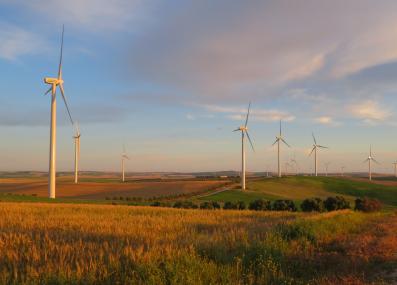
Wind turbines are built to last, and for good reason: they’re meant to endure whatever nature throws at them as they spend decades standing in the breeze, turning it into clean renewable energy. But when turbines reach the ends of their lives, that ruggedness can be a problem. Jeremiah A. Johnson, the A. Thomas Guertin Professor of Chemistry at MIT, says the way turbine blades are constructed makes it difficult to recycle them—which is why, often, they’re simply thrown away. 

Johnson, who studies the recyclability of engineering plastics like those used to make wind turbines, says some parts like the electrical components and wiring could be recycled when a turbine completes its 20 to 30 years of operation. But the big blades often remain a problem. They are typically made of a material called a thermoset, a kind of resilient, “cross-linked” polymer in which all the molecules in the material are covalently bonded to one another. “It's essentially one giant molecule,” he says. “Every atom is connected through a 3D network.” 

That strength makes these thermosets tough enough for high-tech, high-performance applications where the pieces must survive in the elements, like aircraft parts and wind turbines. But, Johnson says, there is still no good way to recycle this kind of material. “The primary thing you can do is burn it,” he says. “But there's no way to melt it down and remold it into its original components like most other plastics.” As a result, he says, most old turbine blades are landfilled. 

Another issue is the “filler.” Inside the plastic exterior, a turbine blade is filled with a material to reinforce it, typically fiberglass. But the fiberglass could only be recycled by first breaking down the tough thermoset coating.  

“Some folks in industry care less about recycling the plastic part of the turbine blade,” Johnson says. “It's that fiberglass filler that they'd love to get back because it's more expensive than the polymer part. And fiberglass production is a high-energy process, so it would be good to reuse it from a climate perspective as well.” 

Johnson is a member of a research center sponsored by the Department of Energy that is developing new ways to recycle thermosets like those used in turbine blade materials. He is working on new ways to make thermosets with certain chemical bonds that could be easily and selectively cut when the blade reaches the end of its 30-year lifespan, allowing the thermoset materially to be broken down chemically—though this technology is not out in the field yet.  

Other researchers are working on ways to make blades out of more easily recyclable plastics, but still have them be strong enough to do their jobs. “Rather frequently, I'll see a news headline in my Google feed announcing a recyclable wind turbine blade,” Johnson says. “Usually, if you look at the details, they've made a wind turbine blade out of a thermoplastic, which is a more traditionally recyclable type of polymer where the molecules aren't covalently attached to each other. So like a plastic bag—you can heat it up to a certain temperature, it'll melt into a liquid, and then that liquid can be reformed into other objects.” 

One day, innovations like these may give us nearly waste-free wind turbines. For now, the rapid growth of wind energy does leave behind some unrecyclable pieces. Still, there is no such thing as waste-free energy, and the climate-warming fossil fuels that wind turbines replace also have serious waste issues, such as oil spills, toxic mine tailings, and ash from burning coal. As the world works to address climate change by transitioning from these fuels to clean energy like wind and solar, we have a chance to redesign our energy system to produce far less waste than we have in the past.


Thank you to Carlo Sebok of Rio de Janeiro, Brazil, for the question.

Submit your own question to Ask MIT Climate

Get the latest from Ask MIT Climate monthly in your inbox

Read more Ask MIT Climate


Creative Commons Attribution-NonCommercial-ShareAlike 4.0 International license (CC BY-NC-SA 4.0).

Want to Learn More?

Listen to this episode of MIT's "Today I Learned: Climate" podcast on sustainable design practices in renewable energy.

Transcriptions

LHF: [00:00:00] Hey, real quick before we begin the episode, we want to know if this podcast is making a difference for you. We have a quick survey we’d love for you to fill out. It would be so valuable to us, plus, two lucky people who fill it out will win a $50 gift certificate to Better World Books, which uses book sale profits to fund literacy programs. To take the survey, go to tilclimate.mit.edu/survey. OK back to the episode.

Hello and welcome to a bonus episode for season two of TILclimate, the podcast where you learn about climate change from real scientists and experts. I’m Laur Hesse Fisher from the MIT Environmental Solutions Initiative.

In season two, we talked a lot about how different energy technologies affect climate change.

But there are other consequences to the ways we make energy today.

Some of these consequences make the news, like oil spills that kill wildlife and devastate fishing industries; and mines that have collapsed on coal miners. And then there are things we don’t hear as much about, like some parts of the U.S. where people have lit their tap water on fire because it’s been contaminated by extracting natural gas nearby; or the fact that nearly 1 in 5 long-term American coal miners have black lung disease; or that millions people die every year from air pollution created by burning fossil fuels.

Our world is now in the midst of a huge energy transition in order to emit fewer greenhouse gases. Technologies like solar panels and batteries help us slow down climate change, but they’re not inherently perfect. They also require mining and processing toxic materials which sometimes is done in a way that’s dangerous and harmful.

As we make a conscious and dedicated effort to massively scale up clean tech, we have a chance to do it in a way that protects people’s rights, health and safety. If we don’t, then even after we have clean energy, we’re still left with a lot of problems.

To help us navigate this, we spoke with MIT’s Suzanne Greene who is an expert in supply chains and understanding the impacts of where our stuff comes from.

SG: [00:02:38] I work at the MIT center for transportation and logistics, and I manage our sustainable supply chains initiative.

LHF: [00:02:45] The term “supply chain” refers to all the materials and activities that go into making, transporting, using, and disposing of something.

SG: [00:02:54] We look at the stuff that we see in our everyday life and then trace it back to the ingredients and where they come from, from all around the globe.

LHF: [00:03:04] Because of our globalized world, many products’ supply chains are far more complex than you might expect. Take for example, something that seems simple, like a banana.

SG: [00:03:19] The Center for Transportation and Logistics did a study on the banana and that was an interesting study because actually the company that we worked with, a banana company didn't fully know its own supply chain. And it's interesting because fertilizer and chemicals, that was actually one of the biggest impacts in the banana’s supply chain.

And so when you're eating a banana, you're not thinking someone mined something out of the ground for this. But that’s a fact … fertilizers, many of them are mined.

LHF: [00:03:49] From a climate change perspective, a company can look at the supply chain to understand how much greenhouse gas your product took to produce, so you can start to reduce it. But the supply chain can also help us create a more just and equitable world.

SG: [00:04:04] We as people on the planet, we might have certain ethics that we apply to the things we want in our lives that we buy, right? So we might say, you know, “we want to see fair trade and fair labor.” So that comes into the banana discussion: Was this picked by someone that's making a fair salary? We vote with our dollars, right? What are we paying for? So, in order to understand that, you need to look down the supply chain and see if all of these things agree with your ethics.

Companies do the same thing. They decide on a set of ethics, you could call it, for their suppliers and certain standards that they need to meet. And some companies are very strict on that. And others less.

LHF: [00:04:46] Yeah, this conversation extends way beyond bananas. We wanted to understand this clean energy industry that’s poised to grow very fast--and making sure we take care of our water, air, and other people as we grow this industry.

So we asked Ms. Greene about the supply chain of one of the fastest-growing energy technologies: a solar panel.

SG: [00:05:10] Okay, so solar panels have a huge variety of ingredients that need to be assembled from around the world.

Aluminum, indium, silicon, cadmium, iron, silver, copper, lead, tellurium, gallium, nickel, tin, germanium, selenium, and zinc.  So all of these things need to be gathered, they need to be dug out of the earth.

How many of th ose have you heard of?

LHF (from interview): [00:05:37] Ah, five? I don't know.

SG: [00:05:39] Yeah, so there's some major things, ™right? There's aluminum, And then silicon is maybe the thing we most associate with solar panels.

LHF (from interview): [00:05:46] Yeah

SG: [00:05:46] So that's like sand. So, that sounds more innocent than some of the other things that are quite rare. In 90% of solar panels, the part that actually turns light into electricity--what’s called the “semiconductor”--is made of silicon. Which is a material that is super abundant; in fact, silicon is the second most common element in the Earth’s crust. But you have to mine silicon, and that’s not always a clean process.

 Chemicals are often used to extract the materials and depending what part of the planet that this resource is from, the chemicals might not be properly disposed of. Right? The chemicals that are used here, we don't know if they're treated before they reach waterways. So that's a concern, right? We want to make sure that our water is clean after we extract these materials.

LHF: [00:06:41] This isn’t exclusive to solar panels. All electronics -- our computers, our cell phones, and the batteries that power them -- can involve some pretty toxic chemicals that need to be handled really carefully, which is why you cant just throw them in the trash when you’re done with them -- they need to be taken to a specific facility. And these materials are being mined all over the planet.

SG: [00:07:05] A lot of copper comes from Chile. A lot of steel comes from Australia and Brazil. A lot of the other metals and minerals are coming from Africa. There's things that are mined in Europe, you know? But a lot of it is in the developing world.

 So when we think about cobalt, for example, that's in a lot of [lithium] batteries. The biggest source of cobalt is the democratic Republic of Congo, which has a pretty bad reputation for forced labor and child labor in mines.

And not all mines in the Congo are bad, but some of them are. So that's the thing we're trying to get resolution on. Like, can you buy from the good mines and can you differentiate between them as an end user?

LHF: [00:07:50] This is a challenge already today. And as solar, wind, and battery technologies skyrocket, it’s going put a lot of pressure on mining companies to produce more. A lot more...

SG: [00:08:03] When we're thinking about electric storage batteries. So that's the batteries that we're going to need to store solar and wind energy for our grid, for our electric grids. The different metals and minerals that are involved in that—aluminum, cobalt, iron, lead, lithium, manganese, nickel—they're expecting a growth in demand by more than 1000% to reach our renewable energy goals. We're talking really big numbers.

For the mining companies, this is a huge opportunity. They are excited about the renewable energy transition. Okay. They are going to mine more. So this is a business opportunity for them.

LHF: [00:08:44] So as we build more solar and wind and batteries -- which we need to do to slow climate change -- it’s important to go into this transition with our eyes fully open to the environmental and social costs that are often hidden in the supply chains.

SG: [00:09:00] What we need to do is hold the companies that are producing these things accountable. And give them the space and the time to clean up the supply chain and make sure it fits all of our standards.

LHF: [00:09:11] Yeah, we’re all in this together. And there’s a lot more to consider in this transition than just CO2 emissions.

SG: [00:09:17] We have to think of the full equation when we're making this transition. You can't just think of eliminating coal. That's not the answer. This is about clean water, fair trade, fair labor, you know, people's rights on the planet, animals’ rights, all of these things are part of it. We want to bring everyone with us on this journey and raise everyone up together. We need to make sure we do it right this time.

LHF: [00:09:48] MIT Environmental Solutions Initiative is doing work in this area: our Here & Real program is helping coal mining communities adapt and thrive as coal leaves their counties; and our Metals, Minerals and the Environment Program, which Ms. Greene leads, is working with big mining companies to advance their sustainability practices. You can find more about these programs -- and sources for today’s episode, in our show notes.

Hey, and don’t forget to take our survey! We want to know what you think about these episodes and what we should be doing differently. Two lucky people will win a $50 gift certificate to Better World Books, which uses book sale profits to fund literacy programs. To take the survey, go to tilclimate.mit.edu/survey. Again that’s tilclimate.mit.edu/survey.

Thank you to Suzanne Greene for joining us on this bonus episode, and thank you for listening.