Have a question?

What does climate change mean for the food we get from the ocean?

A hotter world is already affecting ocean life and the people who depend on it, through warming waters, acidifying oceans, and worsening heatwaves.


September 9, 2026

Fishing and farming in the sea—for tuna, carp, seaweed, oysters—supplies the world with millions of tons of food every year.1 These foods are staples of many people’s diets, support countless local economies, and form a piece of the cultural identities of people across the globe.

All of this relies on a healthy ocean. As our climate pollution warms waters and changes ocean chemistry, it presents growing risks for marine life and for many people who depend on it. Which means now is the time to make sure fisheries are prepared for the future, says Nima Farchadi, a marine ecologist at Woods Hole Oceanographic Institution and San Diego State University. “It’s going to be hard. But it doesn’t mean we can’t try, we shouldn’t try,” he says. “We can be resilient.”

Farchadi says it can be helpful to sort the effects of climate change on the ocean into two categories: “presses” and “pulses.”

Presses are the long-term, gradual trends, like the surface ocean getting warmer over decades and growing more acidic as it absorbs the carbon dioxide (CO2) we release by burning fossil fuels. Farchadi likens these to slowly pressing the gas pedal of your car, so that it gradually speeds up. Pulses, on the other hand, are like you’ve suddenly floored it: extreme events such as the intense marine heatwaves fed by a warming climate.2 The presses and pulses of climate change overlap with each other, and with other stressors (overfishing, pollution) to affect ocean species and fisheries.

This is already playing out today. For instance, along the U.S. East Coast, the fishery for American lobster has changed dramatically since the 1990s. Lobsters can survive at a range of temperatures, but, like Goldilocks, they prefer when things aren’t too hot or too cold. As the ocean has heated up, more southerly waters that were already on the warm side have become increasingly uncomfortable for them. The warming has contributed to a collapse in lobster populations around southern New England—and a boom farther north in the Gulf of Maine, where waters have gotten more hospitable.3

Or we can look to the opposite coast, Farchadi says, where a massive marine heatwave in the mid-2010s shook fisheries up and down the northeast Pacific. The heatwave contributed, for example, to a toxic algal bloom that delayed California’s fishing season for Dungeness crab by several months, leading to millions of dollars of lost revenue.4 It also left its mark on the Pacific cod fishery in the Gulf of Alaska,5 and for the Quinault Indian Nation in Washington, it meant the loss of razor clam harvests.6 In northern California, the heatwave added to what’s been called a “perfect storm”7 of pressures that led officials to close the red abalone fishery—a shutdown that was recently extended until 2036.8

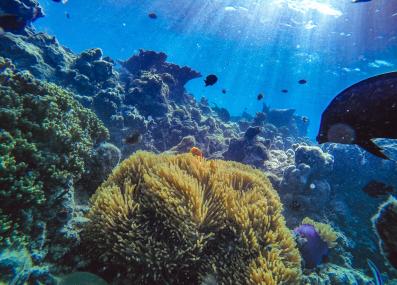
Losses like these are on track to grow and spread in the future—but how severe they become depends on how much climate pollution we add to our atmosphere. For example, coral reefs are highly sensitive to warmer waters, and particularly marine heatwaves. These havens of biodiversity, which support crucial fisheries, face growing risks as the world warms and extreme events worsen.9 Ocean water will also continue to acidify as we release more CO2, threatening shellfish that need the right ocean chemistry to build their shells. Already, ocean acidification has buffeted oyster hatcheries and forced the shellfish industry to adopt new practices in the Pacific Northwest.10

This turbulence—from changing chemistry, heatwaves, species shifts—stands to be felt far and wide: in reshuffled catch, restricted harvests, and higher seafood prices.

But that doesn’t mean the harms will be evenly felt. For instance, because ocean species vary in their responses to climate change, what a fishery catches (and where) is important. One study compared two Massachusetts towns—a mere 40 minutes apart by car—whose small fishing trawlers ply different waters and depend on different species. For one town, the researchers expect fishing opportunities to diminish with climate change; for the other, they were actually projected to expand.11

The risks faced by families, cities, and nations also depend on how heavily they rely on fisheries, as well as the resources they have to adapt. For the millions of people who farm or catch seafood, and the many others who work elsewhere in the supply chain, these changes could mean the loss of a livelihood. And for those who get a lot of their nutrients from seafood, as is the case, for example, for many people in Pacific Island nations, fishery collapse is a serious threat to health.12

Farchadi points out that climate change could be a boon for some fisheries—for instance, in places where a new species moves in. But the gains and losses aren’t spread out evenly. Researchers have found that, in a future of extreme climate change, fishery declines would be especially severe in countries that have contributed little to warming the planet and have fewer resources for recovery.13 In addition, actually building a fishery around a new species can be challenging. “Maybe there’s no market in the [new species] yet,” Farchadi says. Or maybe “you have to learn to catch that new thing,” which could require different gear, plus onshore infrastructure to process and sell the new fish. And when a species is culturally important, it can’t simply be replaced by a new one if it disappears.14

Our best shot at protecting ocean resources is to rein in the presses and pulses themselves, by zeroing out our climate pollution. But ecologists like Farchadi, along with fisheries workers and many others who rely on ocean life, are also thinking about ways to adapt.

That might involve fishers diversifying their catches to hedge against future change. It can also mean addressing habitat destruction and overfishing, so species have fewer stressors to cope with. And because fish don’t care where humans draw lines, it also means strengthening international cooperation. For example, eight Pacific Island nations manage their fishery for migratory tuna using tradable licenses, a tool that could provide for more flexibility as species move across boundaries.15

Farchadi’s work involves partnering with fisheries managers to build models that forecast how species are likely to shift with warming.16 The goal, he says, is to collaborate with people who live and work in this world every day to create practical tools for responding to a changing climate: “It's trying to build something that is not only there for scientific exploration, but it's for application and for use.”


Thank you to Arthur Sinclair of Western Australia for the question.

Submit your own question to Ask MIT Climate

Get the latest from Ask MIT Climate monthly in your inbox

Read more Ask MIT Climate


Creative Commons Attribution-NonCommercial-ShareAlike 4.0 International license (CC BY-NC-SA 4.0).
Footnotes

1 Food and Agriculture Organization of the United Nations. The State of World Fisheries and Aquaculture 2026. (2026).

2 Laufkötter, Charlotte, et al. "High-impact marine heatwaves attributable to human-induced global warming." Science 369 (2020). https://doi.org//10.1126/science.aba0690.

3 Le Bris, Arnault, et al. "Climate vulnerability and resilience in the most valuable North American fishery." PNAS 115 (2018). https://doi.org/10.1073/pnas.1711122115.

4 Free, Christopher M., et al. "Impact of the 2014-2016 marine heatwave on US and Canada West Coast fisheries: Surprises and lessons from key case studies." Fish and Fisheries 24 (2023). https://doi.org/10.1111/faf.12753.

5 Williams, Megan J. Peterson, et al. "The heat is on: Gulf of Alaska Pacific cod and climate-ready fisheries." ICES Journal of Marine Sciences 79 (2022). https://doi.org/10.1093/icesjms/fsab032.

6 Quinault Indian Nation. "Shellfish Program." Accessed September 2026.

7 Rogers-Bennett, Laura. State of California Department of Fish and Wildlife. "The Perfect Storm: Multiple Climate Stressors Push Kelp Forest Beyond Tipping Point in Northern California." (July 18, 2019).

8 State of California Department of Fish and Wildlife. "California Fish and Game Commission Extends Red Abalone Recreational Fishery Closure, Finds CESA Listing of Bear Lake Buckwheat Warranted." (December 18, 2025).

9 Liu, Yaqin, et al. "Impacts of reef degradation on commercial fisheries." Marine Resource Economics 40 (2024). https://doi.org/10.1086/732845.

10 Barton, Alan, et al. "Impacts of coastal acidification on the Pacific Northwest shellfish industry and adaptation strategies implemented in response." Oceanography 28 (2015). https://doi.org/10.5670/oceanog.2015.38.

11 Rogers, Lauren A., et al. "Shifting habitats expose fishing communities to risk under climate change." Nature Climate Change 9 (2019). https://doi.org/10.1038/s41558-019-0503-z.

12 Cheung, William W.L., et al. "Climate change exacerbates nutrient disparities from seafood." Nature Climate Change 13 (2023). https://doi.org/10.1038/s41558-023-01822-1.

13 Boyce, Daniel G., et al. "Future ocean biomass losses may widen socioeconomic equity gaps." Nature Communications 11 (2020). https://doi.org/10.1038/s41467-020-15708-9. The researchers projected that these disparities would be acute under a "worst-case" climate scenario—but that in a future where we aggressively tackle climate change, both the overall losses in many countries, and their concentration in economically vulnerable countries, would decrease considerably. (The researchers didn’t examine climate scenarios in between these two.) This study considered changes in the total mass of marine animals and did not include the effects of fishing or incorporate information about aquaculture.

14 Poe, Melissa R., et al. "'Sense of place': Human wellbeing considerations for ecological restoration in Puget Sound." Coastal Management 44 (2016). https://doi.org/10.1080/08920753.2016.1208037.

15 Clark, Sangaalofa, et al. "The Parties to the Nauru Agreement (PNA) 'Vessel Day Scheme': A cooperative fishery management mechanism assisting member countries to adapt to climate variability and change." In Bahri, Tarûb, et al (Eds.), Adaptive Management of Fisheries in Response to Climate Change. (2021). (pp. 209-224). https://doi.org/10.4060/cb3095en.

16 San Diego State University. "FaCeT: CCS Futures." (Updated November 11, 2024). Accessed September 2026. 

Want to learn more?

Listen to this episode of the Ask MIT Climate podcast on how species are shifting in a warming world.

Transcriptions

Madison Goldberg: Science happens in a lot of places. Sometimes it’s in a lab. Sometimes it’s at a computer screen. And sometimes it happens on the side of a mountain in New Hampshire.

Here, the landscape around you is shaped by elevation. When I visited with a pair of researchers, the air got colder as we climbed. Snow piled up, and there were more spruce and fir trees. It felt like we were moving through multiple worlds as we hiked up the path.

<FIELD TAPE>

Alexej Sirén: This is where we get our ideas from, right? This is where you develop these really deep hypotheses, because it's the first part of the scientific method, is to observe, right?

<END FIELD TAPE>

MG: Alexej Sirén works at the University of New Hampshire, studying how things like climate change and habitat change affect wildlife—including many of the animals who live up here, in the cold of New England’s White Mountains.

<FIELD TAPE>

Toni Lyn Morelli: These species go all the way up into Alaska. These are these cold-adapted, snow-adapted species.

<END FIELD TAPE>

MG: That’s Toni Lyn Morelli, of the U.S. Geological Survey and the University of Massachusetts Amherst. She also studies how wildlife is responding to climate change—and how we can conserve species in the face of it. And here’s a big question that’s on both ecologists’ minds: how is a warming world reshaping where species live?

<FIELD TAPE>

TLM: We're just particularly worried because the marten and the snowshoe hare and the red squirrels, they're all species that—

[Boreal chickadee calls.]

AS: And the boreal chickadee.

TLM: And the boreal chickadee. These are all species that are dependent on it being snowy in the winter. So as a result, we think, okay, well, where's that chickadee going to go? Like, is it going to stick around here or is it going to, in, you know, twenty years, have to have gone somewhere else?

<END FIELD TAPE>

MG: Welcome to Ask MIT Climate. I’m Madison Goldberg. Today, we’re exploring what a warming world means for our fellow species here on Earth—and, specifically, where on the planet they can survive and thrive.

TLM: Species are trying to keep up with their temperature that they evolved in, that they are most comfortable in, and that they will survive and reproduce best in. And so they're starting to move around.

And it would be great if we could predict exactly where they're going to go. And we're getting better at it. But it seems pretty complicated, because ecosystems and species are complicated by all of their different needs and behaviors and traits.

MG: But let’s start here. What does it actually mean for a species to move? It’s not like all the boreal chickadees turn to each other and say, “Okay, guys, time to pack it up and head somewhere colder.”

To help us imagine how it might happen, Dr. Morelli gives the example of a tree species in North America.

TLM: When it spreads its seeds, those seeds go far and wide, often, if they're wind-dispersed.

MG: The area of the world where this tree lives is called its “range.” We’re in the northern hemisphere, so broadly speaking, the northern part of the range is colder, and the southern part is warmer. And the planet as a whole is warming up with climate change.

Okay, so these seeds get carried off by the wind.

TLM: Now, maybe, a hundred years ago, they would have been dispersed into an area to the north where it was just too cold for that seed to set. Now, that area might be warmer. And so now when the seed falls, it doesn't just die off, it actually can sprout into a new, eventually, adult tree.

We can also imagine a contraction on the warmer edge of the range. So that's the southern edge. And there we might see a totally different mechanism, that could be individuals dying from heat waves or drought. They could be not able to reproduce there, so you just, eventually, over time, see that nobody's growing. There's no new baby trees.

MG: We could also picture this tree on a big mountain, where temperatures broadly drop the higher you go. And so you can make a first, rough guess at how you’d expect species to move as the planet warms.

TLM: The coarsest, simplest predictions for the ways that species will respond to climate change by shifting their ranges is upslope, poleward, and deeper in the water, whether that's the ocean or a lake.

MG: So, what are we seeing?

Well, Dr. Morelli and her colleagues sifted through tons of scientific papers to gather tens of thousands of recorded observations. Some looked at whether the warm or cool edge of a species’ range had moved over time. Others looked at whether there had been a change in “abundance”—that’s the number of individuals in a given area—in part of a species’ range.

TLM: And we found about fifty percent, less than fifty percent, have met our simple predictions.

MG: The other half of the observations didn’t line up that way—like, maybe they showed a species moving toward the equator, or not moving at all.

So, the question is: why aren’t we seeing everyone move in the same, predicted directions?

TLM: There's two layers here. It's like, is it actually happening? And then can we record it? We might have trouble recording it if we're looking at the wrong season or we're looking at the wrong life stage.

MG: This is hard research to do. Like, it’s tough to be sure you’re mapping the true boundaries of a species’ range, or that a shift you’re seeing isn’t just noise.

But our simple predictions might also sometimes be wrong. For example, maybe a species doesn’t actually need to move—or, at least, not yet.

TLM: So, in a way, maybe some of this is good news, in that maybe individuals are behaviorally or even evolutionarily able to adapt in place. It may be, though, that we are now going to see reduced reproduction or some higher mortality or something as a result of them staying in place.

MG: Or maybe a species can’t move, or can’t move very fast. Maybe they live in the woods, but deforestation has made the landscape too patchy for them to get very far.

Also, we’ve been thinking about how species will respond to temperature changes. But in our warming world, there’s a lot more than temperature that’s getting shaken up.

TLM: So maybe they're responding to precipitation, which isn't moving just as simple as poleward or upslope. You can also imagine that, well, species don't just respond to climate, they respond to other species and habitat and their food sources. And those could be driving in a different direction.

MG: Which is my cue to introduce you to the American red squirrel.

<FIELD TAPE>

TLM: They’re sort of like the noisy neighbor of the forest. And so if you have the luck to be walking through the White Mountain National Forest, you are likely to hear a red squirrel chatter at you because they want you to know they're there and they've seen you, and so you shouldn't try anything fishy.

AS: Or you may have bumped one of their neighbors and that neighbor is going away from you, and that triggers the other one to be like, get out of my territory. How many times?

TLM: How many times?

<END FIELD TAPE>

MG: Here’s what a red squirrel sounds like, by the way.

[Red squirrel calls.]

MG: And it turns out those calls can be useful for keeping tabs on where red squirrels are living. Dr. Morelli and Dr. Sirén, along with their fellow researchers, have used them to ask: Are red squirrels here moving in line with the changing temperature? Or—are they doing something else?

Because here’s the thing. Dr. Morelli says that the red squirrel’s habitat has also been changing here. After a period of dieback, the conifer trees the squirrels rely on have been regrowing.

<FIELD TAPE>

TLM: They're actually filling in downslope because they’re recovering from these other stressors.

So it turns out we think the red squirrels are actually tracking their habitat and not their temperature. For now. A researcher in one hundred years might find a different pattern.

<END FIELD TAPE>

MG: Other animals in this region also show how complex these questions can be. Dr. Sirén, for instance, has studied Canada lynx. Where these thick-coated wild cats live has a lot to do with where they can find prey. But they also compete for that prey with their close cousins the bobcats. And which cat has the upper hand depends on a whole other factor: snow.

<FIELD TAPE>

AS: So when you'd have these really, really, really deep snow years, it kind of gave lynx this competitive advantage. And they'd be able to colonize those areas where there was a lot of snowshoe hares. And when it was really shallow years, they would kind of disappear from those areas and those would be dominated by bobcats.

<END FIELD TAPE>

MG: So this stuff is complicated. The world is changing in a lot of ways at once. Temperatures are rising, rain and snow are shifting, humans are constantly altering the landscape. And this messiness means that even if a species is shifting in the direction we expect with climate change, we can’t jump to the conclusion that it’s shifting because of climate change.

TLM: We aren't able to, like, manipulate all the different pieces and understand what the responses are in a closed system. We want to be able to say, really rule out that it wasn't all these other things that caused this response. And that's really hard.

MG: If we spot lynx somewhere we don’t expect, we can’t stop them and ask, “did climate change bring you here?” Scientists combine different kinds of evidence, like lab experiments and long-term data on a species’ range, in order to say confidently: Yes, this species is moving, and they were pushed by climate change.

These changes matter for species’ wellbeing and for the health of larger ecosystems. They  also matter for humans, because the species around us shape our lives—from our economies to our cultures to our health.

For example, scientists are worried about disease-carrying ticks and mosquitos moving into new areas.

Or consider the American lobster, one of the most valuable seafood species in the country. Warming waters off the U.S. east coast—plus, potentially, differences in management strategies—have led to dramatic range changes since the 1990s. The lobster fishery in southern New England has collapsed, while farther north in the Gulf of Maine, there’s been a boom.

TLM: And so you could imagine, for example, if lobsters start showing up in your hometown and you are fishing for a living, that could be great news. If you have the gear and the boat and the flexibility to change from the fishery you used to focus on to the one that is now moving in.

That is one end of that lobster fishery. The other, the southern end, there's people there that have spent generations as lobster fishermen, and they have the boats and the time and the expertise, the generational knowledge, to catch lobsters, and the lobsters are going away.

MG: And as plants and animals respond to climate change, people can also lose contact with species or practices or foods that are crucial parts of their culture, history, and connection to where they live.

TLM: For example, we know that the center of sugar maple and maple syrup production is going to be shifting. And there are communities that central to their culture and history is maple sugaring.

MG: As long as we continue warming the planet, we can’t stop our fellow species from responding. But we can try to make things easier for ourselves and the life all around us. Dr. Morelli studies climate change “refugia”—pockets of habitat where the effects of climate change aren’t quite so acute.

TLM: So if we can find those places that seem like they're buffered from climate change, at least for the near future, and protect them from other stressors, they can provide safe havens for populations, or stepping stones as they move to track their climate.

MG: We also can try to make sure the landscapes around us provide species with the food and shelter to stay—or the safe passage to move if they have to.

TLM: So if we think about species needing to shift their ranges, well, we have a very patchy landscape that is broken up with roads and parking lots and other barriers. So we can think about increasing connectivity among areas of habitat.

And then, finally, it's really important that we record what's happening. So monitoring is just really important, and the public can really help with that.

MG: You can actually do this from your phone! There are online databases where you can log the different species you see; we’ll put a few examples in our show notes. 

TLM: The more information we have about where individuals are, when, what they're doing—we can really better understand how species are responding to climate change and how we can help them adapt to these stressors.

MG: Ask MIT Climate is the climate change podcast of the Massachusetts Institute of Technology. Aaron Krol is our executive producer. David Lishansky is our sound editor and producer. Michelle Harris fact-checks our episodes. The music is by Blue Dot Sessions. And I’m your host and associate producer, Madison Goldberg. I also wrote today’s episode.

Many thanks to Dr. Toni Lyn Morelli and Dr. Alexej Sirén for speaking with us, and for showing us the field sites in New Hampshire. You can find more of the show at climate.mit.edu. We’re also on TikTok, Instagram, and Youtube @askmitclimate. And if you’re feeling out of your comfort zone on a climate topic, we’re here for you. Send your questions to askmitclimate@mit.edu.