Have a question?

What would happen if we lost all coral reefs?

Climate change threatens the survival of coral reefs worldwide—and with them, a big slice of marine biodiversity, economic activity, and protection from ocean storms.


November 16, 2023

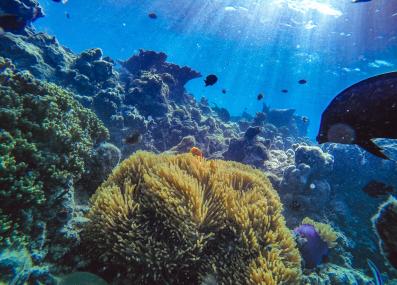
Coral reefs are humming hubs of biodiversity. Although reefs cover less than 1 percent of the ocean floor, about 25 percent of known marine life is connected with them in some way, says Amy Apprill, an associate scientist at the Woods Hole Oceanographic Institution. They are also one of the clearest examples of climate change’s impact on the natural world.
 
“If you ask a kid to draw a picture of what climate change looks like, they will often draw a bleached coral,” she says.

Reef ecosystems face a variety of growing threats. Local issues such as overfishing, irresponsible tourism, and poor water quality threaten the reefs. But the biggest danger to corals is climate change, and the ocean acidification and warming water temperatures it brings. In summer and fall 2023, for example, high temperatures caused mass die-offs of corals in the Florida Keys and across the Caribbean Sea.1 The Intergovernmental Panel on Climate Change in 2018 predicted that most reefs would disappear if global warming reached 1.5 degrees Celsius, and effectively all of them would die if it reached 2 degrees.2

Such a loss wouldn’t just be a calamity for biodiversity. It’s terrible news for humans, too.

Apprill says corals provide the framework for a sprawling undersea ecosystem, like trees in a forest. “You have this really large structure and it provides a habitat for lots of other organisms,” she says. “That habitat includes nooks and crannies for small invertebrates such as shrimps and crabs and snails. A coral reef is also a vibrant nursery hub for a lot of fish, even fish that go to other places for the rest of their lifetime. And then larger predators too, like sharks. Even whales will sometimes come by a reef.”
 
This wealth of species is an economic engine for communities near reefs. Fishing for species that live in or near reefs is a multi-billion-dollar industry that feeds millions of people.3 And reefs are an eco-tourist attraction: more than 2 million people per year visit the iconic Great Barrier Reef off the Australian coast.4 The biodiversity of coral reefs also makes them a rich site for research, including into new chemicals to use in pharmaceuticals, Apprill says.  “We've had cancer drugs come from reefs. There's a covid therapy that's in study right now that was developed from a deep sea coral,” she says.
 
Coral also protects coastal lands from the tumult of the sea, which is crucial as climate change makes powerful storms more common.
 
“They're really good at protecting coastlines,” says Apprill. “In fact, a coral reef will dissipate about 97 percent of wave energy. If you've ever flown over a coral reef, you can often see that—waves breaking, and then inside of the reefs next to the coastline, there's just still water. As we have more storms and more intense hurricanes, we need that infrastructure. It's like a breakwater to help protect our homes.”

And human activity is making climate change even more perilous for corals, Apprill says. When corals die, they are quickly covered by algae. In a thriving reef ecosystem, fish could eat much of that algae and help the reef to recover—but many reef residents have been overfished. Without their help, the ecosystem can pass a tipping point beyond which the reef cannot recover, and all the associated species lose their habitat.
 
Although reefs won’t be safe as long as we keep warming the planet, Apprill says it is still possible to help them locally. Preventing boats from dumping waste too close to a reef relieves stress on these ecosystems, as do measures to prevent chemicals in soil runoff from reaching the corals. These interventions don’t solve the problems of warming or more acidic oceans, but improving water quality makes an important difference.

“I think by fixing these smaller things, we might help make the corals more resilient to climate change, too, because they're getting hit with multiple stressors,” Apprill says. “It's sort of like if you have a work week when five things go wrong. It's hard to recover. But if you had just one thing go wrong, you can be resilient.”


Thank you to Grace Gadston of Lausanne, Switzerland, for the question.

Submit your own question to Ask MIT Climate

Get the latest from Ask MIT Climate monthly in your inbox

Read more Ask MIT Climate


Creative Commons Attribution-NonCommercial-ShareAlike 4.0 International license (CC BY-NC-SA 4.0).
Footnotes

1 NASA Earth Observatory: "Stressful summer for coral reefs," October 16, 2023.

2 "Global Warming of 1.5° C." Intergovernmental Panel on Climate Change, 2018.

3 Conservation International: "Economic Values of Coral Reefs, Mangroves, and Seagrasses: A Global Compilation." Center for Applied Biodiversity Science, Conservation International, Arlington, VA, USA, 2008.

4 Great Barrier Reef Marine Park Authority: Tourism visitation data. Accessed November 16, 2023.

Want to learn more?

Listen to this episode of MIT's "Today I Learned: Climate" podcast on climate impacts on the ocean.

Transcriptions

Part one:

[00:00:00] LHF: Hello, and welcome to Today I Learned: Climate. I’m your host, Laur Hesse Fisher of the MIT Environmental Solutions Initiative.

This is our first episode of season 4 – and we have some great topics coming up this season… we’ll be covering electric cars and hydrogen technology and much more…

But today, we’re going underwater…  to talk about the ocean ….

OK so, quickly, the accelerate climate change we’re experiencing today is mostly caused by humans adding a lot of extra carbon dioxide, CO2, to the atmosphere since we started burning a lot of fossil fuels in the mid 1700s – and that extra CO2 is acting like a blanket around our planet, warming up the Earth.

So, we’ve heard this startling figure about the ocean that maybe you’ve heard too… it's estimated that the ocean has absorbed about one third of that extra CO2. AND that the ocean has absorbed more than 90% of this extra heat. So, first, those are startling figures – they also open a lot of questions, like, how does the ocean absorb all that CO2 and heat? And why does this matter – what does this mean for the health of the ocean and the planet?

We were really excited to dig into all of this with Dr. Sylvia Earle, who may have the coolest title ever.

[00:01:47] SE: “I'm Sylvia Earle. Explorer at large at the National Geographic, founder of Mission Blue, basically an oceanographer., And like other scientists, an explorer.”

Dr. Earle has a lifetime of experience studying the ocean.

 “Since the 1950s, when I first had a chance to breathe air underwater, I've been privileged to have thousands of hours, not just diving, using scuba, but living underwater 10 times. I’ve used dozens of little submarines, more than 30 different kinds to go deeper in the ocean, than you could go holding your breath or even using scuba.”

And during all that time she spent studying the ocean, she saw what an enormous role the ocean plays in how our planet functions – and how it’s changing. She's going to help us explain all of that.

 I think we should just dive in.

[pause/transition music]

 From space, Earth looks blue. Earth is dominated by the existence of the ocean.

Yeah, the ocean covers more than two thirds of our planet.,, It can seem like this mysterious — and maybe scary — expanse with not a lot going on, compared to land. But the health of the ocean affects all of us.

 it's important to recognize that SE: The ocean is the basic system that drives climate.,, Without the ocean, what we think of as climate could not exist.

[00:03:24] LHF: The ocean helps regulate Earth’s rain and snow, produces most of the oxygen we breathe, and affects the Earth’s temperature. 

One thing we learned while making this episode is that it is an incredibly complicated system, with so many factors constantly at play. Gasses are going in and out of the ocean, the temperature shifts at different layers and pockets of water, currents bring streams of water and sea life all around the world, storms come along and mix everything up – it’s a lot to keep track of and explain. So today, we’re going to focus on just a couple of those factors that are essential when talking about the ocean and climate change.

[00:04:07] SE: "If I were an alien and I wanted to make life on Earth change, make it difficult for those pesky humans. I would do two things: I would change the temperature and I would change the chemistry of the planet. And we're doing that. We are changing the temperature and changing the chemistry.”

And because there’s so much to cover, we’re going to do it in two episodes: this one is about humans changing the chemistry of the ocean, and the next one will be about the effects of rising temperatures.

So let’s start with chemistry.

Humans have introduced more carbon dioxide into the atmosphere, which is making our planet warmer.,  To understand what all of this extra CO2 in the atmosphere is doing to the ocean, we need to start with a couple minutes on something called the carbon cycle.

 “The carbon cycle is a living cycle., Economists follow the money. They want to know how the world works from an economic sense. Scientists follow the carbon when they want to know, ‘how does the world work? How does the climate work?’”

OCEAN AND CARBON CYCLE PART I – BIG PICTURE

The carbon cycle is all about how the element carbon flows through our planet: from the atmosphere, to the ocean and life on land, into soils and rock etc., and back up into the atmosphere. ,

The ocean takes in and stores carbon in two main ways: first, CO2 from the air dissolves into water, where it goes through a series of chemical reactions and ends up in a few different forms: mostly as bicarbonate, but also a bit as carbonic acid, carbonate, and even just dissolved CO2, like in sparkling water. Yeah, the ocean is actually very slightly carbonated.,

And here’s the second way:

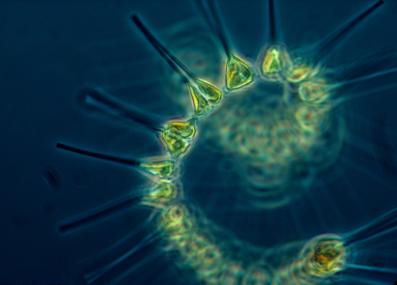
 “In the ocean, the heavy lifting is done by phytoplankton capturing the carbon through a process called photosynthesis.,,

A quick refresher on photosynthesis: with the help of sunlight, plants – as well as other organisms like phytoplankton – pull carbon from the air or water and use it to build their trunks, leaves, roots, bodies,, etc. You can probably visualize that process on land through trees, and it’s also happening in the ocean on a huge scale.

 In every cup full of water you've got literally millions of organisms, tiny creatures, so small that they're not visible , and, and curiously, some creatures that are very much linked to the carbon cycle,, were not even discovered until 1986 by a scientist at MIT, Penny Chisholm, because they are so small.” They are the basis  of much of the food chain in the ocean… ,,,

[slight pause]

And the carbon doesn't stay just with phytoplankton. It is consumed by zooplankton consumed then by larger organisms to small fish eaten by larger fish and so on up the food chain. So the connection between great whales and carbon starts with photosynthesis. Just as on the land.”,,

[00:07:29] LHF: So those phytoplankton are pulling in carbon and turning it into food for other life in the ocean.

[00:07:35] SE: “ [And then] Life in the ocean does what all life eventually does when it dies, it tends to either be consumed by some other organisms, but eventually it goes to the bottom of the ocean. There's this snow of life that ultimately is sequestered in the deep sea. It's where most of the carbon on the planet actually is.”,

And some of it becomes limestone, calcium carbonate. The carbon is held in the rocks, in the sediments in the deep sea, that's where the great carbon deposits are.,,

[00:08:18] LHF: If you were to dive down to the deep sea floor and look around, you would see a mix of rocks, minerals ,and a slow flurry of decomposing pieces of plants and animals. All of that holds carbon in the ocean over millions of years. 

And in this way the ocean functions as a huge carbon storage space – kind of like a bank vault, a metaphor you might remember from our episodes on forests – and keeps a whole lot of carbon out of the atmosphere. ,

It’s important to mention that some of that carbon gets re-released from the surface of the water back up into the air – like soda going flat.

Before humans started burning a lot of fossil fuels and cutting down forests, this was pretty much in balance: the ocean and atmosphere pretty much exchanged the same amount of carbon.

But this has changed. The concentration of CO2 in the atmosphere has gone up, and so, on the whole, the ocean is now actually taking in more carbon than it emits., ,

[00:09:29] SE: The ocean will take carbon dioxide up, but it doesn't remain as CO2. It becomes carbonic acid, which is changing the chemistry of the ocean, the pH of the ocean – more acidic.

This is the acidification issue that is in the minds of some. The evil twin of climate change.

[00:09:52] LHF: We’re already seeing this “ocean acidification” happening. Since humans started burning a lot of fossil fuels a couple hundred years ago, the ocean has gotten 30% more acidic. 

This can make it harder for some some snails as well as oysters and clams to build their shells, and for corals to build their skeletons.,

Scientists will be the first to admit that they don’t really understand what this is going to mean for the vast amount of life in the ocean. Every living thing in the ocean reacts a little differently to acidification.

But a lot of these organisms are a critical part of the marine food web. And billions of people rely on ocean life as their main source of protein, and for their livelihoods.

In the lab and in the ocean, scientists are measuring the effects of ocean acidification,, and we have some resources in our show notes if you want to learn more about ocean acidification and its current and potential impacts.

OK so all this extra CO2 is having an impact on the ocean in and of itself. But CO2 is a heat trapping gas that’s also warming up the planet.

That extra heat also affects the ocean. So in our next episode, we’ll cover how the rising temperatures of climate change are affecting the ocean – and some cool technology that’s helping scientists better understand what’s going on.,  Keep listening for what’s next.


Episode two:

[00:00:00] LHF: Welcome to part 2 of our oceans episode,

If you haven't checked out part 1 I highly recommend you do – it gives important context for this episode, including the role the ocean plays in helping regulate the elements that keep life alive.

Our featured guest today for this part two is again Dr. Sylvia Earle.

[00:00:34] SE: Explorer at large at the National Geographic, founder of Mission Blue, basically an oceanographer.,

Dr. Earle has spent decades studying and diving in the ocean.

 When astronauts go up in the sky, they have spent enormous amounts of time trying to understand their life support system and do everything they can to take care of their life support system. Why? Because their life depends on it. You have to know what you're breathing. You have to be conscious of the temperature.

And here we are, as residents of spaceship Earth, we need to care for our life support system. And we still have a lot to understand, but we do know that we're doing things that are altering the basic chemistry and temperature of the planet, and it is putting us at risk.

[00:01:27] LHF: In part 1, we covered how humans are changing the chemistry of the ocean. Today, we’re focusing on the other thing Dr. Earle mentioned: temperature.

[00:01:38] SE: You change the temperature and you change everything.

[00:01:43] LHF: So we know that global temperatures are rising – is this happening in the ocean, too? And what effect is that having?

First, we gotta tease out how temperature in the ocean works differently than temperature on land.

Imagine you’re about to step on the beach on a hot summer day – I’m thinking of a beach in New Jersey where I went a lot when I was a kid. You’re looking at that big section of sand you want to cross to get to the what. So, you take a step and – ouch! It’s really hot! So, you run up to the water and dip your feet in, and it’s still pretty cold. But why? The sand and the water are both sitting out under the same sun.

Well, the sand absorbs and releases heat more quickly, which is why it feels hot on your feet. Water, however, can absorb a lot of heat before it radiates it out. That means the ocean doesn’t experience rapid swings in temperature, like it can on land. Where I live, in the springtime, one day it might be 70 degrees, but the next day it’s down to 50 degrees. That doesn’t happen often in the ocean.

Because of water’s incredible capacity to hold heat,  the ocean can – and is – taking in a lot of the extra heat that we’ve created by adding CO2 to the atmosphere.,

[00:03:17] SE: “Because of the ability of the ocean to absorb the temperature, it holds the heat over a longer period of time than at the surface or on the land. It's a gradual process, but the ocean is becoming warmer, overall.”

[00:03:38] LHF: Warming affects the ocean in a lot of ways. First, when water gets warmer, it actually loses some of its ability to hold carbon. The higher temperatures make it less likely that CO2 will go through the chemical reactions that turn it into forms of carbon that tend to stay in the ocean longer. More of it will stay on the surface, and so more of it will go back out into the atmosphere. This is something called a feedback loop– levels of CO2 in the atmosphere rise, the planet gets warmer, the ocean gets warmer, it can hold less CO2 which releases more back into the atmosphere which makes the whole planet warmer and global warming actually accelerates.

And as you may remember from our episodes on sea level rise, water expands when it gets warmer and sea ice melts, so that contributes to rising sea levels.,,

Warmer waters can affect ocean life, too, like coral reefs.

[00:04:42] SE: “ Corals are sensitive to temperature. They live within a fairly narrow range and yes, they do like it warm, but not too warm. And they don't like it too cold either.And when the temperature, stays warmer than is comfortable for them, the algae that live in their tissues that are critical to generating food and perhaps also oxygen for the corals, they either die or they escape., In any case, the phenomenon known as coral bleaching occurs,. It just looks like a snow storm on a coral reef when this happens.”

Why do we care about this? Well, coral reefs provide one of the most important ecosystems in the ocean., . They support more species per square foot than any other marine environment; and support billion-dollars industries like fishing and tourism.,, Many medicines are developed from life around coral reefs. ,

And the U.S. National Oceanic and Atmospheric Administration, NOAA, says that coral reefs buffer shorelines against 97 percent of the energy from waves, storms, and floods. They do an incredible job at helping to protect the property of the millions and millions of people who live near coral reefs.

So, you might be wondering – what does all this add up to? What’s going to happen to the ocean if we keep putting carbon into the atmosphere, and the planet keeps getting warmer?

Well, scientists are getting a picture, but they aren’t exactly sure how this will all play out. There isn’t a scientific consensus yet on how much carbon or heat the ocean can absorb, or how acidic it can get, or other impacts like how the currents might change, which is, actually something scientists are pretty worried about.

 We know more now than ever before, owing to discoveries made literally since the middle of the 20th century.

 “A network of monitoring stations has come into form —  the global ocean observing system — and Argo floats., These are systems that follow the ocean currents deployed from the surface to send and travel with the currents and then pop up periodically and send their data back to satellites that go back to land-based receivers.

[00:07:23] LHF: What do those look like? Are they like little robots?

[00:07:27] SE: Cute little robots. Yes. The Argo floats descend from the surface and look at the water column and travel with the currents, and then come back up to the surface to put their data back into those listening from above.

And there are thousands of these around the world that did not exist when I was a kid.”

[00:07:49] LHF: The robots are helping us monitor temperatures, acidification levels and more,, and how these things are changing.

[00:07:57] SE: “21st century humans, we are probably the luckiest people ever to arrive on Earth because we know we've got problems. We can see them. In some cases we can taste them. We can certainly measure these changes. Therefore, unlike other intelligent creatures — like whales and elephants and cats and dogs, and even some very smart fish that I know — we can do something about this.”

[00:08:35] LHF: In these two episodes, we skimmed the surface of the relationship between oceans and climate change. If you want to dive deeper, we have an ocean of resources in our show notes at tilclimate.mit.edu, just swim over to the episode page.

If you are an educator or know educators in your life, we’ve developed a flexible set of activities to bring climate topics, like this one, into the classroom. We write them so they can fit with existing STEM or non-STEM curricula, and incorporating the TILclimate podcast introduces a fun way for students to engage and learn. Check out https://climate.mit.edu/educators. You can also download our guides for free on the educator sites teachers-pay-teachers and SubjectToClimate.

And as always we'd love to hear from you, so find us on twitter @tilclimate. We have an exciting season coming up for you so please subscribe and review this episode, we’d love to hear what you think.

An enormous thanks to Dr. Sylvia Earle for joining us as our guest expert for this episode, and also to Dr. Carolina Bastidas and Dr. Jonathan Lauderdale for their extra help explaining the incredible complexities of the ocean to us.  And thank you for listening.