Climate
Search

Main navigation

  • Climate 101
    • What We Know
    • What Can Be Done
    • Climate Primer
  • Explore
    • Podcast
    • Explainers
    • Climate Questions
    • For Educators
  • MIT Action
    • News
    • Events
    • Resources
  • Search
MIT

Main navigation

  • Climate 101
    • What We Know
    • What Can Be Done
    • Climate Primer
  • Explore
    • Podcast
    • Explainers
    • Climate Questions
    • For Educators
  • MIT Action
    • News
    • Events
    • Resources
  • Search
PostMarch 9, 2017

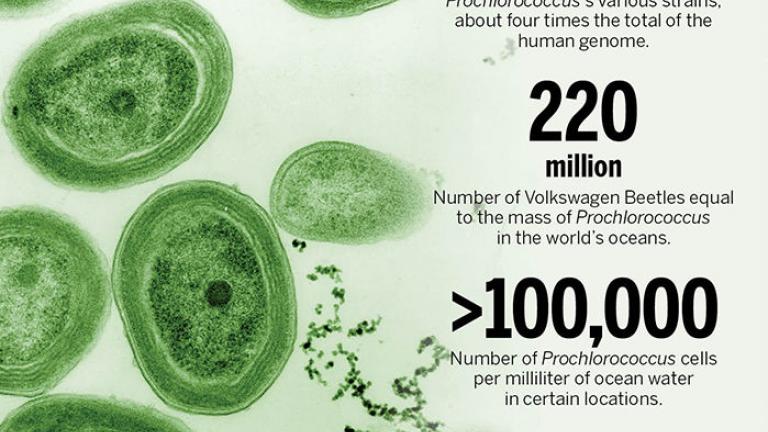
Prochlorococcus: The microbe supplying 5% of the world’s photosynthesis

Penny Chrisholm is an expert on Prochlorococcus. In fact, MIT’s professor of Biological Oceanography has dedicated the last 30 years of the career to researching this incredible microbe.

Prochlorococcus is an intriguing organism. It influences our climate and may have even fueled the surge of early life in the oceans hundreds of millions of years ago, according to new research by Chrisholm and her team.

Learn more about Professor Chrisholm and her favourite microbe here.

PHOTO: N. WATSON AND L. THOMPSON, MIT
by ClimateX Team
Topics
Atmosphere
Biodiversity
Food, Water & Agriculture

Related Posts

PostJuly 17, 2026

How an influx of salt may affect microbial ecosystems

MIT News
Climate-driven sea level rise is making freshwater ecosystems saltier, and MIT researchers have uncovered how that shift could reshape the microbial communities that sustain rivers and estuaries.
PostJuly 1, 2026

Advancing a scenario-based modeling framework for long-term land-use planni...

MIT Center for Sustainability Science and Strategy
Mississippi River watershed
PostJune 29, 2026

Scientists find ozone depletion began decades before discovery of ozone hol...

MIT News
“The fact that ozone depletion would have happened as early as the late 1950s, which is much earlier than I would have thought, just absolutely blew my mind,” says Susan Solomon.
PostJune 24, 2026

What happens when environmental change outpaces life’s ability to adapt?

MIT News
Crinoid fossils from the Permian Period. A new model suggests that the end-Permian and other mass extinctions on Earth may occur when environmental change outpaces the ability of species to adapt.

MIT Climate Knowledge in Your Inbox


MIT Groups Log In

Log In

Footer

  • About
  • Terms & Conditions
  • Privacy Policy
  • Accessibility
  • Contact
MIT Climate Project
MIT
  • Instagram
  • TikTok
  • YouTube
  • Simplecast
Communicator Award Winner