by Jason Sparapani | Department of Materials Science and Engineering
Sometimes the answers to seemingly intractable environmental problems are found in nature itself.
Take the growing challenge of plastic waste. Jacqueline Prawira, an MIT senior in the Department of Materials Science and Engineering (DMSE), has developed biodegradable, plastic-like materials from fish offal, as featured in a recent segment on the CBS show “The Visioneers with Zay Harding.”
“We basically made plastics to be too good at their job. That also means the environment doesn’t know what to do with this, because they simply won’t degrade,” Prawira told Harding. “And now we’re literally drowning in plastic. By 2050, plastics are expected to outweigh fish in the ocean.”
“The Visioneers” regularly highlights environmental innovators. The episode featuring Prawira premiered during a special screening at Climate Week NYC on Sept. 24.
Her inspiration came from the Asian fish market her family visits. Once the fish they buy are butchered, the scales are typically discarded.
“But I also started noticing they’re actually fairly strong. They’re thin, somewhat flexible, and pretty lightweight, too, for their strength,” Prawira says. “And that got me thinking: Well, what other material has these properties? Plastics.”
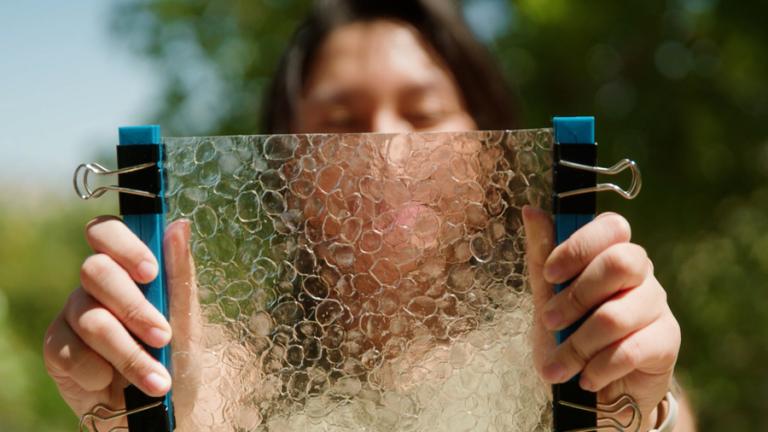
She transformed this waste product into a transparent, thin-film material that can be used for disposable products such as grocery bags, packaging, and utensils.
Both her fish-scale material and a composite she developed don’t just mimic plastic — they address one of its biggest flaws. “If you put them in composting environments, [they] will degrade on their own naturally without needing much, if any, external help,” Prawira says.
This isn’t Prawira’s first environmental innovation. Working in DMSE Professor Yet-Ming Chiang’s lab, she helped develop a low-carbon process for making cement — the world’s most widely used construction material, and a major emitter of carbon dioxide. The process, called silicate subtraction, enables compounds to form at lower temperatures, cutting fossil fuel use.
Prawira and her co-inventors in the Chiang lab are also using the method to extract valuable lithium with zero waste. The process is patented and is being commercialized through the startup Rock Zero.
For her achievements, Prawira recently received the Barry Goldwater Scholarship, awarded to undergraduates pursuing careers in science, mathematics, or engineering.
In her “Visioneers” interview, she shared her hope for more sustainable ways of living.
“I’m hoping that we can have daily lives that can be more in sync with the environment,” Prawira said. “So you don’t always have to choose between the convenience of daily life and having to help protect the environment.”