Description
Salt marshes humming with insects and birds. Mangrove forests with tangled, arching roots. Seagrass meadows that blanket the ocean floor. The world’s coastal saltwater wetlands provide shelter for wildlife, purify water, and protect seaside infrastructure. And as Dr. Julie Simpson of MIT tells us, they also have a climate superpower: drawing down and locking away extraordinary amounts of planet-warming carbon dioxide.
Dr. Julie Simpson is a coastal aquatic ecologist with the MIT Sea Grant College Program in the Marine Advisory Services group. She also co-instructs a course on climate and planetary health through the MIT D-Lab. Her interests include the effects of climate change on salt marshes and other coastal habitats, the ecology and physiology of fresh- and saltwater plants and algae, water quality regulation, and the transport of pollutants like nutrients, metals, and pharmaceuticals to the coastal ocean.
We gratefully acknowledge Heidi Nepf, Donald and Martha Harleman Professor of Civil and Environmental Engineering at MIT; Nepf Lab Ph.D. student Ernie Lee; and MIT undergraduate student Joyce Yambasu for additional assistance and participation in this episode. Thanks as well to the Waquoit Bay National Estuarine Research Reserve and to research coordinator Megan Tyrrell.
For more episodes of Ask MIT Climate, visit climate.mit.edu, where you can also find our online Q&A series and sign up for our newsletter. Subscribe wherever you get your podcasts, and find us on Instagram, TikTok, and YouTube for outtakes, bonus content, and more climate knowledge from MIT. As always, we love hearing from our listeners; email us at askmitclimate@mit.edu.
Credits:
Aaron Krol, Executive Producer
Madison Goldberg, Host, Writer, and Associate Producer
David Lishansky, Editor and Producer
Michelle Harris, Fact-checker
Music by Blue Dot Sessions
Transcript
<FIELD TAPE>
Madison Goldberg: Did you grow up around here, or?
Julie Simpson: No, I grew up in New York City, thinking nature was something that happened somewhere else. And then I went out to California for graduate school—careful on the bridge here. And then came back here to work because the Northeast is home.
<END FIELD TAPE>
MG: That’s Julie Simpson, a coastal ecologist with MIT Sea Grant. Over the summer, I went to Cape Cod with her and some other researchers, to visit a salt marsh. I wanted to learn more about why ecosystems like this one matter for Earth’s climate.
They packed their stuff into a big wagon, and I followed them onto the marsh.
<FIELD TAPE>
MG: Wow.
Heidi Nepf: Yeah, it’s beautiful out here.
MG: It's absolutely gorgeous.
<END FIELD TAPE>
MG: The sky looked enormous. And so did the marsh—like this huge green blanket. In some places, there were pools of water among the plants, like holes in the knitting. You could hear birds and insects everywhere, and it just felt like the entire landscape was buzzing with life.
Welcome to Ask MIT Climate. I’m Madison Goldberg.
So, you might know that people are working to protect and restore forests to help address climate change. That’s because trees pull carbon dioxide out of the air as they grow. Some of that carbon becomes part of their trunks and roots and soil—instead of hanging around in the atmosphere and warming our planet. But forests aren’t the only ecosystems that can do this.
JS: There is absolutely carbon in forest soils, and it is being sequestered and being held away. It's just that salt marshes are—it's their superpower. They're really, really great at it.
MG: Like forests, salt marshes and other coastal wetlands are also under threat. What does that mean for our planet, and for us? Today we’re going to dig into that—and I mean literally. And if you’re not already a fan of wetlands, I think you might become one by the end of this. Because, let me tell you, Dr. Simpson’s love for them is contagious.
So, there are a lot of different wetlands on Earth, but today we’re focusing on the world’s coastlines—and, specifically, a few special ecosystems that have evolved to deal with seawater. We’re going to talk about three major types.
The first are salt marshes, like the one I went to on Cape Cod. These are full of grasses and shrubs, and they’re at the mercy of the tides, which flood them with salty water and then trickle back out again.
You find a lot of these salt marshes in cold or mild climates. As you move towards the equator, you get another kind of coastal ecosystem: mangrove forests. These trees and shrubs have some pretty cool ways of handling their tidal environment. Like, some species have these arching roots that keep them stable in loose soil and help them pull oxygen from the air.
JS: They have these big, chunky roots that look like giant fingers or almost tentacles or something, and they reach into the water, and they tend to grow in a very close tangle. So the roots of all the different trees will be very tangled in amongst each other.
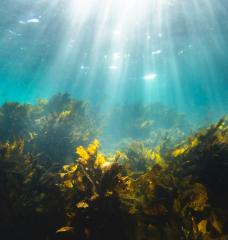
MG: And then, last but not least, we have seagrasses. These grow in shallow waters all over the world and can form big, lush meadows.
JS: And they are adapted to grow entirely underwater. There's a whole diversity of those as well. There are tropical species, there are temperate species. The one we have here locally, eelgrass, grows all around the northern hemisphere. It's very widespread.
Coastal wetlands are definitely underappreciated compared to other ecosystems or natural habitats. I think part of the reason for that is that they're not as easy to get to. They're muddy. You know, you have to really watch your step. If you take a step in the wrong place, you can just quickly sink in, up to your waist, basically.
MG: But Dr. Simpson says these are really special places. For one thing, it’s pretty impressive that these plants can handle what the sea dishes out to them.
JS: You know, people don’t give plants nearly enough credit. Animals are cool and have cool adaptations. But an animal can leave or dig a burrow, whereas a plant has to sit there and deal with whatever the environment is throwing at it.
MG: But there’s more—and now we’re getting to why these ecosystems matter for Earth’s climate.
JS: They’re really, really productive. Every piece of growth, every new leaf that's formed, represents carbon dioxide that's taken out of the atmosphere, because that's what they're doing. They're just carbon-eating machines. So they're just growing and growing and taking up enormous amounts of carbon dioxide and turning it into plant tissue.
MG: So we have all these growing plants sucking lots of carbon dioxide out of the air—or the water, in the case of seagrasses. And these wetlands are also good at trapping even more plant material that flows in from rivers and the ocean. But they have another superpower, and that’s locking away the carbon for a long time—like, way after old plant parts fall to the ground. Dr. Simpson says other ecosystems do this, too; wetlands are just real pros at it.
JS: So where, in a forest, the forest is going to drop its leaves in the fall, and all those leaves get broken down by bacteria and fungi and other things that are living in the forest floor—the carbon that was stored in those leaves that year during photosynthesis, that carbon gets returned back to the atmosphere.
In salt marshes, because the soils are waterlogged, you don't get as much bacterial activity. So when a soil is waterlogged, you don't have very much oxygen in it, and the bacterial activity in the absence of oxygen slows way, way, way down. So the plant grows a bunch of leaves. The leaves fall down to the bottom, and it just stays there.
MG: Seawater also plays an important role here. We’re not going to get into this too deeply. But, basically, with so little oxygen around, many microbes break down their food differently from the way we humans are used to—you know, breathing in oxygen, breathing out carbon dioxide. Some of these microbes instead produce methane, a powerful climate-warming gas. This is an important process in freshwater wetlands.
But when seawater flows in, that brings its own chemistry. And it turns out this is very helpful for microbes that produce hydrogen sulfide gas, which doesn’t warm the climate.
JS: That's not a smell that everyone likes. It's the smell of rotten eggs. I kind of get used to it, and now I like it, because to me, it’s the smell of marshes.
MG: Now, this is the super-short version. It’s not that saltwater wetlands don’t produce any methane. They can. But generally speaking, researchers have found that if you have enough seawater coming in, full of salt and the chemical sulfate, you can expect methane emissions to be relatively low. Which is good from a climate perspective—and another reason these saltwater systems are special.
So, even though these coastal wetlands cover only a tiny portion of the Earth’s surface, acre for acre, they’re doing a lot to draw carbon from our atmosphere. But a lot of the world’s coastal wetlands have been degraded or lost, from hurricanes, erosion, farming, ditch-digging, and more. And while there’s been progress on protecting these ecosystems, that doesn’t mean they’re in the clear.
Take sea level rise, which can overwhelm coastal ecosystems. Vulnerable wetlands—like salt marshes in Louisiana and Egypt—are at risk of major losses from the rising ocean. Some might be able to build up their soils or migrate inland, but that depends a lot on our choices: like whether we build things that block a wetland’s path inland, or whether we slow sea level rise by addressing rising temperatures.
With wetlands up against pressures from development and climate change, people are trying to protect and restore them.
JS: There are a lot of different methods of restoration, and some work better in different kinds of marshes, right? Like, every marsh is not the same kind of thing that you just plop down anywhere.
MG: Which brings us back to Cape Cod. Because the research I went to see could help inform this work in the future.
This marsh, which is near Waquoit Bay on the Cape’s southern shore, is dotted with standing pools of water. As pools grow, some of the plants around them die, and as they shrink, the plant life can rebound. It’s kind of like a little test bed for a wetland being degraded or restored. And the researchers wanted to know: What do these changes mean for the marsh’s carbon-storing superpower?
Here’s Ernie Lee, the MIT Ph.D. student who’s leading this project.
<FIELD TAPE>
Ernie Lee: In Waquoit Bay, there are some contracting pools, meaning the pool sizes are shrinking, and at the edge of the pool, there’re new plants that are growing out. So you want to sample whether the soil in those revegetated areas recover the organic carbon that we would expect at high marsh.
<END FIELD TAPE>
MG: To figure that out, you have to get a little muddy.
To measure the carbon stored in different parts of the marsh, the researchers collected samples called “cores.” These are long, vertical tubes of soil that contain lots and lots of material that’s been buried. Each layer of soil accumulates on top of the last, so the bottom of the core is the oldest part—and looking at a core is like looking back in time.
To get a core, the researchers used this T-shaped tool that kind of looks like the front of a scooter. You hold onto the handlebars and push it into the mud. Then, you pull the whole thing out and hopefully bring a nice tube of soil with it.
<FIELD TAPE>
JS: Beautiful. Look at that core.
HN: Wow. That is a gorgeous core.
JS: Holy cow, it’s super deep.
<END FIELD TAPE>
MG: If, like me, you’re wondering what makes a core “gorgeous”—one key thing is that it’s intact, so you can be more sure about the depths of the different sections. Or, alternately:
<FIELD TAPE>
HN: Wow, look at—that’s beautiful sediment. That is, like, spa mud-quality, right there.
<END FIELD TAPE>
MG: The researchers sliced each core into sections, so they can study what’s in the soil at different depths. Then they put the sections into a cooler to take back to the lab and analyze for their carbon content.
Collecting these cores can be messy and sometimes challenging. But Ernie’s done a lot of work here, and he says the challenges can sometimes be opportunities.
<FIELD TAPE>
EL: I think spontaneity is part of the nature of this field work, and that's also part of the fun, because maybe you can’t core at the specific location you planned to, but maybe moving a meter away, you get much more valuable data.
<END FIELD TAPE>
MG: So there are still open questions about the role wetland restoration could play in addressing climate change. Which is part of why protecting these ecosystems in the first place is so crucial.
JS: That is one of the most important things, because the habitat you already have is much more valuable in so many different ways than the habitat that you try and create, because we are very clumsy at creating.
MG: Plus, coastal wetlands cover only a very small fraction of the Earth. Even with their carbon-storing superpowers, and even with lots of successful restoration, they won’t come close to canceling out all of humanity’s climate pollution.
But it’s also important to remember that these ecosystems matter for a lot more than climate change.
JS: Oh, my goodness, there are so many reasons to care. One of the major things that marshes do, they purify the water. Petroleum and oil products from cars that run off on streets, dog poop, trash, all that stuff ends up in a river, and that river might end up running through a marsh. If the river just goes straight out to the ocean, all that stuff just goes out to the ocean and pollutes the ocean. So what marshes do, one really important service that marshes provide for us, is they trap a lot of pollutants.
Coastal wetlands provide protection against waves and storm surge and the damage that those things can cause. So if you get a big storm coming in, if you have a large marsh protecting your infrastructure, your railroads, your homes, your roads, your electrical lines, your sewers, things like that—the marsh can not only slow down the waves, it absorbs a lot of the energy, and in some cases, it can also absorb a lot of the water.
MG: Mangroves, for example, protect millions of people from flooding every year in Vietnam, India, Bangladesh, and other countries with these forests.
And on top of all that, these places mean a lot to a lot of people.
JS: One of the wonderful things about a salt marsh is the soundscape, to me. You can hear birds chirping. You know, especially if it's springtime and the birds are really active. You can hear insects buzzing around. You can see things hopping.
I never want to lose the aesthetic and spiritual things that we also get from something like being able to walk in a salt marsh, or just sit on the edge of it and look at it if there's a little bench or something. They make our lives a lot better, and we don't even realize it.
MG: Ask MIT Climate is the climate change podcast of the Massachusetts Institute of Technology. Aaron Krol is our executive producer. David Lishansky is our sound editor and producer. Michelle Harris fact-checks our episodes. The music is by Blue Dot Sessions. And I’m your host and associate producer, Madison Goldberg. I also wrote today’s episode.
Many thanks to Dr. Julie Simpson, Ernie Lee, Joyce Yambasu, and Professor Heidi Nepf for talking to me about these topics and letting me tag along to Waquoit Bay.
You can find more Ask MIT Climate, and all our other climate learning resources, at climate.mit.edu. We’re also on TikTok, Instagram, and Youtube @askmitclimate. And if you still feel stuck in the mud on some climate topic, we love hearing from our listeners. Email us your climate questions at askmitclimate@mit.edu.
Dive Deeper
- Read more about Dr. Simpson and MIT Sea Grant.
- Check out these related resources from the MIT Climate Portal:
- Our Explainers on coastal ecosystems and sea level rise.
- And from our Q&A series, if you’re eager to keep learning about the sea and its denizens: Why is the ocean so important for climate change? Plus, how do hurricanes affect coastal and ocean life? And what would happen if we lost all coral reefs?
- The National Oceanic and Atmospheric Administration has a number of resources about coastal ecosystems drawing down and locking away carbon.
- The Smithsonian National Museum of Natural History’s Ocean Portal offers deep dives into the worlds of seagrasses and mangroves.
- Using the Global Mangrove Watch platform, you can map the area of the world’s mangroves, explore where different species live, and more.
- The Global Wetland Outlook 2025 from the international Convention on Wetlands gauges the wellbeing of these ecosystems and compiles data on the value they provide. For info about U.S. wetlands specifically, you can also see the latest Wetlands Status and Trends report from the U.S. Fish & Wildlife Service.
- For an overview of climate change, check out our climate primer: Climate Science and Climate Risk (by Prof. Kerry Emanuel).
- For more episodes of Ask MIT Climate, visit askmitclimate.org.
We fact-check our episodes. Click here to download our list of sources.