New to climate change?
Explore our Webby award-winning overview of the science, risks and solutions of climate change. Just the facts.
Curious what's happening at MIT?
Check out the work happening across the Institute to accelerate science and high-impact solutions to climate change.
Image
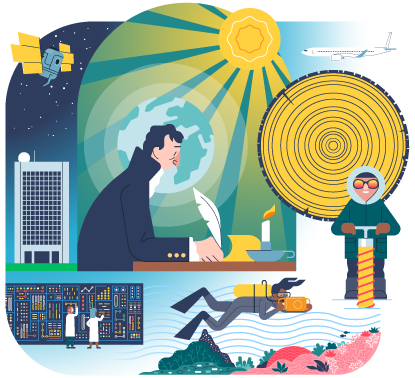
An illustration of scientists studying climate change

What We Know About Climate Change

The science is clear: the Earth’s climate is changing faster today than ever before in the history of our species – and human actions are the main reason why. If global warming goes on unchecked, we leave ourselves open to severe risks. Read More
Image
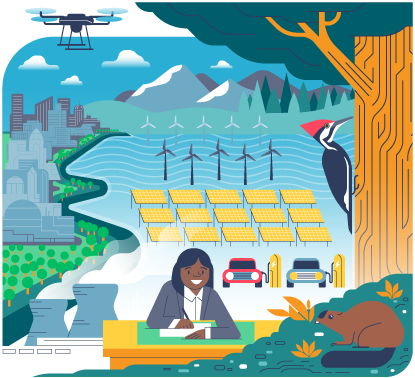
An illustration of various actions we can take to slow climate change and reduce its impacts

What Can Be Done About Climate Change

The world needs to soon level off – and then decrease – the amount of greenhouse gases in the atmosphere. Great progress can be made with the technologies we have today. But to take on the hardest challenges in addressing climate change, we urgently need new solutions. Read More

Ask MIT Climate Podcast

Get smart quickly on climate change. This MIT podcast breaks down the science, technologies, and policies behind climate change, how it’s impacting us, and what our society can do about it. Each quick episode gives you the what, why, and how on climate change — from real scientists — to help us all make informed decisions for our future. See all episodes

Transcriptions

NBC News: The water level at the state’s second-largest reservoir is the lowest it’s ever been. Droughts aren’t new to this part of California, but what is different is the intensity and duration of the current droughts, brought on by the effects of climate change.

Madison Goldberg: As humans continue to burn fossil fuels and put more heat-trapping pollution in the air, we’re feeling the effects. And one of them is that the world is becoming drier.

And, also…wetter.

NBC News: That’s happening in every corner of the U.S., from Fort Lauderdale’s staggering floods in April, to September when Brooklyn got 30 days of rain in just three hours. Climate change is driving both these events and the overall trend, with the most destructive floods happening three times as often as they once did.

MG: It might seem kind of baffling that climate change would worsen both droughts and floods—like the weather is mad at us or something. But this is exactly what climate scientists have predicted for decades. So what’s going on?

Mathew Barlow: That's a great question. And I think it really is sort of counterintuitive.

MG: That’s Mathew Barlow.

MB: I'm a professor of climate science at the University of Massachusetts Lowell with a focus on extreme events like heat waves, cold snaps, droughts, and floods.

MG: Professor Barlow says, for many extreme events, it can be hard to see the connection to climate change if we think about it just as a matter of warming.

MB: To zoom out a little bit, our simplest metric is globally averaged surface temperature, which has basically no relationship to anybody's everyday life and is a small number that sounds insignificant. You know, global temperature has warmed a little over a degree Celsius. If this room warmed a degree Celsius, we probably wouldn't even notice. But we do experience extreme events.

MG: I’m Madison Goldberg, and you’re listening to Ask MIT Climate. Today, we’re going to trace the path from global warming to the water cycle. How does our climate pollution connect to the deluges and droughts we’re seeing today, and what should we expect for the future? Because while the story of water and warming can be complicated, the fact is that the two are intertwined.

And it all starts with a simple truth of physics.

MB: Warmer air can hold more water.

MG: As our climate pollution heats the air, the water molecules in the atmosphere move around faster, and, basically, get more reluctant to clump together into raindrops.

That means you need to get more water vapor into the air before it will fall back out. And that water has to come from somewhere.

MB: The other piece of it is that a hotter surface can evaporate more effectively. You can dry the land out quicker.

MG: These are the ingredients of drought. The air holds onto water longer before it will fall, while the land below is sapped of its moisture.

But when the water finally does drop… well, there’s more up there to come down.

MB: So you get a system that can have more rainfall as well as less rainfall.

MG: And that’s exactly what we’re seeing. On average across the globe, there’s more water vapor in the atmosphere than there was a century or even a decade ago. That thirstier atmosphere has intensified droughts in many parts of the world. And at the same time, the largest downpours are getting bigger.

Now, this isn’t to say that we’re looking at a future where every dry spell drains the reservoirs, or where every storm floods the streets.

MB: The way the average changes and the way the extremes change can be different. It doesn't always appear that the average storm is becoming stronger, but that the strongest storms are becoming stronger.

MG: That’s important to keep in mind as we prepare for the world to continue warming. With rain, for instance, it’s not necessarily a change in the average, middle-of-the-road storm that we’re worried about. It’s the very largest downpours that give the most cause for concern.

MB: We aren't, infrastructure wise, really adapted even for the climate of the previous thirty years. We tend to not build very well for extreme events. When we build, a default way we build is with impervious surfaces: houses, roofs, roads, sidewalks, parking lots, preventing water from going into the soil very easily. So then it runs off much more easily and accumulates.

MG: And as the strongest storms get stronger, flooding can get worse even far from any major body of water.

MB: People may underestimate the risk if you're by a river or you're by a coastal region, but I think they understand that risk is there. What we're seeing more of that I think people are not as prepared for is the stormwater flooding. We've seen that in Western Massachusetts, we've seen that in Vermont, eastern New York, but all over the world, those kind of heavy flood events are happening. And we're now at the point where you can get enough rainfall so quickly that you don't need to be by a river. You don't need to be by a coast.

MG: This means many communities need to start preparing. And that requires us to think about all the factors that can make floods more dangerous—because the outcome doesn’t just depend on the strength of the storm. It depends on how our towns and cities are built, how emergency response unfolds, and whether people have what they need in order to recover.  

Preparation has many parts: updating response plans and early warning systems, making sure people will have access to resources after a disaster—and when possible, building in ways that stop floods from gathering so much force.

MB: So if you have more grass or what are often called rain gardens, more trees, more green space in general, you're really reducing the amount of flooding. We also know the impervious surfaces are vast associated with cars. So if you increase the amount of public transportation, even buses, you can change the number of parking spots a lot. So where we're willing to tackle that problem, public transportation, we also could make really large inroads on managing flooding by reducing impervious surfaces. 

MG: Of course, there’s no off-the-shelf plan that’s going to help with extreme events everywhere. That’s partly because these big global changes come in lots of local varieties.

Where we record this show around Boston, we get big winter storms called nor’easters.

MB: Here in New England, our local ocean temperatures off the coast are rising at one of the highest rates in the whole world. So the ocean is very, very warm. So in the winter, when the land is relatively cold, you've increased that temperature contrast between land and ocean. And that's also a fuel source for storms because you have a wedge of cold, dense air that's sort of piled up, ready to flow, like if you piled up all the water in your bathtub on one side and took your hands away, it would splash down.

MG: Boston has always been vulnerable to big blizzards and hurricane-force winds. And in a warmer, wetter world, those risks may be magnified.

But elsewhere, the effects are very different.

MB: Overall, the desert regions in the subtropics are expected to get drier, say in the Middle East, southwest Asia in the northern hemisphere, and the southwest U.S.

MG: These regions have dry climates already. And to see why climate change is set to make them even drier, it helps to understand why that is.

Basically, these areas are dry because they’re downwind of the warm, wet tropics surrounding the equator. Here’s what happens.

MB: So it's warmest at the equator. You have a lot of ocean at the equator, a lot of warm ocean. So that's a great place for precipitation.

MG: All the rainfall in the tropics creates currents of rising air. When the air rises, it cools up there in the high atmosphere and spreads out from the equator. When it arrives around the subtropics, farther north and south, that cool air falls again. And as it falls, it warms back up—which means it wants to pick up more water, not drop it.

MB: And if you look at the world, most of the desert regions are in the subtropics because that’s where the air that went up in the heavy rainfall of the tropics is coming down.

MG: As with the northeast and its big snowstorms, these regions are used to this general pattern—but our warming planet is magnifying it.

MB: In the tropics, the ocean is going to get warmer. The precipitation is going to get stronger. That means more downward moving air over the subtropics. So in a place like California, for instance, you could have a discussion about whether that's increasing the occurrence of drought or whether California is just becoming more arid. And I think people are sort of leaning towards, it's just becoming more arid. At what point do you call a 20- or a 30-year drought just the climate of the region? 

MG: These changes aren’t always easy to predict. Some deserts in the subtropics, like the Sahara, might actually be getting wetter, not drier. And New England, of course, isn’t the only part of the world with big coastal storms. Whether these storms get stronger or weaker will likely vary from place to place. Our planet is just too complex for simple rules to hold everywhere.

MB: Things that would be simple if we didn’t have continents are more complicated, because the shape of the continents actually interacts with the wind systems. So you have the Indian monsoon at the same latitude in the subtropics as some of the biggest deserts on Earth.

And I think a big concern is the variability of the main monsoon regions. There's a growing concern that the variability might increase. And even if you get the same amount of rain in, say, the monsoon season, if that rain is packed into fewer, more intense events, that's worse for people and for agriculture.

MG: Depending on where you live, changes to the water cycle might not only be felt in droughts and storms. A warmer, wetter atmosphere can affect all kinds of other hazards. For instance, where there’s more drought, you often see more wildfires.

MB: In places like the Western U.S., for several years now, we've seen the evidence of that. As it dries out, it's just been much easier for vegetation to burn and for fires to start and spread.

The other piece of it is this cycling between more wet and more dry. There seems to be some evidence that the wet part builds up the vegetation, the fuel, and then the dry part dries it out. And I think that especially is a concern in eastern Canada and New England, where we've started in the last couple of years to see this cycling between wet, and you build up the vegetation, and then at least a long enough dry period to make it pretty flammable.

MG: Another example: a wetter atmosphere can make heat waves more dangerous.

MB: One of the ways that people respond to heat is by sweating. So as long as you can sweat, you're cooling yourself. If the air is really humid, you can't sweat effectively because you can't put more moisture into the air that's already saturated with moisture. So humid heat is much more high impact than dry heat.

MG: Which is all to say, understanding the water cycle can help us make more sense of how climate change is altering our world. But as we’ve seen, changes to the way water moves around our planet don’t play out the same everywhere—and our planning needs to account for that.

We can say this about planning for the future, though: No matter where you are, shifting away from fossil fuels and other sources of climate pollution helps ensure that change unfolds more like a trickle, and not a flood.

MB: We know that storms are going to continue to get more intense, at least for a few decades, no matter what. So we need to prepare for that. Absolutely. But at the same time, we should also be focusing on stopping making the problem worse.

One of the most important things you can do as an individual to respond to climate change is simply talk to other members of your community about it. The more people talk about it, the more people understand that most of us are very concerned about it. I think that's very important, especially as a counterweight to the despair that I personally find it very easy to fall into. We can't return our climate back to the climate of thirty years ago, there's a certain amount of warming that we can expect no matter what we do, but we can stop it from getting worse. 

MG: Ask MIT Climate is the climate change podcast of the Massachusetts Institute of Technology. Aaron Krol is our executive producer and the writer for today’s episode. David Lishansky is our sound editor and producer. Michelle Harris fact-checks our episodes, and the music is by Blue Dot Sessions. And I’m your host and associate producer, Madison Goldberg.

Thank you to Professor Mathew Barlow for joining us today. You can find more episodes of the show at climate.mit.edu. We’re also on TikTok, Instagram, and Youtube @askmitclimate. And if you’re feeling deluged by climate questions—and parched for answers—we’d love to help. Email us at askmitclimate@mit.edu.

"What We Know" and "What Can Be Done" illustrations by Rick Pinchera.