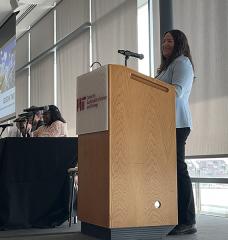
George Tynan followed a nonlinear path to fusion.
Following his undergraduate degree in aerospace engineering, Tynann's work in the industry spurred his interest in rocket propulsion technology. Because most methods for propulsion involve the manipulation of hot ionized matter, or plasmas, Tynan focused his attention on plasma physics.
It was then that he realized that plasmas could also drive nuclear fusion. “As a potential energy source, it could really be transformative, and the idea that I could work on something that could have that kind of impact on the future was really attractive to me,” he says.
That same drive, to realize the promise of fusion by researching both plasma physics and fusion engineering, drives Tynan today. It’s work he will be pursuing as the Norman C. Rasmussen Adjunct Professor in the Department of Nuclear Science and Engineering (NSE) at MIT.
An early interest in fluid flow
Tynan’s enthusiasm for science and engineering traces back to his childhood. His electrical engineer father found employment in the U.S. space program and moved the family to Cape Canaveral in Florida.
“This was in the ’60s, when we were launching Saturn V to the moon, and I got to watch all the launches from the beach,” Tynan remembers. That experience was formative and Tynan became fascinated with how fluids flow.
“I would stick my hand out the window and pretend it was an airplane wing and tilt it with oncoming wind flow and see how the force would change on my hand,” Tynan laughs. The interest eventually led to an undergraduate degree in aerospace engineering at California State Polytechnic University in Pomona.
The switch to a new career would happen after work in the private sector, when Tynan discovered an interest in the use of plasmas for propulsion systems. He moved to the University of California at Los Angeles for graduate school, and it was here that the realization that plasmas could also anchor fusion moved Tynan into this field.
This was in the ’80s, when climate change was not as much in the public consciousness as it is today. Even so, “I knew there’s not an infinite amount of oil and gas around, and that at some point we would have to have widespread adoption of nuclear-based sources,” Tynan remembers. He was also attracted by the sustained effort it would take to make fusion a reality.
Doctoral work
To create energy from fusion, it’s important to get an accurate measurement of the “energy confinement time,” which is a measure of how long it takes for the hot fuel to cool down when all heat sources are turned off. When Tynan started graduate school, this measure was still an empirical guess. He decided to focus his research on the physics of observable confinement time.
It was during this doctoral research that Tynan was able to study the fundamental differences in the behavior of turbulence in plasma as compared to conventional fluids. Typically, when an ordinary fluid is stirred with increasing vigor, the fluid’s motion eventually becomes chaotic or turbulent. However, plasmas can act in a surprising way: confined plasmas, when heated sufficiently strongly, would spontaneously quench the turbulent transport at the boundary of the plasma
An experiment in Germany had unexpectedly discovered this plasma behavior. While subsequent work on other experimental devices confirmed this surprising finding, all earlier experiments lacked the ability to measure the turbulence in detail.
Brian LaBombard, now a senior research scientist at MIT’s Plasma Science and Fusion Center (PSFC), was a postdoc at UCLA at the time. Under LaBombard’s direction, Tynan developed a set of Langmuir probes, which are reasonably simple diagnostics for plasma turbulence studies, to further investigate this unusual phenomenon. It formed the basis for his doctoral dissertation. “I happened to be at the right place at the right time so I could study this turbulence quenching phenomenon in much more detail than anyone else could, up until that time,” Tynan says.
As a PhD student and then postdoc, Tynan studied the phenomenon in depth, shuttling between research facilities in Germany, Princeton University’s Plasma Physics Laboratory, and UCLA.
Fusion at UCSD
After completing his doctorate and postdoctoral work, Tynan worked at a startup for a few years when he learned that the University of California at San Diego was launching a new fusion research group at the engineering school. When they reached out, Tynan joined the faculty and built a research program focused on plasma turbulence and plasma-material interactions in fusion systems. Eventually, he became associate dean of engineering, and later, chair of the Department of Mechanical and Aerospace Engineering, serving in these roles for nearly a decade.
Tynan visited MIT on sabbatical in 2023, when his conversations with NSE faculty members Dennis Whyte, Zach Hartwig, and Michael Short excited him about the challenges the private sector faces in making fusion a reality. He saw opportunities to solve important problems at MIT that complemented his work at UC San Diego.
Tynan is excited to tackle what he calls, “the big physics and engineering challenges of fusion plasmas” at NSE: how to remove the heat and exhaust generated by burning plasma so it doesn’t damage the walls of the fusion device and the plasma does not choke on the helium ash. He also hopes to explore robust engineering solutions for practical fusion energy, with a particular focus on developing better materials for use in fusion devices that will make them longer-lasting, while minimizing the production of radioactive waste.
“Ten or 15 years ago, I was somewhat pessimistic that I would ever see commercial exploitation of fusion in my lifetime,” Tynan says. But that outlook has changed, as he has seen collaborations between MIT and Commonwealth Fusion Systems (CFS) and other private-sector firms that seek to accelerate the timeline to the deployment of fusion in the real world.
In 2021, for example, MIT’s PSFC and CFS took a significant step toward commercial carbon-free power generation. They designed and built a high-temperature superconducting magnet, the strongest fusion magnet in the world.
The milestone was especially exciting because the promise of realizing the dream of fusion energy now felt closer. And being at MIT “seemed like a really quick way to get deeply connected with what’s going on in the efforts to develop fusion energy,” Tynan says.
In addition, “while on sabbatical at MIT, I saw how quickly research staff and students can capitalize on a suggestion of a new idea, and that intrigued me,” he adds.
Tynan brings his special blend of expertise to the table. In addition to extensive experience in plasma physics, he has spent a lot more time on hardcore engineering issues like materials, as well. “The key is to integrate the whole thing into a workable and viable system,” Tynan says.