A startup making emergency housing cheaper and faster to deploy won this year’s MIT $100K Entrepreneurship Competition on May 12.
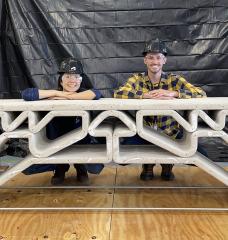
Uplift Microhome is building reusable, modular housing units to provide housing on demand to people affected by natural disasters and other emergencies. Each of the company’s homes has its own batteries and water reservoir, allowing them to quickly be transported and placed off-grid.
“Every year, millions of Americans are displaced by natural disasters,” said co-founder Charlie Nitschelm, who is in MIT’s Leaders for Global Operations program, earning a master’s in engineering and an MBA. “If they're lucky, they can stay with friends or family. If they’re not so lucky, they could end up in a homeless shelter. But disasters aren’t just two-week problems. It takes months, sometimes years, to get back to what life was like before. Bottom line: We lack dignified and affordable housing after disasters.”
Uplift Microhome was one of seven teams chosen to pitch at the final event, which took place inside a packed Kresge Auditorium. Each team got five minutes to pitch their startups before a few minutes of questioning from judges.
This year’s competition started in April with more than 80 applications. The program’s judges selected 16 teams to compete in the semifinal before whittling that number down to the finalist teams for Tuesday’s event.
“This competition isn’t just about one big night,” $100K managing director and MIT Sloan School of Management student Celine Christory said. “It’s a year-long journey for our organizers and students. It kicks off with the ‘Pitch’ event in December, moves to ‘Accelerate’ in March, and culminates in the ‘Launch’ event.”
In the pitch that won the $100,000 Danny Lewin Grand Prize, Nitschelm said it takes an average of four months for the U.S. Federal Emergency Management Agency (FEMA) to deploy single-use housing after a disaster. That’s because these homes require power and utilities in addition to extensive foundation preparation.
“As a result, less than 1 percent of survivors actually receive a physical home,” Nitschelm said. “The rest get a check and are told to go figure it out. This isn’t just our opinion. The Department of Homeland Security audited FEMA and recommended providing a cost-effective housing alternative that allows disaster survivors to stay close to their home.”
Uplift’s homes can be transported on the back of a tractor trailer and deployed using a standard forklift. In addition to its battery and water reservoir, the homes feature self-leveling bases that allow them to be deployed on uneven terrain.
“That dramatically simplifies delivery, installation, and deactivation to the point where you can economically recover, refurbish, and redeploy the unit,” says co-founder Trevor O’Leary, a student at Harvard Business School.
The company has already built a home and believes it can manufacture each unit at a cost similar to the cheapest tractor trailer while delivering housing in hours. The company expects the marginal cost of reusing each unit to be an order of magnitude less expensive than current solutions. Down the line, it plans to deploy homes to combat housing insecurity, for seasonal workers and during construction projects. It plans to manufacture its homes in the United States.
The second-place $50,000 David T. Morgenthaler Founder’s Prize was awarded to the startup Mohan, which is using generative artificial intelligence to map the Earth’s subsurface in three dimensions. The company is deploying its technology to help mining companies decide where to drill, starting by targeting copper deposits.
“Everyone is talking about AI and chips, but no one is talking about what they sit on: copper,” said co-founder Hongze Bo, a PhD student in MIT’s Department of Earth, Atmospheric and Planetary Sciences. “Every cable, GPU, and data center depends on copper. By 2030, we’re going to be 4 million tons of copper short. But we don't know where the next deposit is. Today we just drill and hope.”
The core of Mohan’s technology is a diffusion AI model that iteratively removes noise from subsurface data to create underground scans. The company also develops its own subsurface data.
“We built a full, 3D subsurface model using generative AI,” explained Bo. “It’s the same technology behind [image generation tools] Sora and Midjourney.”
The third place $5,000 prize went to Iceberg Systems, which is using autonomous AI agents to predict how risk cascades across the economy. The company invented a new class of AI systems at MIT that coordinates millions of AIs to simulate how risks emerge through interaction. It has been working with the Department of Energy.
“Iceberg simulates behaviors across millions of market participants, from brokers to consumers to institutions, to simulate and predict how shocks cascade through their interactions and create systemic risk in the economy,” says co-founder and MIT PhD student Ayush Chopra.
The $5,000 Audience Choice Prize went to Pixology, an agentic AI platform that creates on-brand, sponsor-ready sports content to help monetize live moments.
The other finalists that presented at this year’s event were:
- NeuralPhysics, which is building foundation physics models and agents for hardware design simulation and manufacturing;
- DesignFlownAI, a design intelligence app embedded in computer-aided design software to give engineers insights in real time; and
- Auto Lab, an autonomous AI platform that helps teams build better models faster.
The $100K Entrepreneurship Competition is one of MIT’s annual flagship entrepreneurial events. It began more than 30 years ago when a group of students, along with the late Ed Roberts, who was the founder and chair of the Martin Trust Center for MIT Entrepreneurship, decided to start a startup pitch competition.
The prize started at $10,000 then grew to $50,000 before reaching today’s $100,000 grand prize. Past participants include HubSpot, Akamai, and Lightmatter.
In addition to the prizes, teams received mentorship from venture capitalists, serial entrepreneurs, corporate executives, and attorneys; funding for prototypes; business plan feedback; and more.