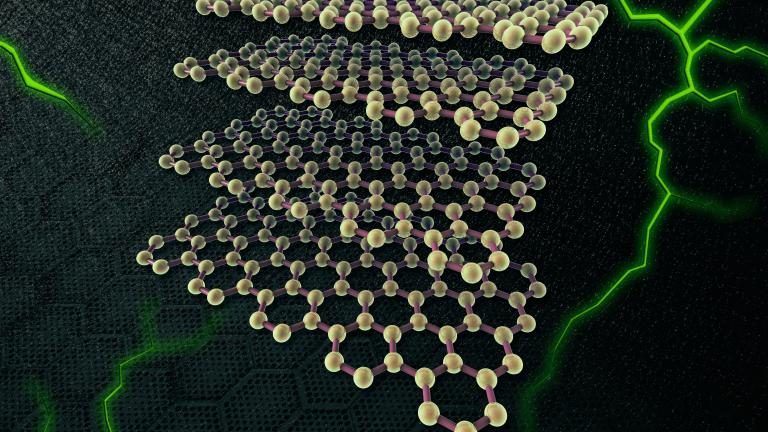
Graphite is a key structural component in some of the world’s oldest nuclear reactors and many of the next-generation designs being built today. But it also condenses and swells in response to radiation — and the mechanism behind those changes has proven difficult to study.
Now, MIT researchers and collaborators have uncovered a link between properties of graphite and how the material behaves in response to radiation. The findings could lead to more accurate, less destructive ways of predicting the lifespan of graphite materials used in reactors around the world.
“We did some basic science to understand what leads to swelling and, eventually, failure in graphite structures,” says MIT Research Scientist Boris Khaykovich, senior author of the new study. “More research will be needed to put this into practice, but the paper proposes an attractive idea for industry: that you might not need to break hundreds of irradiated samples to understand their failure point.”
Specifically, the study shows a connection between the size of the pores within graphite and the way the material swells and shrinks in volume, leading to degradation.
“The lifetime of nuclear graphite is limited by irradiation-induced swelling,” says co-author and MIT Research Scientist Lance Snead. “Porosity is a controlling factor in this swelling, and while graphite has been extensively studied for nuclear applications since the Manhattan Project, we still do not have a clear understanding of the porosity in both mechanical properties and swelling. This work addresses that.”
The open-access paper appears this week in Interdisciplinary Materials. It is co-authored by Khaykovich, Snead, MIT Research Scientist Sean Fayfar, former MIT research fellow Durgesh Rai, Stony Brook University Assistant Professor David Sprouster, Oak Ridge National Laboratory Staff Scientist Anne Campbell, and Argonne National Laboratory Physicist Jan Ilavsky.
A long-studied, complex material
Ever since 1942, when physicists and engineers built the world’s first nuclear reactor on a converted squash court at the University of Chicago, graphite has played a central role in the generation of nuclear energy. That first reactor, dubbed the Chicago Pile, was constructed from about 40,000 graphite blocks, many of which contained nuggets of uranium.
Today graphite is a vital component of many operating nuclear reactors and is expected to play a central role in next-generation reactor designs like molten-salt and high-temperature gas reactors. That’s because graphite is a good neutron moderator, slowing down the neutrons released by nuclear fission so they are more likely to create fissions themselves and sustain a chain reaction.
“The simplicity of graphite makes it valuable,” Khaykovich explains. “It’s made of carbon, and it’s relatively well-known how to make it cleanly. Graphite is a very mature technology. It’s simple, stable, and we know it works.”
But graphite also has its complexities.
“We call graphite a composite even though it’s made up of only carbon atoms,” Khaykovich says. “It includes ‘filler particles’ that are more crystalline, then there is a matrix called a ‘binder’ that is less crystalline, then there are pores that span in length from nanometers to many microns.”
Each graphite grade has its own composite structure, but they all contain fractals, or shapes that look the same at different scales.
Those complexities have made it hard to predict how graphite will respond to radiation in microscopic detail, although it’s been known for decades that when graphite is irradiated, it first densifies, reducing its volume by up to 10 percent, before swelling and cracking. The volume fluctuation is caused by changes to graphite’s porosity and lattice stress.
“Graphite deteriorates under radiation, as any material does,” Khaykovich says. “So, on the one hand we have a material that’s extremely well-known, and on the other hand, we have a material that is immensely complicated, with a behavior that’s impossible to predict through computer simulations.”
For the study, the researchers received irradiated graphite samples from Oak Ridge National Laboratory. Co-authors Campbell and Snead were involved in irradiating the samples some 20 years ago. The samples are a grade of graphite known as G347A.
The research team used an analysis technique known as X-ray scattering, which uses the scattered intensity of an X-ray beam to analyze the properties of material. Specifically, they looked at the distribution of sizes and surface areas of the sample’s pores, or what are known as the material’s fractal dimensions.
“When you look at the scattering intensity, you see a large range of porosity,” Fayfar says. “Graphite has porosity over such large scales, and you have this fractal self-similarity: The pores in very small sizes look similar to pores spanning microns, so we used fractal models to relate different morphologies across length scales.”
Fractal models had been used on graphite samples before, but not on irradiated samples to see how the material’s pore structures changed. The researchers found that when graphite is first exposed to radiation, its pores get filled as the material degrades.
“But what was quite surprising to us is the [size distribution of the pores] turned back around,” Fayfar says. “We had this recovery process that matched our overall volume plots, which was quite odd. It seems like after graphite is irradiated for so long, it starts recovering. It’s sort of an annealing process where you create some new pores, then the pores smooth out and get slightly bigger. That was a big surprise.”
The researchers found that the size distribution of the pores closely follows the volume change caused by radiation damage.
“Finding a strong correlation between the [size distribution of pores] and the graphite’s volume changes is a new finding, and it helps connect to the failure of the material under irradiation,” Khaykovich says. “It’s important for people to know how graphite parts will fail when they are under stress and how failure probability changes under irradiation.”
From research to reactors
The researchers plan to study other graphite grades and explore further how pore sizes in irradiated graphite correlate with the probability of failure. They speculate that a statistical technique known as the Weibull Distribution could be used to predict graphite’s time until failure. The Weibull Distribution is already used to describe the probability of failure in ceramics and other porous materials like metal alloys.
Khaykovich also speculated that the findings could contribute to our understanding of why materials densify and swell under irradiation.
“There’s no quantitative model of densification that takes into account what’s happening at these tiny scales in graphite,” Khaykovich says. “Graphite irradiation densification reminds me of sand or sugar, where when you crush big pieces into smaller grains, they densify. For nuclear graphite, the crushing force is the energy that neutrons bring in, causing large pores to get filled with smaller, crushed pieces. But more energy and agitation create still more pores, and so graphite swells again. It’s not a perfect analogy, but I believe analogies bring progress for understanding these materials.”
The researchers describe the paper as an important step toward informing graphite production and use in nuclear reactors of the future.
“Graphite has been studied for a very long time, and we’ve developed a lot of strong intuitions about how it will respond in different environments, but when you’re building a nuclear reactor, details matter,” Khaykovich says. “People want numbers. They need to know how much thermal conductivity will change, how much cracking and volume change will happen. If components are changing volume, at some point you need to take that into account.”
This work was supported, in part, by the U.S. Department of Energy.