Utilizing waste carbon at scale, assessing public trust in artificial intelligence and data centers, and building a quantum toolkit for critical applications were among the topics energy experts explored at the MIT Energy Initiative (MITEI)’s annual research conference on Sept. 22-23.
The complexity of the energy transition demands “a truly interdisciplinary and international approach,” said Paula Hammond, Institute Professor and dean of the MIT School of Engineering, kicking off the conference, which was themed “Transitioning energy at a pivotal moment.”
More than 200 people attended Energizing@MIT: MITEI’s Annual Research Conference in person and online, including faculty, scientists, and researchers; representatives of global energy firms; nonprofit organizations; and academic institutions.
With the rapid proliferation of artificial intelligence and data centers, the challenge of the energy transition grows ever greater, requiring “researchers who can pursue fundamental questions about materials, chemistry, and energy systems … engineers who can design new technologies and determine how they might function at scale … and experts in economics, policy, human behavior, and sociology who can help us understand how those technologies will interact with communities and with the world around us,” said Hammond.
From keynote speakers to panelists, seed grant innovators to startup entrepreneurs, the conference featured exemplars in all these categories.
Deploying today’s technologies
Eric Toone, chief technical officer and managing partner at Breakthrough Energy, set the tone for day one with a keynote address that was clear-eyed in his assessment. “If energy is prosperity,” he told the audience, “at least today, prosperity is emissions.” Yet, Toone was optimistic when he heralded examples of Breakthrough Energy-funded ventures, from iron-air batteries to vacuum-insulated glass windows, which can reduce the carbon costs of energy.
“We can absolutely develop new technologies that provide the exact same service, but at zero carbon,” he said.
The conference made Toone’s claim tangible as it spanned the full arc of decarbonization — from deploying what we know today to uncovering what may be possible tomorrow.
There are “projects that are actually being developed, companies that are putting steel in the ground now, electrons onto the grid to deliver capacity now, or in the very, very near term,” said John Parsons, deputy director for research at the MIT Center for Energy and Environmental Policy Research. Parsons moderated a panel on the revival of nuclear fission power.
Highlights included Crane Clean Energy Center’s restoration of the Three Mile Island Unit 1 nuclear plant, set to restart in mid-2027; work by Électricité de France (EDF) to extend and modernize France’s 57-reactor nuclear fleet, adapting plants to climate impacts; and GE Vernova’s development of mature light-water reactor technology, with a new plant under construction in Ontario.
Carbon utilization offers another path to mitigating carbon dioxide (CO2) emissions. “The land and ocean are passively taking up almost 50 percent of anthropogenic CO2 emissions,” said Carolyn Ruppel, MITEI’s deputy director for science and technology, who moderated the panel. “The idea is to find uses for some of the rest of it.” The session showcased research exploring a host of technologies for making products with captured CO2.
Nicola Ferralis, a research scientist in the MIT Department of Materials Science and Engineering (DMSE), highlighted the importance of large-scale uses for carbon waste, such as structural carbon for vehicles and buildings. “We need to find applications that are actually able to match the supply by mass,” he said.
Admir Masic, an associate professor in the MIT Department of Civil and Environmental Engineering and DMSE, described self-heating concrete panels used in real-world conditions in Sapporo, Japan, as well as new concrete materials that can store energy.
“The pace of the transition to a renewable-energy economy will strongly rely on the availability of scalable, bulk energy-storage solutions,” said Masic.
Kripa K. Varanasi, a professor in the MIT Department of Mechanical Engineering, is working on ways to make technologies such as emissions-plume capture at power plants economically viable.
In a panel devoted to startups with links to MITEI or MITEI member companies, speakers described moving novel energy technologies from research to commercialization: Alfredo Rivela of Adaion has developed an AI tool for electrical utilities that optimizes their use of the grid; Eddie Obropta of Raptor Maps trains drones to inspect solar farms; Michele Guarnieri’s HiBot has created a robot that detects issues in power lines; and Michael Wang of Lithios is conducting field pilots that use electrochemistry to separate lithium from low-grade brines.
Successful ventures, the speakers agreed, begin with a clear customer problem that can be validated by industry users and that offers a path to scaled deployment. For industry users, “innovation is not a corporate virtue,” said Steve Hellman, managing partner at Alliance Partners. “It’s an existential requirement.”
Early-stage research and basic science
The conference also offered a bounty of promising early research on technologies and approaches for cutting carbon emissions. A panel on MITEI’s Seed Innovation Fund Program projects introduced MIT scientists who are separating and recycling rare earth elements; designing algorithms to decide which power plants should run to meet electricity demand; and modeling the impacts on human and natural systems of development and decarbonization.
A poster session revealed the next generation of energy researchers in such fields as chemistry, architecture, aeronautics and astronautics, and computer science. Graduate students are developing a wide array of technologies for carbon mitigation and new energy systems, such as a steam electrolysis process for hydrogen production; models of end-to-end decarbonization in buildings; and designs for hydrogen- and methane-fueled aircraft.
The conference highlighted the importance of fundamental science in feeding the pipeline of new energy technologies. Wednesday’s keynote speaker, Danna Freedman, the F. G. Keyes Professor of Chemistry at MIT and inaugural director of Quantum@MIT, traced scientists’ evolving capacity to harness quantum computing as a tool for solving a range of problems, including those in energy.
“What we want to do at Q-MIT is solve the hard problem, and the hard problem isn’t developing these ridiculously intricate and beautiful quantum tools,” said Freedman. “It is connecting the quantum tools with the applications that will change the world.”
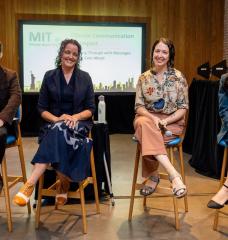
A companion panel explored one such application: quantum sensing, which leverages fundamental physics to capture a nanoscale view of materials and their properties. For instance, Lukasz Zielinski, scientific advisor to the Integrated Sensing and Measurement Program at SLB, uses a lidar camera with single-photon detectors to identify methane plumes. Moderator Paola Cappellaro, the Ford Professor of Engineering in the MIT Department of Nuclear Science and Engineering, described her work using diamond-based sensors for detecting tiny magnetic fields from battery current, potentially helping measure battery conditions without disturbing the battery electrically. Such quantum sensors, Cappellaro said, can be “practical and impactful.”
Data centers and public trust
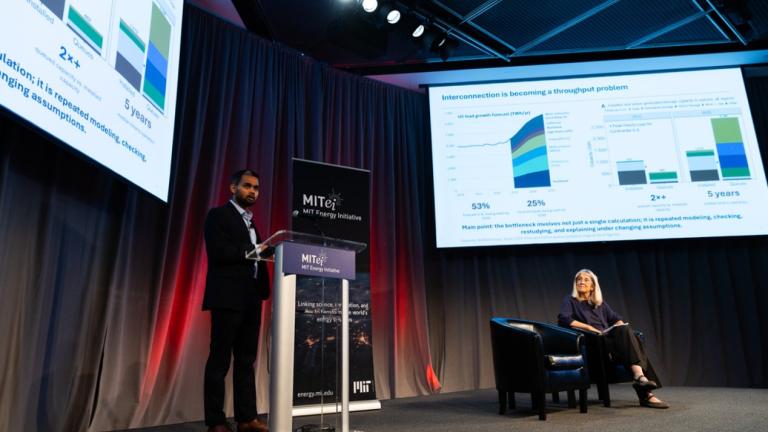
One critical challenge facing energy researchers and industry emerged in sessions throughout the two days: the explosive growth of AI and the energy-hungry data centers that fuel this technology. As Deepjyoti Deka, a MITEI principal research scientist, put it, “the big test for AI right now is whether AI can reduce energy usage, improve efficiency, as well as bring in innovation faster than the rate at which it is going to consume electricity to get trained and deployed.”
“New ‘hyperscale’ facilities built for artificial intelligence can use more power than entire cities,” said Steve Clemmer, director of energy research in the Climate and Energy Program at the Union of Concerned Scientists, sharing a recent analysis of data center proliferation. With new facilities being 10 to even 10,000 times larger than data centers built just a decade ago, he said, wholesale electricity costs will rise, and “increased reliance on fossil fuels will result in tens of billions of dollars in health damages, and trillions in climate damages.” He noted that decision-makers can mitigate these harmful impacts through clean energy development, strong ratepayer protections, and other safeguards.
Given mounting opposition to data centers, Kathryn Kline Tyndall, associate director of energy at the Bipartisan Policy Center, recommended that industry proponents provide early, accessible information about power, water, quality-of-life, land-use, environmental, and economic impacts, tailored to each community in which they hope to set up shop.
Larry Susskind, the Ford Professor of Urban and Environmental Planning in the MIT Department of Urban Studies and Planning, recommended that developers go further, and demonstrate credible benefits to communities. To achieve this, Susskind suggests a facilitated negotiation process between developers and local groups whose object is a community benefits agreement — a deal that might involve altering the data center design, and providing workforce development, infrastructure investment, and clean energy partnerships.
Ultimately, developers must accept that they can’t rush community acceptance; they have to earn it by giving residents a meaningful role in shaping projects and sharing their benefits.
“You’re going to have to proceed at the speed of trust,” said Susskind.