Climate
    • What We Know
    • What Can Be Done
    • Climate Primer
    • Podcast
    • Explainers
    • Climate Questions
    • For Educators
    • News
    • Events
    • Resources
  • Search
Search
MIT

Main navigation

    • What We Know
    • What Can Be Done
    • Climate Primer
    • Podcast
    • Explainers
    • Climate Questions
    • For Educators
    • News
    • Events
    • Resources
  • Search
PostJanuary 17, 2019

New Climate Model to be Built from the Ground Up

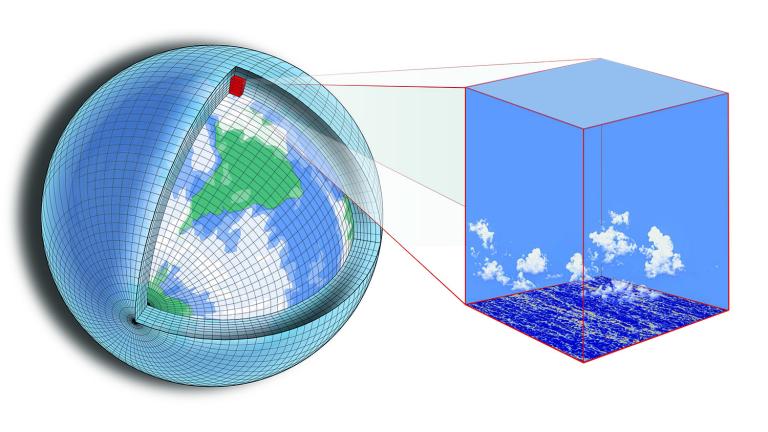
A consortium of researchers led by Caltech, in partnership with MIT; the Naval Postgraduate School (NPS); and the Jet Propulsion Laboratory (JPL), are teaming up to build a new type of climate model that is designed to provide more precise and actionable predictions. 

The consortium, dubbed the Climate Modeling Alliance (CliMA), plans to fuse Earth observations and high-resolution simulations into a model that represents important small-scale features, such as clouds and turbulence, more reliably than existing climate models. The goal is a climate model that projects future changes in critical variables such as cloud cover, rainfall, and sea ice extent more accurately — with uncertainties at least half the size of those in existing models.

The MIT CliMA team will be led by Raffaele Ferrari and John Marshall, Cecil and Ida Green Professors of Oceanography from the Department of Earth, Atmospheric and Planetary Sciences (EAPS).

Read the full story at EAPS News


Adapted from a press release issued by Caltech, in partnership with the MIT School of Science, the Naval Postgraduate School, and the Jet Propulsion Laboratory.

by MIT Department of Earth Atmospheric and Planetary Sciences
Topics
Climate Modeling
Education

Related Posts

PostAugust 31, 2026

Playing against climate risk

MIT News
Left to right: Researchers Anamitra Saha and Sai Ravela of the MIT Department of Earth, Atmospheric and Planetary Sciences, and Jayanta Basu of the University of Calcutta design the board for a "snakes and ladders" game. The game is the first step in encouraging community members to use an app-based simulation that suggests solutions to their unique geographical and environmental challenges.
PostAugust 24, 2026

Generating scenarios for extreme events, without extreme data

MIT News
MIT engineers have developed a tool that generates realistic extreme events and worst-case scenarios. Their method does not need to know about previous extreme events in order to generate realistic, future extreme events.
PostAugust 11, 2026

Researcher Profile: 3 questions with Jennifer Morris

MIT Center for Sustainability Science and Strategy
Jennifer Morris moderating a panel at the 48th Global Change Forum in March 2026 (Photo by Jamie Bartholomay)
PostAugust 4, 2026

Reframing leadership as a design problem

MIT News
Nicholas de Monchaux is Weber-Shaughness Professor of Architecture at MIT, as well as professor of urban studies and planning and affiliated faculty with the Program in Science, Technology, and Society.

MIT Climate Knowledge in Your Inbox


MIT Groups Log In

Log In

Footer

  • About
  • Terms & Conditions
  • Privacy Policy
  • Accessibility
  • Contact
MIT Climate Project
MIT
  • Instagram
  • TikTok
  • YouTube
  • Simplecast
Communicator Award Winner