Around 11 billion tons of goods, or about 1.5 tons per person worldwide, are transported by sea each year, representing about 90 percent of global trade by volume. Internationally, the merchant shipping fleet numbers around 110,000 vessels. These ships, and the ports that service them, are significant contributors to the local and global economy — and they’re significant contributors to greenhouse gas emissions.
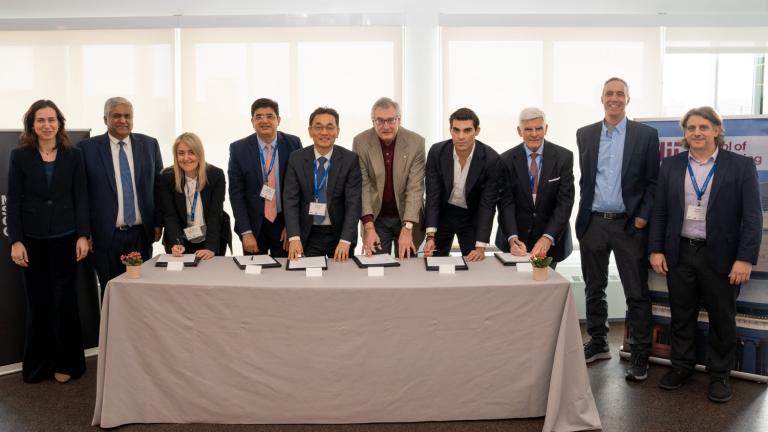
A new consortium, formalized in a signing ceremony at MIT last week, aims to address climate-harming emissions in the maritime shipping industry, while supporting efforts for environmentally friendly operation in compliance with the decarbonization goals set by the International Maritime Organization.
“This is a timely collaboration with key stakeholders from the maritime industry with a very bold and interdisciplinary research agenda that will establish new technologies and evidence-based standards,” says Themis Sapsis, the William Koch Professor of Marine Technology at MIT and the director of MIT’s Center for Ocean Engineering. “It aims to bring the best from MIT in key areas for commercial shipping, such as nuclear technology for commercial settings, autonomous operation and AI methods, improved hydrodynamics and ship design, cybersecurity, and manufacturing.”
Co-led by Sapsis and Fotini Christia, the Ford International Professor of the Social Sciences; director of the Institute for Data, Systems, and Society (IDSS); and director of the MIT Sociotechnical Systems Research Center, the newly-launched MIT Maritime Consortium (MC) brings together MIT collaborators from across campus, including the Center for Ocean Engineering, which is housed in the Department of Mechanical Engineering; IDSS, which is housed in the MIT Schwarzman College of Computing; the departments of Nuclear Science and Engineering and Civil and Environmental Engineering; MIT Sea Grant; and others, with a national and an international community of industry experts.
The Maritime Consortium’s founding members are the American Bureau of Shipping (ABS), Capital Clean Energy Carriers Corp., and HD Korea Shipbuilding and Offshore Engineering. Innovation members are Foresight-Group, Navios Maritime Partners L.P., Singapore Maritime Institute, and Dorian LPG.
“The challenges the maritime industry faces are challenges that no individual company or organization can address alone,” says Christia. “The solution involves almost every discipline from the School of Engineering, as well as AI and data-driven algorithms, and policy and regulation — it’s a true MIT problem.”
Researchers will explore new designs for nuclear systems consistent with the techno-economic needs and constraints of commercial shipping, economic and environmental feasibility of alternative fuels, new data-driven algorithms and rigorous evaluation criteria for autonomous platforms in the maritime space, cyber-physical situational awareness and anomaly detection, as well as 3D printing technologies for onboard manufacturing. Collaborators will also advise on research priorities toward evidence-based standards related to MIT presidential priorities around climate, sustainability, and AI.
MIT has been a leading center of ship research and design for over a century, and is widely recognized for contributions to hydrodynamics, ship structural mechanics and dynamics, propeller design, and overall ship design, and its unique educational program for U.S. Navy Officers, the Naval Construction and Engineering Program. Research today is at the forefront of ocean science and engineering, with significant efforts in fluid mechanics and hydrodynamics, acoustics, offshore mechanics, marine robotics and sensors, and ocean sensing and forecasting. The consortium’s academic home at MIT also opens the door to cross-departmental collaboration across the Institute.
The MC will launch multiple research projects designed to tackle challenges from a variety of angles, all united by cutting-edge data analysis and computation techniques. Collaborators will research new designs and methods that improve efficiency and reduce greenhouse gas emissions, explore feasibility of alternative fuels, and advance data-driven decision-making, manufacturing and materials, hydrodynamic performance, and cybersecurity.
“This consortium brings a powerful collection of significant companies that, together, has the potential to be a global shipping shaper in itself,” says Christopher J. Wiernicki SM ’85, chair and chief executive officer of ABS.
“The strength and uniqueness of this consortium is the members, which are all world-class organizations and real difference makers. The ability to harness the members’ experience and know-how, along with MIT’s technology reach, creates real jet fuel to drive progress,” Wiernicki says. “As well as researching key barriers, bottlenecks, and knowledge gaps in the emissions challenge, the consortium looks to enable development of the novel technology and policy innovation that will be key. Long term, the consortium hopes to provide the gravity we will need to bend the curve.”