

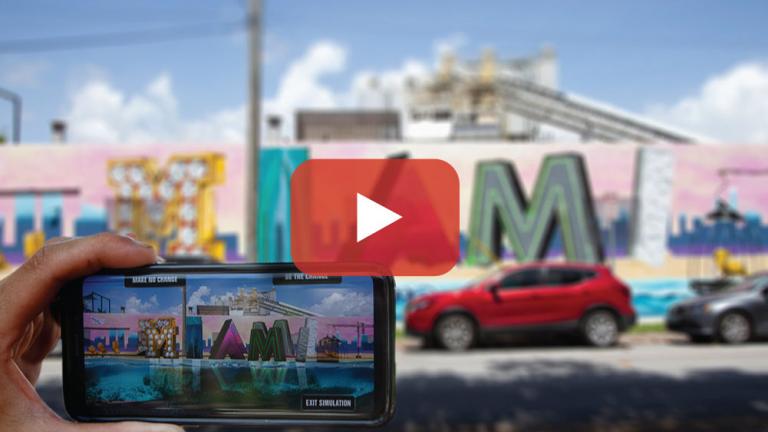
“To decarbonize society, we have all of the actual technical solutions that we need, but what we lack is political will and social will,” says Linda Cheung MBA ’17, cofounder and creative director of Before It’s Too Late, a nonprofit using art and technology to increase public awareness about climate change and inspire action. “To create radical change, you need to get people in a state of openness first.”
The Miami-based organization uses murals to depict scenes from nature that come to life in augmented reality. Passersby can trigger animation of the murals by viewing them through an app on a mobile device. The finished products are meant to inform and inspire observers, says Cheung. Even during the months-long process of painting the murals, the community was able to engage with the artists and hear the message of environmental advocacy behind the work. And the augmented reality adds another level, explains Cheung, providing the artists with the ability to add factoids, audio, additional messaging, and links where viewers can learn more.
Cheung worked in finance and marketing on Wall Street before coming to MIT Sloan. Her decision to move to Miami after graduating from MIT was closely related to her desire to work on environmental issues. Given Miami’s vulnerability as a coastal city to the effects of climate change, she suspected its citizens would grasp the urgency of her organization’s message.
“We focus on finding creative ways to engage regular people with various environmental issues and to help people feel personally connected to that issue,” says Cheung. Only when that happens, she says, will people “not only want to change their own behaviors but want to be part of promoting larger-scale change in whatever way that they can.”
In this new video, hear Cheung talk about her work, and see her organization’s murals come to life.

![The “New World of Weather” project, one of MIT’s five Climate Grand Challenges announced in 2022, is “advancing the science, technologies, and practical strategies needed to help communities anticipate [extreme weather] and build greater resilience,” says MIT Vice President for Energy and Climate Evelyn Wang.](/sites/default/files/styles/teaser_mini_image/public/post-images/mit-climate-cyclone.jpg?itok=KwBU2suI)
