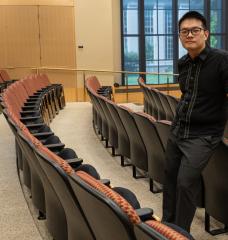
“I am fascinated by the way mathematics can describe fluid motion,” says Bodner, a self-described “desk oceanographer” who is an assistant professor in the Department of Earth, Atmospheric and Planetary Sciences. She holds an MIT Schwarzman College of Computing shared position with the Department of Electrical Engineering and Computer Science, which is housed jointly in the college and the School of Engineering.
Through her research into localized ocean turbulence and its impact on climate patterns, she seeks to improve larger-scale climate models, leading to better projections of long-term changes, such as sea-level rise, that are important to coastal communities.
Applying math and theory to natural phenomena
Bodner uses AI tools, satellite imagery, and data from idealized and more realistic simulations in her studies of complex ocean-atmosphere interactions.
“I was interested in math and earth sciences and ended up focusing on fluid dynamics, which combines the best of both worlds,” she said. “It’s a way we can explain natural phenomena with equations and physics. I got excited by the possibility of being able to see something and then write down this super complex mathematical form.
“More recently, I’ve started using computational tools, including different types of model simulations. AI is emerging in ocean observation products. It has been interesting to be able to combine computational tools and theory together with explaining natural phenomena and their impact.”
Bodner came to MIT in 2024, previously having been a Simons Junior Fellow at the Courant Institute of Mathematical Sciences at New York University. She received her BS in geophysics and mathematics and MS in geophysics from Tel Aviv University, and her SM in applied mathematics and PhD in earth, environmental, and planetary sciences from Brown University.
She cofounded and directs an online summer program, Climatematch Academy, that has trained thousands of users from diverse backgrounds around the world to engage climate challenges using cutting-edge techniques.
“I am passionate about teaching and am especially motivated to teach computational tools for climate science,” said Bodner. “I believe it is critical that the future generation of scientists are properly trained to use the wealth of climate data and tools available on open-source platforms.”
Monitoring the interaction of ocean and atmosphere on a local scale
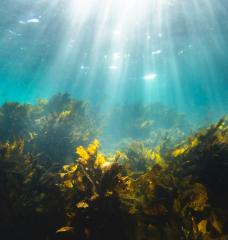
Her research focuses on the role of turbulence in the upper, or topmost, layer of the ocean, where the exchange of heat and energy with the atmosphere occurs, playing a significant role in global climate regulation.
“The ocean and the atmosphere communicate through that upper layer through turbulence,” she said. “It’s an interesting mathematical and physical problem, too small to capture from theories we’ve developed for large-scale ocean circulation, but too big to be captured in a tank or classroom experiment. Beyond the theoretical mathematical perspective, this hyperlocal phenomenon can impact the global climate.”
Global models are used in long-term projections of changes in sea surface temperatures, in rising sea levels, and in “what our climate system is going to be doing over the next hundred years,” she says. But the grid used in the global model doesn’t resolve a particular geographic locality such as Boston, which occupies a mere pixel or grid point in the model.
“Any kind of local effects we need to plan for over the next few decades are going to be informed by this coarse model,” she observes. “And then the question is, do we have the right information? Improving our understanding of what happens on a smaller scale, on the order of one kilometer or less, will better inform long-term projections on the larger scale.”

![The “New World of Weather” project, one of MIT’s five Climate Grand Challenges announced in 2022, is “advancing the science, technologies, and practical strategies needed to help communities anticipate [extreme weather] and build greater resilience,” says MIT Vice President for Energy and Climate Evelyn Wang.](/sites/default/files/styles/teaser_mini_image/public/post-images/mit-climate-cyclone.jpg?itok=KwBU2suI)