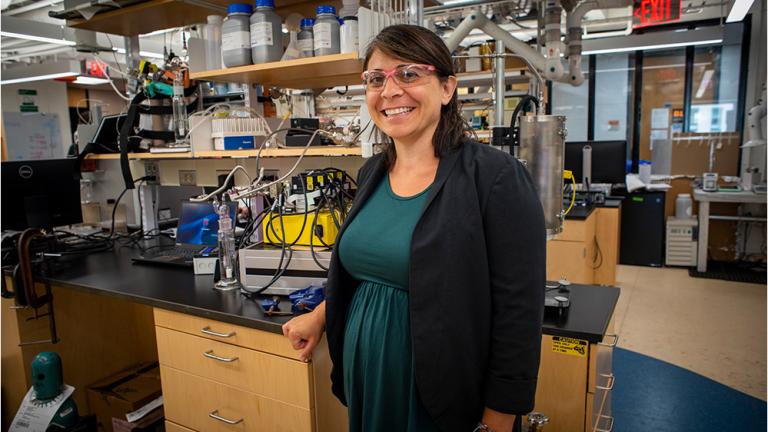
Desirée Plata, associate professor of civil and environmental engineering at MIT, has been named co-director of the MIT Climate and Sustainability Consortium (MCSC), effective Sept. 1. Plata will serve on the MCSC’s leadership team alongside Anantha P. Chandrakasan, dean of the MIT School of Engineering, the Vannevar Bush Professor of Electrical Engineering and Computer Science, and MCSC chair; Elsa Olivetti, the Esther and Harold E. Edgerton Associate Professor in Materials Science and Engineering, associate dean of engineering, and MCSC co-director; and Jeremy Gregory, MCSC executive director.
Plata succeeds Jeffrey Grossman, the Morton and Claire Goulder and Family Professor in Environmental Systems, who has served as co-director since the MCSC’s launch in January 2021. Grossman, who played a central role in the ideation and launch of the MCSC, will continue his work with the MCSC as strategic advisor.
“Professor Plata is a valued member of the MIT community. She brings a deep understanding of and commitment to climate and sustainability initiatives at MIT, as well as extensive experience working with industry, to her new role within the MCSC,” says Chandrakasan.
The MIT Climate and Sustainability Consortium is an academia-industry collaboration working to accelerate implementation of large-scale solutions across sectors of the global economy. It aims to lay the groundwork for one critical aspect of MIT’s continued and intensified commitment to climate: helping large companies usher in, adapt to, and prosper in a decarbonized world.
“We are thrilled to bring Professor Plata’s knowledge, vision, and passion to our leadership team,” says Olivetti. “Her experience developing sustainable technologies that have the potential to improve the environment and reduce the impacts of climate change will help move our work forward in meaningful ways. We have valued Professor Plata’s contributions to the consortium and look forward to continuing our work with her.”
Plata played a pivotal role in the creation and launch of the MCSC’s Climate and Sustainability Scholars Program and its yearlong course for MIT rising juniors and seniors — an effort that she and Olivetti were recently recognized for with the Class of 1960 Innovation in Education Fellowship. She has also been a member of the MCSC’s Faculty Steering Committee since the consortium’s launch, helping to shape and guide its vision and work.
Plata is a dedicated researcher, educator, and mentor. A member of MIT’s faculty since 2018, Plata and her team at the Plata Lab are helping to guide industry to more environmentally sustainable practices and develop new ways to protect the health of the planet — using chemistry to understand the impact that industrial materials and processes have on the environment. By coupling devices that simulate industrial systems with computation, she helps industry develop more environmentally friendly practices.
To celebrate her work in the lab, classroom, and community, Plata has received many awards and honors. In 2020, she won MIT’s prestigious Harold E. Edgerton Faculty Achievement Award, recognizing her innovative approach to environmentally sustainable industrial practices, her inspirational teaching and mentoring, and her service to MIT and the community. She is a two-time National Academy of Sciences Kavli Frontiers of Science Fellow, a two-time National Academy of Engineers Frontiers of Engineering Fellow, and a Caltech Young Investigator Sustainability Fellow. She has also won the ACS C. Ellen Gonter Environmental Chemistry Award, an NSF CAREER award, and the 2016 Odebrecht Award for Sustainable Development.
Beyond her work in the academic space, Plata is co-founder of two climate- and energy-related startups: Nth Cycle and Moxair, illustrating her commitment to translating academic innovations for real-world implementation — a core value of the MCSC.
Plata received her bachelor’s degree from Union College and her PhD from the MIT and Woods Hole Oceanographic Institution (MIT-WHOI) joint program in oceanography/applied ocean science and engineering. After receiving her doctorate, Plata held positions at Mount Holyoke College, Duke University, and Yale University.