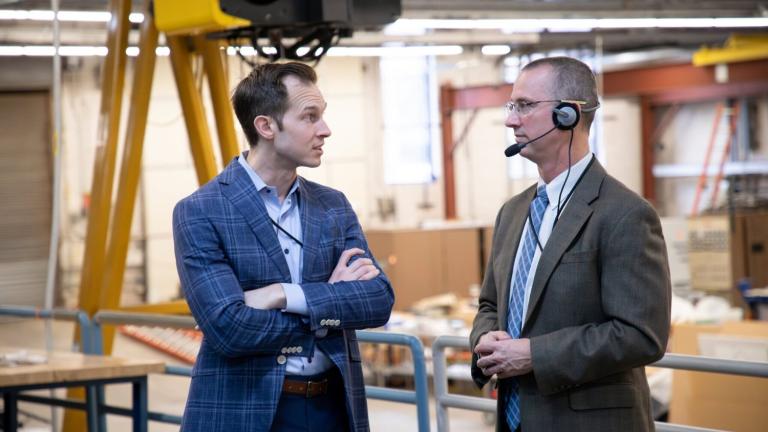
The MIT Plasma Science and Fusion Center (PSFC) showcased its high-temperature superconducting (HTS) magnet technology, essential for fusion energy and increasingly relevant to superhot geothermal applications, to Representative Jake Auchincloss (D-Mass) during his March 12 visit.
High-field electromagnets are required to confine plasma in fusion reactors, and PSFC’s HTS technology enables dramatically higher magnetic fields, allowing for more compact and cost-effective reactor designs. The same HTS technology can also be applied to gyrotrons, which are high-power microwave sources that operate more efficiently at higher frequencies, enabling new energy applications.
One such application is millimeter-wave drilling for superhot geothermal energy, where microwave energy is used to heat, melt, or vaporize rock. Because drilling rates scale with input power and costs increase less rapidly with depth than in conventional drilling, this approach could overcome key economic barriers to accessing deep geothermal resources and enable scalable, baseload clean energy.
During Auchincloss’ recent visit to PSFC, MIT researchers explained the technology development and testing underway to take millimeter-wave technology from laboratory to the real world.
“I visited MIT’s Plasma Science and Fusion Center to learn more about the science and engineering necessary to make this technology work at utility scale. Superhot geothermal uses microwaves to melt rock, going much deeper and hotter than is possible with contact drilling. This can generate clean, baseload power in America east of the Rocky Mountains, where the geology has conventionally not been suitable for industrial geothermal,” says Auchincloss.
“The technology is still years away from working in a state with ‘cool rock’ like Massachusetts, but the ultimate benefit for the Bay State could be tremendous. In addition to lower utility bills, a new industry with good jobs could thrive here. Indeed, this is already starting to happen, as spinouts from MIT — and the suppliers for these spinouts — are already setting up shop in Massachusetts,” he says.
Staff from MIT startup Quaise Energy participated in Auchincloss’ visit to PSFC. Quaise Energy, which has an office in Cambridge, completed a successful drilling demonstration using gyrotron-based millimeter-wave technology last fall in Texas. One of the first rounds of MIT Energy Initiative (MITEI) seed funding provided support for PSFC’s initial development of the technology in 2008.
Superhot rock geothermal energy refers to tapping temperatures of nearly 400 degrees Celsius to generate large amounts of electricity. Conventional drilling approaches can fail at the great depths (several kilometers) and high temperatures required to reach this geothermal resource. The millimeter-wave drilling technology invented at PSFC and being commercialized by Quaise Energy could be faster and more effective than conventional drilling, especially at high temperatures and great depths. PSFC is planning a new laboratory facility to further study millimeter-wave drilling and test improvements to the existing technology.
“This initiative will leverage MIT’s extensive capabilities in geophysics, geochemistry, millimeter-wave technology, and AI, along with existing infrastructure including power, water, and experimental facilities. The goal is to anchor next-generation geothermal innovation within an integrated academic-industry ecosystem, accelerating both technology maturation, de-risking deployment pathways, and developing the needed workforce,” says Steve Wukitch, the interim director and a principal research scientist at PSFC.
Oliver Jagoutz, the Cecil and Ida Green Professor of Geology and director of the Earth Resources Laboratory (ERL), also participated in the representative’s visit to PSFC. ERL is teaming with PSFC on the planned laboratory facility for testing millimeter-wave drilling under representative pressure and temperature conditions and on realistic rock samples.
Earlier in March, MITEI’s Spring Symposium, titled “Next-generation geothermal for firm power,” explored the current state of the geothermal industry, innovative technologies, and the opportunities ahead. During the symposium, Wukitch served as moderator of a panel on drilling advances and described the planned PSFC laboratory facility for millimeter-wave testing, and Quaise Energy’s Matt Houde described the company’s recent advances and future plans. On the following day, MITEI and the Clean Air Task Force co-hosted a gathering of MITEI member companies, next-generation geothermal companies, and investors for a GeoTech Summit, titled “Accelerating geothermal technology, projects, and deal flow.”