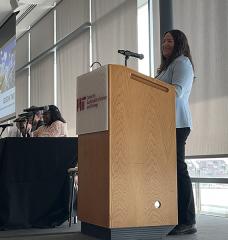
Over 200 students, alumni, faculty, staff, funders, and community collaborators gathered at the MIT Media Lab on April 15 for the 25th annual IDEAS Social Innovation Incubator Showcase and Awards, hosted by the Priscilla King Gray (PKG) Center for Social Impact.
Since its founding in 2001, the PKG Center’s IDEAS Incubator has launched hundreds of social ventures in over 60 countries, guiding MIT’s technical talent toward urgent social challenges — from energy and climate to health care, education, and economic development.
“Global and local challenges are increasingly complex and interconnected,” said Lauren Tyger, assistant dean for social innovation at the PKG Center and director of IDEAS. “IDEAS educates technical founders in systems thinking and community-based innovation, helping students develop business models that achieve both measurable social outcomes and financial sustainability.”
IDEAS alumni celebrated
The event celebrated the many successful social ventures launched by IDEAS alumni with a 25-Year Impact Report and a keynote speech from IDEAS alumnus Bill Thies ’01, ’02, MNG ’02, PhD ’09.
Thies traced his tuberculosis medication adherence work in India from a low-cost electronic pillbox through multiple iterations that helped shift India’s treatment policies toward patient autonomy. Ultimately, his work led to Nikshay, a national electronic medical records platform now supporting 150 million people, which recently transitioned to full government control.
“Innovations can open doors for much more important changes than the innovations themselves,” Thies said. Limitations to technical interventions surface important questions, such as “what policies do we want to change, to become more supportive and human-centered? And how can technology be a bridge to that new world we would envision?”
Thinking back on the influence of IDEAS on his own path, Theis reflected: “I always assumed that in IDEAS we were incubating projects. But what I’ve come to realize is that it’s actually the other way around: the projects are incubating us. We are the ones who will ultimately drive the change we hope to see in the world.”
Vision for scaling social entrepreneurship at MIT and catalytic gift announced
Thies’ message was echoed by Chancellor for Academic Advancement Eric Grimson, who explained how IDEAS aligns with MIT’s strategic initiatives, including MIT’s Generative AI Impact Consortium (MGAIC), Health and Life Sciences Collaborative (MIT HEALS), and the Climate Project, as well as President Sally Kornbluth’s and Provost Anantha Chandrakasan’s recent call to accelerate entrepreneurship. “Many of the current presidential initiatives naturally include an opportunity for social entrepreneurship,” said Grimson, who applauded IDEAS alumni pursuing ventures in climate, health, and AI-powered social enterprises.
The PKG Center’s director, Alison Badgett, shared the center’s vision for the future of IDEAS. “As MIT’s only student entrepreneurship program focused solely on social impact,” said Badgett, “we recognize the need to both scale social entrepreneurship programming at MIT and to better position our student founders for scale after graduating.”
Badgett announced a first-in gift of $150,000 from the Morgridge Family Foundation to help realize the center’s vision. The foundation’s gift will enable the PKG Center to develop a robust social impact investor ecosystem at MIT, connecting student- and alumni-led ventures with potential funders and helping more aspiring entrepreneurs see social impact as a viable path.
This year’s award-winning social ventures
This year’s top $20,000 award winner was Beyond Words, an assistive application for iPhone and Apple Watch that gives nonverbal individuals a layer of support by passively capturing biometrics, audio, and location, and communicating it to caregivers.
Other award winners were:
- AyuConnect ($10,000) uses WhatsApp-native, voice-first electronic health records to enhance care access while reducing clinician burnout in India.
- PEAR ($7,500) offers a hands-on STEM research program for Nigerian and other African students, equipping them with technical skills to solve community problems.
- CommonGround ($5,000) connects Bostonians to tailored and hyper-local climate actions through an online platform, replacing eco-anxiety with collective resilience.
- Sehat Screen ($5,000) is an AI-powered cervical cancer screening device for women in Afghanistan and other resource-constrained countries.
- Breakthrough Health ($2,500) is a care coordination platform that links hepatitis C patients in recovery centers to health care.
- Sero ($2,500) is a voice-first AI tool that helps rural borrowers in Nepal understand loan contracts and access fair credit in their own language, with no dependency on literacy.
During the event, Shane Kosinski, executive director of the Office of the Vice President for Energy and Climate, announced inaugural Climate Student Innovators awards, funded by the MIT Climate Project. Four IDEAS teams received this award, which will be presented annually.
“The MIT Climate Project is an all-of-MIT initiative with the ambitious goal to make a measurable difference on climate change within a decade. We reach this global impact not by top down mandates, but by testing good ideas where they are needed most and supporting them to succeed,” explained Kosinski. “This vision is also hardwired into the character, history and purpose of PKG IDEAS.”
This year’s IDEAS teams awarded by the MIT Climate Project were:
- Q’ochas Resilientes ($15,000) co-designs climate-resilient water technology in the Peruvian Andes to uplift ancestral knowledge and support agricultural livelihoods.
- NECTICA ($15,000) tackles urban flooding in Lagos by empowering women-led cooperatives with a low-tech sorter bin to separate and monetize composite waste.
- MittiNav ($15,000) designs production and supply-chain systems to scale biochar technology that restores soil and stores carbon.
- Resilient Grid ($5,000) collects and processes food waste through anaerobic digestion on skid platforms to produce biogas for electricity and heat in Caribbean island nations.
“The Climate Project is thrilled to present the first-ever Climate Student Innovators Awards to these teams,” said Vice President for Energy and Climate Evelyn Wang. “We applaud this year’s IDEAS winners for developing systemic interventions in partnership with affected communities.”
Several additional teams received $1,000 awards:
- 1for1Health is a fertility platform offering education, testing, and insights to expand access and reduce disparities in reproductive health decisions.
- Ceed CRM brings cutting-edge AI to mission-driven organizations that have been stuck with tools built for sales teams, not social impact.
- CerviSeal created a medical device that reduces pain, tissue trauma, and risk during cervical manipulation for women undergoing hysteroscopy.
- FoodLoop connects farms and restaurants through matchmaking, demand forecasting, and forward contracts to strengthen local food systems.
- Homeroom Hero is an AI tool for teachers that instantly grades short-form assessments, reducing workload and improving student learning without putting tech in front of kids.
- Gees Health is a noninvasive, at-home hormone monitor that helps women with polycystic ovary syndrome track and manage their health with continuous insights.
- Illume makes discreet wearables that are a safe way for recovering victims of human trafficking to contact trusted people, building their support network.
- Longevia is an AI-powered platform that translates complex medical data into personalized, actionable insights for chronic kidney disease patients.
- Opta is an AI talent refinery upskilling Brazil's low-socioeconomic status students for small and medium business jobs, driving economic mobility.
- Recover Hospitality scales recovery-informed wellness coaching for hospitality workers through AI-powered motivational interviewing and benefits navigation.
The event closed with Tyger thanking the vast network of alumni, mentors, funders, and campus partners who make IDEAS possible, and the 104 volunteers who supported this year’s incubator challenge. “IDEAS builds more than social enterprises — we’re building the infrastructure and community needed for alumni and their ventures to achieve long-lasting impact. Our vision is a future where MIT entrepreneurship is not only groundbreaking, but fundamentally grounded in social impact.”