Climate
Search

Main navigation

  • Climate 101
    • What We Know
    • What Can Be Done
    • Climate Primer
  • Explore
    • Explainers
    • Ask MIT Climate
    • Podcast
    • For Educators
  • MIT Action
    • News
    • Events
    • Resources
  • Search
MIT

Main navigation

  • Climate 101
    • What We Know
    • What Can Be Done
    • Climate Primer
  • Explore
    • Explainers
    • Ask MIT Climate
    • Podcast
    • For Educators
  • MIT Action
    • News
    • Events
    • Resources
  • Search
PostJune 8, 2021

Climate projections with Sergey Paltsev

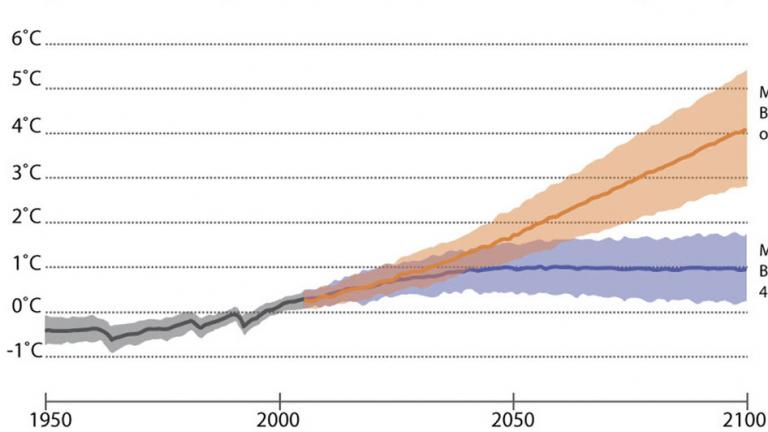
Global average temperature change projections (UCAR)
Photo Credit
UCAR

Re-posted from Climate Now:

Dr. Sergey Paltsev, Deputy Director of MIT’s Joint Program on the Science and Policy of Global Change, spoke with Climate Now hosts James Lawler and Katherine Gorman about climate projections and the tools he and his colleagues at MIT use to communicate projected outcomes to policymakers and the public.

Listen to Podcast.

FEATURING:

Sergey Paltsev
Deputy Director of the MIT Joint Program on the Science and Policy of Global Change

HOSTED BY:

James Lawler
Climate Now Host

Katherine Gorman
Climate Now Host

by MIT Center for Sustainability Science and Strategy
Topics
Climate Modeling

Related Posts

PostDecember 8, 2025

Where the Ocean and Atmosphere Communicate

MIT Spectrum
Global map showing kilometer-scale ocean turbulence that mix water masses and transport heat, energy, and nutrients.
PostAugust 26, 2025

Simpler models can outperform deep learning at climate prediction

MIT News
Simple climate prediction models can outperform deep-learning approaches when predicting future temperature changes, but deep learning has potential for estimating more complex variables like rainfall, according to an MIT study.
PostJune 5, 2025

How will U.S. land use change by 2050?

MIT Center for Sustainability Science and Strategy
How will U.S. land use change by 2050?
PostMay 22, 2025

Study: Climate change may make it harder to reduce smog in some regions

MIT News
A modeling study shows that global warming will likely make it harder to reduce ground-level ozone, a respiratory irritant that is a key component of smog, by cutting nitrogen oxide emissions.

MIT Climate News in Your Inbox


MIT Groups Log In

Log In

Footer

  • About
  • Terms & Conditions
  • Privacy Policy
  • Accessibility
  • Contact
MIT Climate Project
MIT
Communicator Award Winner