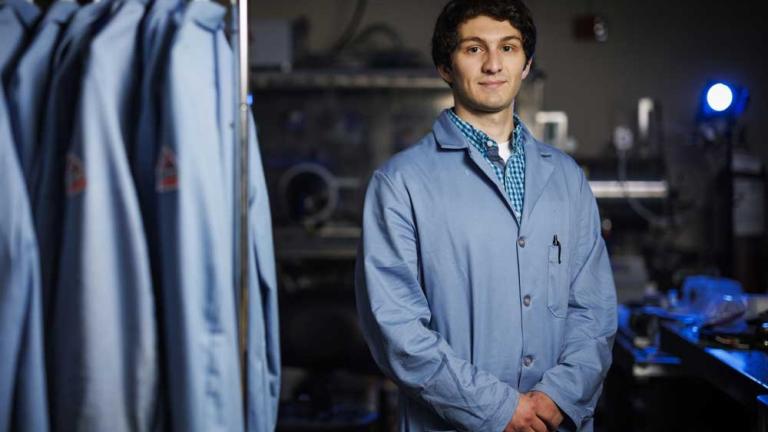
For Hugh Smith, the challenge of building an energy-secure future isn’t about creating the world’s “best” battery. It’s about designing the right battery for the right job.
As a fifth-year PhD candidate in MIT’s Department of Materials Science and Engineering, Smith studies sodium-ion batteries, an emerging alternative to the lithium-ion batteries that power everything from smartphones to electric vehicles. By replacing expensive critical minerals like lithium, nickel, and cobalt with more readily available elements like sodium, iron, and manganese, his research aims to make energy storage both more affordable and more sustainable.
“I’ve believed for a very long time that the biggest engineering problem humanity faces is the transition to clean energy,” Smith says. “Batteries are a critical bottleneck in that transition.”
Growing up in Albany, New York, Smith was drawn to materials science because it combined two of his favorite subjects: chemistry and math. What kept him interested, however, was the field’s ability to touch nearly every aspect of everyday life.
“Anytime you interact with a solid material, there are people who intentionally designed that material for a specific purpose,” he says.
That idea of designing materials with a real-world purpose eventually led him to batteries. After earning his undergraduate degree in materials science from Case Western Reserve University, Smith came to MIT to explore how new battery chemistries could reduce costs without sacrificing performance.
Consumers often want batteries that charge quickly, last for years, store large amounts of energy, and remain inexpensive. But in reality, improving one characteristic of this technology usually means compromising another. A smartphone battery, for example, prioritizes energy density and long lifespan, while a battery storing electricity for the power grid doesn’t need to be lightweight or compact. Instead, cost and reliability become the most important considerations.
Rather than chasing an all-encompassing solution, Smith focuses on finding the right balance for specific applications, often juggling competing priorities. Instead of strengthening a singular characteristic, Smith works to maximize as many components of the battery as possible, including cost, performance, sustainability, and reliability, depending on how it will be used.
“It’s trying to balance everything,” he says. “It’s not catering extremely to some properties and then abandoning others.”
The sodium-ion batteries Smith studies could eventually provide lower-cost options for electrical grids or more affordable electric vehicles. Because sodium-ion batteries can largely be manufactured using the same infrastructure already developed for lithium-ion batteries, they also offer a potentially smoother path toward commercialization than many emerging battery technologies.
Smith’s graduate school journey has been defined as much by the process of learning how to do research as by the science itself. He joined a brand-new research group at MIT as its first graduate student, and helped establish the lab run by Professor Iwnetim Abate. Without senior graduate students or postdocs to turn to for day-to-day guidance, he often had to teach himself new techniques and how to troubleshoot when things went wrong.
“I learned not to be fearful of new things,” Smith says. “Just because I didn’t know how to do something didn’t mean I couldn’t figure it out.”
He says the experience transformed him into a more independent researcher and someone who is willing to dive headfirst into unfamiliar problems.
Before beginning graduate school, Smith spent seven months at the Battery Innovation Center in Newberry, Indiana, an experience that broadened his understanding of how scientific discoveries become real technologies. Working alongside materials scientists, chemists, mechanical engineers, and chemical engineers showed him that no single discipline can solve the challenges of battery development alone.
“It requires a huge team effort,” Smith says. “It requires a lot of different types of knowledge.”
He says the experience also helped him better understand where his own expertise could make the greatest impact and when collaboration across disciplines is essential.
Outside the lab, Smith makes time to stay active through MIT’s intramural sports program, where he plays soccer, ultimate frisbee, football, and volleyball on teams with fellow graduate students. The games offer a chance to unwind after long days of research while strengthening the friendships he’s built throughout graduate school. He also enjoys fishing around the Boston area with friends and exploring New England’s coastal towns, museums, and historic sites.
As he prepares to graduate in the winter and pursue a career in battery research and development, Smith hopes to continue designing technologies that support the transition to clean energy.
“Lots of smart people have already made wind and solar very cheap,” Smith says. “The issue is reliability, and batteries can help solve that problem. I hope the work I’m doing helps to affordably unlock the transition to an electric grid powered by reliable clean energy, and an electrified transportation network.”