Climate
Search

Main navigation

  • Climate 101
    • What We Know
    • What Can Be Done
    • Climate Primer
  • Explore
    • Podcast
    • Explainers
    • Climate Questions
    • For Educators
  • MIT Action
    • News
    • Events
    • Resources
  • Search
MIT

Main navigation

  • Climate 101
    • What We Know
    • What Can Be Done
    • Climate Primer
  • Explore
    • Podcast
    • Explainers
    • Climate Questions
    • For Educators
  • MIT Action
    • News
    • Events
    • Resources
  • Search
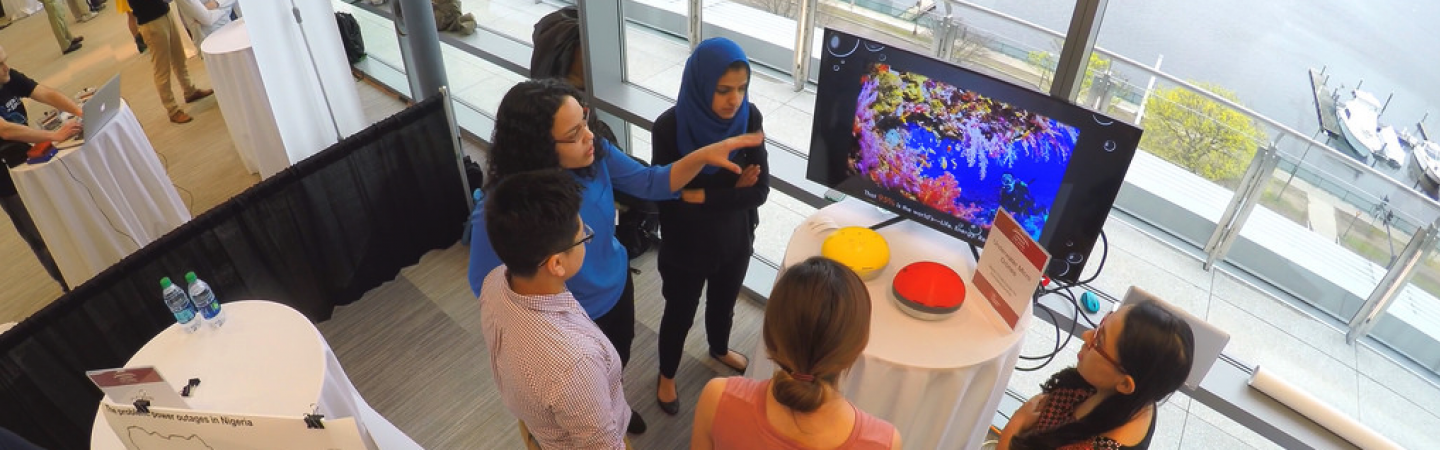
Students gather around a display of a coral reef at an MIT event

Climate News at MIT

The latest climate change research and action happening in and around MIT.
Filter
Topics
  • Adaptation
  • Arctic & Antarctic
  • Arts & Communication
  • Atmosphere
  • Biodiversity
  • Buildings
  • Carbon Capture
  • Carbon Removal
  • Cities & Planning
  • Climate Modeling
  • Education
  • Energy
    • Batteries, Storage & Transmission
    • Electrification
    • Energy Efficiency
    • Fossil Fuels
    • Nuclear & Fusion Energy
    • Renewable Energy
  • Finance & Economics
    • Carbon Pricing
  • Food, Water & Agriculture
  • Forests
  • Geoengineering
  • Government & Policy
    • Advocacy & Activism
    • International Agreements
    • National Security
  • Health & Medicine
  • Humanities & Social Science
    • Climate Justice
  • Industry & Manufacturing
  • MIT Action
  • Oceans
    • Sea Level Rise
  • Transportation
    • Air Travel
    • Alternative Fuels
    • Cars
    • Freight
    • Public Transportation
  • Waste
  • Weather & Natural Disasters
    • Drought
    • Flooding
    • Heatwaves
    • Hurricanes
    • Wildfires
Content type
  • Educator Guide
  • Podcast
  • Post
  • Video
OceansAlternative FuelsClear All
PostJanuary 13, 2026

Understanding ammonia energy’s tradeoffs around the world

MIT News
“Before this, there was no harmonized datasets quantifying the impacts of this transition,” says lead author Woojae Shin. “It’s filling a major knowledge gap.”
PostDecember 8, 2025

Where the Ocean and Atmosphere Communicate

MIT Spectrum
Global map showing kilometer-scale ocean turbulence that mix water masses and transport heat, energy, and nutrients.
PostNovember 25, 2025

Unlocking ammonia as a fuel source for heavy industry

MIT News
Because of the power density advantages of ammonia over renewables and batteries, Amogy is targeting power-hungry industries like maritime shipping, power generation, construction, and mining.
PostNovember 12, 2025

MIT senior turns waste from the fishing industry into biodegradable plastic...

MIT News
A person holds a translucent rectangle of material with scale-like shapes on it.
PostNovember 11, 2025

12.307 Weather and Climate Laboratory

MIT OCW
Diagram of a cylinder on a table connected through a hose, labeled "drain," to another cylinder below the table
PostOctober 29, 2025

Burning things to make things

MIT Department of Mechanical Engineering
Associate Professor Sili Deng
PostOctober 20, 2025

MIT Maritime Consortium releases “Nuclear Ship Safety Handbook”

MIT Department of Mechanical Engineering
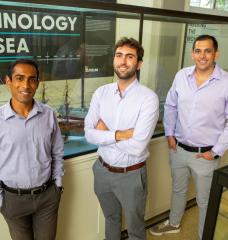
"The Nuclear Ship Safety Handbook" co-authors (left to right) Anthony Valiaveedu, Nat Edmonds, and Jose Izurieta pose in MIT's Hart Naval Gallery.
PostOctober 8, 2025

How to reduce greenhouse gas emissions from ammonia production

MIT Energy Initiative
MIT researchers have proposed an approach for combined blue-green ammonia production that minimizes waste products and, when combined with some other simple upgrades, could reduce the greenhouse emissions from ammonia production by as much as 63 percent, compared to the leading “low-emissions” approach being used today.
PostOctober 1, 2025

Palladium filters could enable cheaper, more efficient generation of hydrog...

MIT News
Palladium plug membrane at the end of the membrane fabrication process (left). Dashed green lines outline the membrane. Scanning electron microscopy image of the membrane shows the palladium plugs embedded inside the pores of the silica support (right).
PostSeptember 17, 2025

Q&A: David Whelihan on the challenges of operating in the Arctic

MIT Lincoln Laboratory
David Whelihan has traveled to the Arctic over the past few years to test prototype low-cost sensor nodes designed to monitor loss in Arctic sea ice extent and thickness.

Pagination

  • Current page1
  • Page2
  • Page3
  • Page4
  • Page5
  • Next page ›
1 - 10 of 224

MIT Climate News in Your Inbox


MIT Groups Log In

Log In

Footer

  • About
  • Terms & Conditions
  • Privacy Policy
  • Accessibility
  • Contact
MIT Climate Project
MIT
Communicator Award Winner