Climate
Search

Main navigation

  • Climate 101
    • What We Know
    • What Can Be Done
    • Climate Primer
  • Explore
    • Podcast
    • Explainers
    • Climate Questions
    • For Educators
  • MIT Action
    • News
    • Events
    • Resources
  • Search
MIT

Main navigation

  • Climate 101
    • What We Know
    • What Can Be Done
    • Climate Primer
  • Explore
    • Podcast
    • Explainers
    • Climate Questions
    • For Educators
  • MIT Action
    • News
    • Events
    • Resources
  • Search
PostAugust 22, 2023

Why salt marshes could help save Venice

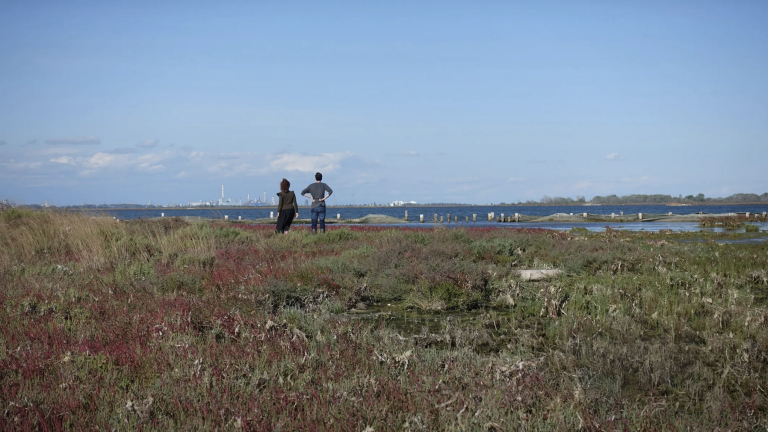
surveying Venice's central lagoon
Photo Credit
Courtesy Photo

Venice, Italy, is suffering from a combination of subsidence—the city's foundations slowly sinking into the mud on which they are built—and rising sea levels. In the worst-case scenario, it could disappear underwater by the year 2100.

Alessandro Gasparotto, an environmental engineer, is one of the many people trying to keep that from happening. Standing on a large mudflat in the center of the Venetian lagoon, he pushes a hollow three-foot-high metal cylinder called a piezometer into the thick black mud. This instrument will measure how groundwater moves through the sediment as the lagoon's tides rise and fall. Knowing what's happening under the mud is crucial for understanding whether, and how, vegetation can grow and eventually transform this barren landscape of mud into a salt marsh.

Read the full story at MIT Technology Review.

by MIT Technology Review
Topics
Adaptation
Cities & Planning
Sea Level Rise

Related Posts

PostMarch 2, 2026

Coping with catastrophe

MIT News
Miho Mazereeuw is the author of the new book, “Design Before Disaster: Japan’s Culture of Preparedness,” published by the University of Virginia Press.
PostFebruary 24, 2026

Beyond the Early Era of EVs: Evidence from the Staggered Rollout of the HOV...

MIT Center for Energy and Environmental Policy Research
traffic on a highway with an express HOV lane
PostFebruary 24, 2026

More trees where they matter, please

MIT News
Research reveals a strong disparity in the amount of heat-mitigating tree cover within nine cities across the globe, with wealthy neighborhoods benefitting from shade the most. Amsterdam, pictured here, has a distinct pattern of less shade in lower-income areas.
PostFebruary 19, 2026

Parking-aware navigation system could prevent frustration and emissions

MIT News
MIT researchers have developed a parking-aware navigation system that helps drivers identify lots offering the optimal balance between proximity to their destination and the likelihood of available spaces.

MIT Climate Knowledge in Your Inbox


MIT Groups Log In

Log In

Footer

  • About
  • Terms & Conditions
  • Privacy Policy
  • Accessibility
  • Contact
MIT Climate Project
MIT
  • Instagram
  • TikTok
  • YouTube
  • Simplecast
Communicator Award Winner