Climate
Search

Main navigation

  • Climate 101
    • What We Know
    • What Can Be Done
    • Climate Primer
  • Explore
    • Podcast
    • Explainers
    • Climate Questions
    • For Educators
  • MIT Action
    • News
    • Events
    • Resources
  • Search
MIT

Main navigation

  • Climate 101
    • What We Know
    • What Can Be Done
    • Climate Primer
  • Explore
    • Podcast
    • Explainers
    • Climate Questions
    • For Educators
  • MIT Action
    • News
    • Events
    • Resources
  • Search
PostApril 1, 2020

Virtual seminars: job-creating, high-efficiency, low-carbon infrastructure

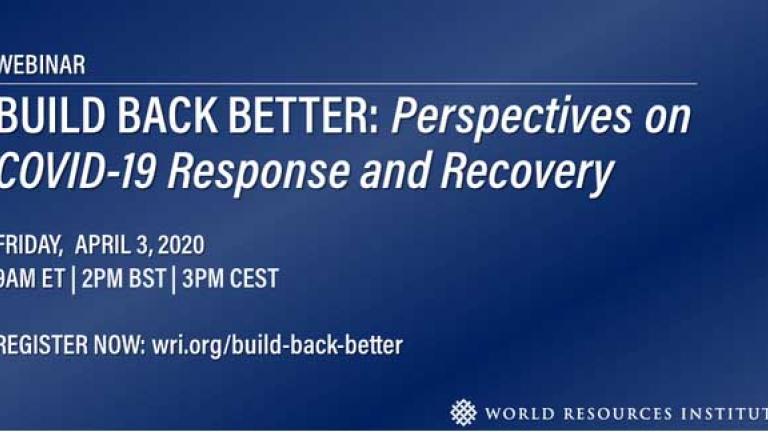
Build Back Better: COVID-19 Response and Recovery

REGISTER to join the World Resources Institute on Friday, April 3 at 9:00am ET for the first in a series a virtual seminars about how policymakers and leaders can design coronavirus stimulus packages to create jobs and foster inclusive, sustainable economic growth. 

WRI economists and policy experts will share lessons from previous economic stimulus packages, highlighting opportunities for “shovel-ready,” job-creating, high-efficiency, low-carbon infrastructure in China, United States, Africa and elsewhere. Speakers will also explain the negative consequences of propping up failing fossil fuel projects that utilize outdated economic models and past-century technologies, creating air pollution that kills millions of people annually. Finally, our panelists will discuss how it is essential that governments not only jump-start their economies but also protect citizens from major threats of all kinds, including extreme weather events, rising sea levels, and increased water risk driven by climate change.

 

by MACA - MIT Alumni for Climate Action
Topics
Humanities & Social Science
Energy
Food, Water & Agriculture
Government & Policy
Transportation

Related Posts

PostJuly 1, 2026

Advancing a scenario-based modeling framework for long-term land-use planni...

MIT Center for Sustainability Science and Strategy
Mississippi River watershed
PostJune 30, 2026

How Uncertainty Shapes Electricity Storage Decisions

MIT Center for Energy and Environmental Policy Research
PostJune 30, 2026

MIT researchers advance toward greater bandwidth, more energy-efficient com...

MIT News
FUTUR-IC, funded by the National Science Foundation Convergence Accelerator, was created to address resource-efficiency issues. For example, integrating photonics with the electronics that underpin today’s microchips could address energy use because the transmission, or communication of data, using light is much more energy efficient.
PostJune 26, 2026

How data centers can better manage energy use

MIT News
“There are two dimensions that data centers have to make decisions about,” Christopher Knittel says. “One is how much of their load in any one time period is flexible. And two, how many hours, plus or minus, can they move that computation?”

MIT Climate Knowledge in Your Inbox


MIT Groups Log In

Log In

Footer

  • About
  • Terms & Conditions
  • Privacy Policy
  • Accessibility
  • Contact
MIT Climate Project
MIT
  • Instagram
  • TikTok
  • YouTube
  • Simplecast
Communicator Award Winner