The following is a joint announcement from MIT and Community Jameel.
An international project to build community resilience to the effects of climate change, launched by Community Jameel and a research team at MIT, has been recognized as an innovation sprint at the 2023 summit of the United States’ and United Arab Emirates’ Agriculture Innovation Mission for Climate (AIM4C).
The Jameel Observatory Climate Resilience Early Warning System Network (Jameel Observatory-CREWSnet), one of MIT’s five Climate Grand Challenges flagship projects, aims to empower communities worldwide, specifically within the agriculture sector, to adapt to climate shocks by launching cross-sector collaborations and by combining state-of-the-art climate and socioeconomic forecasting techniques with technological solutions to support communities’ resilience.
AIM4C is a joint initiative of the U.S. and U.A.E. that seeks to enhance climate action by accelerating agriculture and food systems innovation and investment. Innovation sprints are selected by AIM4C to accelerate their impact following a competitive process that considers scientific excellence and financial support.
“As we launch Jameel Observatory-CREWSnet, the AIM4C summit offers a great opportunity to share our plans and initial work with all those who are interested in enhancing the capacity of agricultural communities in vulnerable countries to deal with challenges of climate change,” says Elfatih Eltahir, HM King Bhumibol Professor of Hydrology and Climate at MIT and project leader of the Jameel Observatory-CREWSnet.
Jameel Observatory-CREWSnet seeks to bridge the gap between the knowledge about climate change created at research institutions such as MIT and the local farming communities that are adapting to the impacts of climate change. By effectively informing and engaging local communities, the project seeks to enable farmers to sustainably increase their agricultural productivity and income.
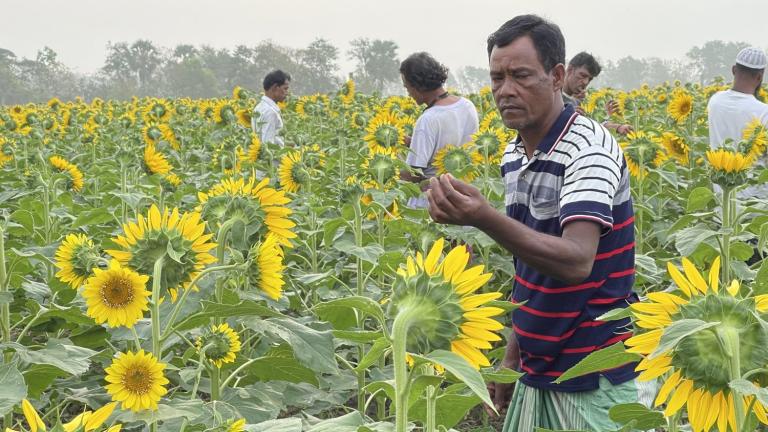
The Jameel Observatory-CREWSnet will initially pilot in Bangladesh and Sudan, working with local partners BRAC, a leading international nonprofit headquartered in Bangladesh, and the Agricultural Research Corporation-Sudan, the principal agricultural research arm of the Sudanese government, and with MIT’s Abdul Latif Jameel Poverty Action Lab (J-PAL), the global research center working to reduce poverty by ensuring that policy is informed by scientific evidence. Beginning in southwestern Bangladesh, the Jameel Observatory-CREWSnet will integrate next-generation climate forecasting, predictive analytics, new technologies, and financial instruments. In East Africa, with a focus on Sudan, the initiative will emphasize adopting modern technology to use a better variety of heat-resistant seeds, increasing the use of targeted fertilizers, strengthening soils through soil fertility mapping combined with data modeling, and emphasizing vertical expansion of agriculture over traditional horizontal expansion. The work in Sudan is extensible to other regions in Africa. Jameel Observatory-CREWSnet's activities and timeline will be reevaluated as the team monitors the ongoing situation in Sudan.
Using local climate insights, communities will be empowered to adapt proactively to climate change by optimally planning their agricultural activities, targeting emergent economic opportunities, and proactively managing risks from climate change.
George Richards, director of Community Jameel, says: “Community Jameel is proud to be collaborating with MIT, BRAC, and the Agricultural Research Corporation-Sudan to empower agricultural communities to adapt to the ever-growing challenges arising from climate change — challenges which, as we are seeing acutely in Sudan, are compounded by other crises. We welcome the support of the U.S. and U.A.E. governments in selecting the Jameel Observatory-CREWSnet as an AIM4C innovation sprint.”
Md Liakath Ali, director of climate change, urban development, and disaster risk management at BRAC, says: “Over our five decades working alongside climate-vulnerable communities in Bangladesh, BRAC has seen firsthand how locally led climate adaptation helps protect lives and livelihoods. BRAC is proud to work with Community Jameel and MIT to empower vulnerable communities to proactively adapt to the impacts of climate change.”
The Jameel Observatory-CREWSnet was launched at COP27 in Sharm El Sheikh as part of the Jameel Observatory, an international collaboration launched in 2021 that focuses on convening researchers and practitioners who use data and technology to help communities adapt to the impacts of climate change and short-term climate shocks.
The Jameel Observatory focuses on using data and evidence to prepare for and act on environmental shocks as well as those impacts of climate change and variability which threaten human and environmental well-being. With a special focus on low- and middle-income countries, the Jameel Observatory works at the interface of climate, natural disasters, agricultural and food systems, and health. It emphasizes the need to incorporate local as well as scientific knowledge to prepare and act in anticipation of environmental shocks.
Launched in 2020, MIT’s Climate Grand Challenges initiative is designed to mobilize the Institute’s research community around tackling the most difficult unsolved climate problems in emissions reduction, climate adaptation and resilience, risk forecasting, carbon removal, and understanding the human impacts of climate change. MIT selected 27 teams as finalists from a field of nearly 100 initial proposals. In 2022, five teams with the most promising concepts were announced as multi-year flagship projects.