The MIT Global Seed Funds (GSF) program fosters global research collaborations with MIT faculty and their peers abroad — creating partnerships that tackle complex global issues, from climate change to health-care challenges and beyond. Administered by the MIT Center for International Studies (CIS), the GSF program has awarded more than $26 million to over 1,200 faculty research projects since its inception in 2008. Through its unique funding structure — comprising a general fund for unrestricted geographical use and several specific funds within individual countries, regions, and universities — GSF supports a wide range of projects. The current call for proposals from MIT faculty and researchers with principal investigator status is open until Dec. 10.
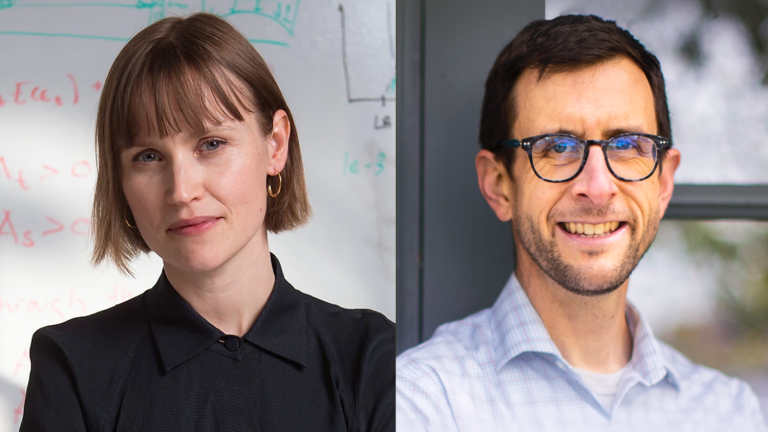
CIS recently sat down with faculty recipients Josephine Carstensen and David McGee to discuss the value and impact GSF added to their research. Carstensen, the Gilbert W. Winslow Career Development Associate Professor of Civil and Environmental Engineering, generates computational designs for large-scale structures with the intent of designing novel low-carbon solutions. McGee, the William R. Kenan, Jr. Professor in the Department of Earth, Atmospheric and Planetary Sciences (EAPS), reconstructs the patterns, pace, and magnitudes of past hydro-climate changes.
Q: How did the Global Seed Funds program connect you with global partnerships related to your research?
Carstensen: One of the projects my lab is working on is to unlock the potential of complex cast-glass structures. Through our GSF partnership with researchers at TUDelft (Netherlands), my group was able to leverage our expertise in generative design algorithms alongside the TUDelft team, who are experts in the physical casting and fabrication of glass structures. Our initial connection to TUDelft was actually through one of my graduate students who was at a conference and met TUDelft researchers. He was inspired by their work and felt there could be synergy between our labs. The question then became: How do we connect with TUDelft? And that was what led us to the Global Seed Funds program.
McGee: Our research is based in fieldwork conducted in partnership with experts who have a rich understanding of local environments. These locations range from lake basins in Chile and Argentina to caves in northern Mexico, Vietnam, and Madagascar. GSF has been invaluable for helping foster partnerships with collaborators and universities in these different locations, enabling the pilot work and relationship-building necessary to establish longer-term, externally funded projects.
Q: Tell us more about your GSF-funded work.
Carstensen: In my research group at MIT, we live mainly in a computational regime, and we do very little proof-of-concept testing. To that point, we do not even have the facilities nor experience to physically build large-scale structures, or even specialized structures. GSF has enabled us to connect with the researchers at TUDelft who do much more experimental testing than we do. Being able to work with the experts at TUDelft within their physical realm provided valuable insights into their way of approaching problems. And, likewise, the researchers at TUDelft benefited from our expertise. It has been fruitful in ways we couldn’t have imagined within our lab at MIT.
McGee: The collaborative work supported by the GSF has focused on reconstructing how past climate changes impacted rainfall patterns around the world, using natural archives like lake sediments and cave formations. One particularly successful project has been our work in caves in northeastern Mexico, which has been conducted in partnership with researchers from the National Autonomous University of Mexico (UNAM) and a local caving group. This project has involved several MIT undergraduate and graduate students, sponsored a research symposium in Mexico City, and helped us obtain funding from the National Science Foundation for a longer-term project.
Q: You both mentioned the involvement of your graduate students. How exactly has the GSF augmented the research experience of your students?
Carstensen: The collaboration has especially benefited the graduate students from both the MIT and TUDelft teams. The opportunity presented through this project to engage in research at an international peer institution has been extremely beneficial for their academic growth and maturity. It has facilitated training in new and complementary technical areas that they would not have had otherwise and allowed them to engage with leading world experts. An example of this aspect of the project's success is that the collaboration has inspired one of my graduate students to actively pursue postdoc opportunities in Europe (including at TU Delft) after his graduation.
McGee: MIT students have traveled to caves in northeastern Mexico and to lake basins in northern Chile to conduct fieldwork and build connections with local collaborators. Samples enabled by GSF-supported projects became the focus of two graduate students’ PhD theses, two EAPS undergraduate senior theses, and multiple UROP [Undergraduate Research Opportunity Program] projects.
Q: Were there any unexpected benefits to the work funded by GSF?
Carstensen: The success of this project would not have been possible without this specific international collaboration. Both the Delft and MIT teams bring highly different essential expertise that has been necessary for the successful project outcome. It allowed both the Delft and MIT teams to gain an in-depth understanding of the expertise areas and resources of the other collaborators. Both teams have been deeply inspired. This partnership has fueled conversations about potential future projects and provided multiple outcomes, including a plan to publish two journal papers on the project outcome. The first invited publication is being finalized now.
McGee: GSF’s focus on reciprocal exchange has enabled external collaborators to spend time at MIT, sharing their work and exchanging ideas. Other funding is often focused on sending MIT researchers and students out, but GSF has helped us bring collaborators here, making the relationship more equal. A GSF-supported visit by Argentinian researchers last year made it possible for them to interact not just with my group, but with students and faculty across EAPS.