Lauren Hinkel | EAPS News
Thursday, September 24, 2020
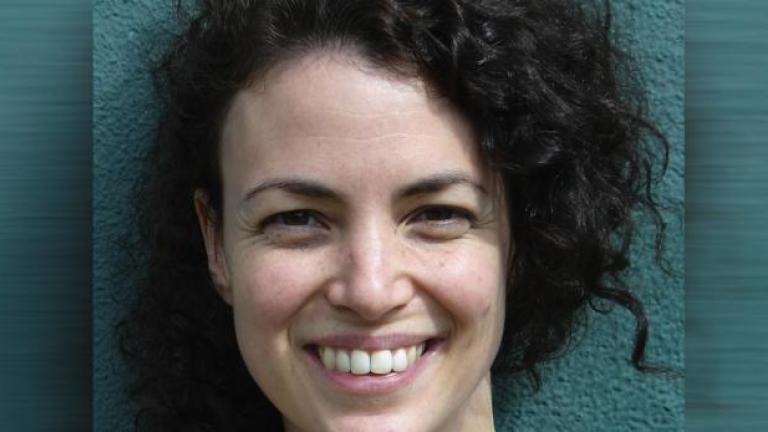
EAPS is pleased to announce that Talia Tamarin-Brodsky will join the department as an Assistant Professor in climate science, effective January 2022.
Talia Tamarin-Brodsky works at the intersection of weather and climate. This is an area that EAPS sees as offering tremendous opportunity for scientific advances. Her research interests include atmospheric temperature variability and how it responds to climate change, atmospheric dynamics and variability, regional climate and extremes, subseasonal-to-seasonal predictability, and stratosphere-troposphere interactions. Tamarin-Brodsky uses computational methods to study the spatial distribution of temperature near the Earth’s surface and how temperature anomalies evolve and migrate. Weather conditions near the surface can be affected by Sudden Stratospheric Warming events, which are disruptions in the stratospheric polar vortex, such as a splitting, associated with a warm Arctic. Tamarin-Brodsky examines links between troposphere conditions and interactions with the stratosphere around those events using the latest forecasting data. She is also looking at storm tracks with a Lagrangian approach to track their poleward movement and shifts under climate change.
“Climate dynamicists have tended to focus on the mean climate state and its changes, but recent work, including that of Tamarin-Brodsky, has demonstrated that it is more dynamically insightful and societally relevant to consider climate change as a change in weather conditions,” says EAPS Cecil & Ida Green Professor of Oceanography Raffaele Ferrari and chair of the search committee. “Talia Tamarin-Brodsky has already made innovative and impactful advances on two major problems in atmospheric dynamics and climate that have baffled far more senior colleagues: the poleward shift of the extratropical storm tracks with climate warming and the prediction that mid-latitude warming will be the result of weaker cold outbreaks rather than stronger warm spells.”
Tamarin-Brodsky received her bachelor’s degree in Mathematics and Geophysics as well as her master’s in Physics from Tel-Aviv University, Israel. She earned her PhD from the Weizmann Institute. She completed a postdoctoral project at the University of Reading, U.K., but the pandemic forced her to stay in Israel where she is working at Tel Aviv University. We very much look forward to Talia joining our faculty.