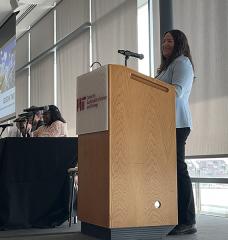
Patagonia, the outdoor apparel and gear company, organizes an annual case competition as a platform for graduate students across the country to solve pressing challenges in environmental sustainability. This year, teams were asked to propose environmentally-benign alternatives to single-use plastic packaging for apparel and food products that can be implemented at scale by 2025. The pervasive use of single-use plastics, which constitute a significant portion of the 330 million metric tons of plastics produced annually, has become of increasing concern as the material has been found to pollute marine environments and to take centuries to degrade.
A group of six MIT PhD and MBA students collaborated to develop and hone novel innovations fulfilling the Patagonia Case Competition prompt. Team NourishMIT collectively represented five different programs across the Institute: Audrey Bazerghi, an MBA candidate and master's student in civil and environmental engineering; Cristina Bleicher, an MBA candidate; Ty Christoff-Tempesta, a PhD candidate in materials science and engineering; Cherry Gao, a PhD candidate in biological engineering; Ellena Kim, an MBA candidate; and Jordan Landis, an MBA candidate and master's student in mechanical engineering. The team started working in October 2018 to ultimately devise the winning proposal that focused on cost-effective and timely biodegradation of apparel polybags and everyday food packaging.
One hundred twenty-four teams from across the world entered the competition with written proposals, and the top 10 finalists were invited to pitch their solutions to a panel of judges at the Haas School of Business at the University of California at Berkeley in April. Teams competed for cash prizes totaling $22,500, and the top two teams were also invited to travel to Patagonia’s headquarters in Ventura, California, to advance implementation of the proposed solutions and to surf with Patagonia’s employees. The 2019 competition marks the first time that an MIT team has won first place in the Patagonia Case Competition since its inception in 2016.
Team NourishMIT received financial support from the Parsons Laboratory for Environmental Science and Engineering, as well as from the MIT Sloan Sustainability Initiative.