This spring, J-PAL North America — a regional office of MIT’s Abdul Latif Jameel Poverty Action Lab (J-PAL) — launched its first ever Learning Lab, centered on climate action. The Learning Lab convened a cohort of government leaders who are enacting a broad range of policies and programs to support the transition to a low-carbon economy. Through the Learning Lab, participants explored how to embed randomized evaluation into promising solutions to determine how to maximize changes in behavior — a strategy that can help advance decarbonization in the most cost-effective ways to benefit all communities. The inaugural cohort included more than 25 participants from state agencies and cities, including the Massachusetts Clean Energy Center, the Minnesota Housing Finance Agency, and the cities of Lincoln, Nebraska; Newport News, Virginia; Orlando, Florida; and Philadelphia.
“State and local governments have demonstrated tremendous leadership in designing and implementing decarbonization policies and climate action plans over the past few years,” said Peter Christensen, scientific advisor of the J-PAL North America Environment, Energy, and Climate Change Sector. “And while these are informed by scientific projections on which programs and technologies may effectively and equitably reduce emissions, the projection methods involve a lot of assumptions. It can be challenging for governments to determine whether their programs are actually achieving the expected level of emissions reductions that we desperately need. The Climate Action Learning Lab was designed to support state and local governments in addressing this need — helping them to rigorously evaluate their programs to detect their true impact.”
From May to July, the Learning Lab offered a suite of resources for participants to leverage rigorous evaluation to identify effective and equitable climate mitigation solutions. Offerings included training lectures, one-on-one strategy sessions, peer learning engagements, and researcher collaboration. State and local leaders built skills and knowledge in evidence generation and use, reviewed and applied research insights to their own programmatic areas, and identified priority research questions to guide evidence-building and decision-making practices. Programs prioritized for evaluation covered topics such as compliance with building energy benchmarking policies, take-up rates of energy-efficient home improvement programs such as heat pumps and Solar for All, and scoring criteria for affordable housing development programs.
“We appreciated the chance to learn about randomized evaluation methodology, and how this impact assessment tool could be utilized in our ongoing climate action planning. With so many potential initiatives to pursue, this approach will help us prioritize our time and resources on the most effective solutions,” said Anna Shugoll, program manager at the City of Philadelphia’s Office of Sustainability.
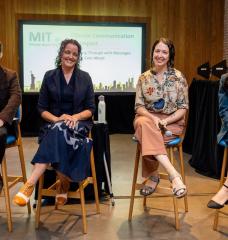
This phase of the Learning Lab was possible thanks to grant funding from J-PAL North America’s longtime supporter and collaborator Arnold Ventures. The work culminated in an in-person summit in Cambridge, Massachusetts, on July 23, where Learning Lab participants delivered a presentation on their jurisdiction’s priority research questions and strategic evaluation plans. They also connected with researchers in the J-PAL network to further explore impact evaluation opportunities for promising decarbonization programs.
“The Climate Action Learning Lab has helped us identify research questions for some of the City of Orlando’s deep decarbonization goals. J-PAL staff, along with researchers in the J-PAL network, worked hard to bridge the gap between behavior change theory and the applied, tangible benefits that we achieve through rigorous evaluation of our programs,” said Brittany Sellers, assistant director for sustainability, resilience and future-ready for Orlando. “Whether we’re discussing an energy-efficiency policy for some of the biggest buildings in the City of Orlando or expanding [electric vehicle] adoption across the city, it’s been very easy to communicate some of these high-level research concepts and what they can help us do to actually pursue our decarbonization goals.”
The next phase of the Climate Action Learning Lab will center on building partnerships between jurisdictions and researchers in the J-PAL network to explore the launch of randomized evaluations, deepening the community of practice among current cohort members, and cultivating a broad culture of evidence building and use in the climate space.
“The Climate Action Learning Lab provided a critical space for our city to collaborate with other cities and states seeking to implement similar decarbonization programs, as well as with researchers in the J-PAL network to help rigorously evaluate these programs,” said Daniel Collins, innovation team director at the City of Newport News. “We look forward to further collaboration and opportunities to learn from evaluations of our mitigation efforts so we, as a city, can better allocate resources to the most effective solutions.”
The Climate Action Learning Lab is one of several offerings under the J-PAL North America Evidence for Climate Action Project. The project’s goal is to convene an influential network of researchers, policymakers, and practitioners to generate rigorous evidence to identify and advance equitable, high-impact policy solutions to climate change in the United States. In addition to the Learning Lab, J-PAL North America will launch a climate special topic request for proposals this fall to fund research on climate mitigation and adaptation initiatives. J-PAL will welcome applications from both research partnerships formed through the Learning Lab as well as other eligible applicants.
Local government leaders, researchers, potential partners, or funders committed to advancing climate solutions that work, and who want to learn more about the Evidence for Climate Action Project, may email na_eecc@povertyactionlab.org or subscribe to the J-PAL North America Climate Action newsletter.