

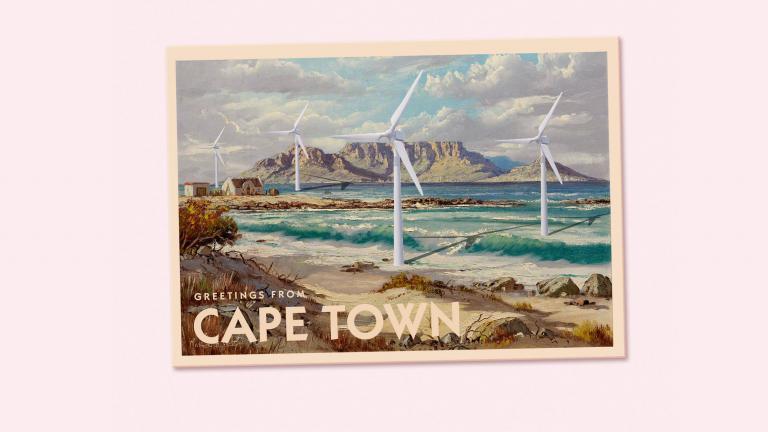
As renewable energy gets cheaper, South African cities such as Cape Town have demanded the right to find their own sources.
The primary culprit in South Africa’s power woes is the aging national electricity provider, Eskom. After years of mismanagement of state funds earmarked for critical infrastructure repairs, Eskom’s plants are regularly unable to operate at full capacity. The result is rolling blackouts that last from two to six hours per day. The power cuts have proved disastrous for the economy, with costs estimated at between $4 billion and $8 billion in 2019.
That year, desperate to find a solution, Cape Town announced plans to purchase its own power from independent renewable-power producers. The falling cost and exponential growth of renewable-energy technology have made this possible. Amazon recently announced it will build its own solar farm to power its data centers in South Africa, thereby insulating itself from outages on the national grid. If companies can do it, why can’t cities?
Read the full article at: https://www.technologyreview.com/2021/04/28/1022945/cape-town-renewable-energy-independence-south-africa/
Image by: Nico Ortega

![The “New World of Weather” project, one of MIT’s five Climate Grand Challenges announced in 2022, is “advancing the science, technologies, and practical strategies needed to help communities anticipate [extreme weather] and build greater resilience,” says MIT Vice President for Energy and Climate Evelyn Wang.](/sites/default/files/styles/teaser_mini_image/public/post-images/mit-climate-cyclone.jpg?itok=KwBU2suI)