Climate
Search

Main navigation

  • Climate 101
    • What We Know
    • What Can Be Done
    • Climate Primer
  • Explore
    • Podcast
    • Explainers
    • Climate Questions
    • For Educators
  • MIT Action
    • News
    • Events
    • Resources
  • Search
MIT

Main navigation

  • Climate 101
    • What We Know
    • What Can Be Done
    • Climate Primer
  • Explore
    • Podcast
    • Explainers
    • Climate Questions
    • For Educators
  • MIT Action
    • News
    • Events
    • Resources
  • Search
PostSeptember 7, 2023

2023 U.S. C3E Women in Clean Energy Symposium and Awards

2023 U.S. C3E Women in Clean Energy Symposium and Awards
Clearing hurdles to achieve net zero by 2050: Moving forward, eliminating risks, and leaving no one behind
September 27, 3:00-6:15 pm ET
September 28, 9:00 am-5:00 pm ET
Register for the livestream.


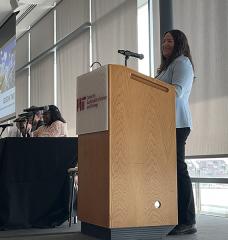
The twelfth annual C3E Women in Clean Energy Symposium and Awards will consist of plenary sessions, award presentations, and panel discussions. To achieve a rapid transition to an affordable and sustainable net-zero world, we must strategically increase momentum and address challenges. We will discuss how to preserve and strengthen policies to enable clean energy, address energy system inequities, speed up the technology journey from lab to market, and overcome present and future supply chain vulnerabilities to achieve net zero by 2050.

by MIT Energy Initiative
Topics
Education
Energy

Related Posts

PodcastJuly 2, 2026

E9: Dry spells and downpours

Ask MIT Climate Podcast
Ask MIT Climate
PostJune 30, 2026

How Uncertainty Shapes Electricity Storage Decisions

MIT Center for Energy and Environmental Policy Research
PostJune 30, 2026

MIT researchers advance toward greater bandwidth, more energy-efficient com...

MIT News
FUTUR-IC, funded by the National Science Foundation Convergence Accelerator, was created to address resource-efficiency issues. For example, integrating photonics with the electronics that underpin today’s microchips could address energy use because the transmission, or communication of data, using light is much more energy efficient.
PostJune 26, 2026

How data centers can better manage energy use

MIT News
“There are two dimensions that data centers have to make decisions about,” Christopher Knittel says. “One is how much of their load in any one time period is flexible. And two, how many hours, plus or minus, can they move that computation?”

MIT Climate Knowledge in Your Inbox


MIT Groups Log In

Log In

Footer

  • About
  • Terms & Conditions
  • Privacy Policy
  • Accessibility
  • Contact
MIT Climate Project
MIT
  • Instagram
  • TikTok
  • YouTube
  • Simplecast
Communicator Award Winner