Climate
    • What We Know
    • What Can Be Done
    • Climate Primer
    • Podcast
    • Explainers
    • Climate Questions
    • For Educators
    • News
    • Events
    • Resources
  • Search
Search
MIT

Main navigation

    • What We Know
    • What Can Be Done
    • Climate Primer
    • Podcast
    • Explainers
    • Climate Questions
    • For Educators
    • News
    • Events
    • Resources
  • Search
PostOctober 4, 2023

2023 Climate Tech Companies to Watch: Commonwealth and its compact tokamak

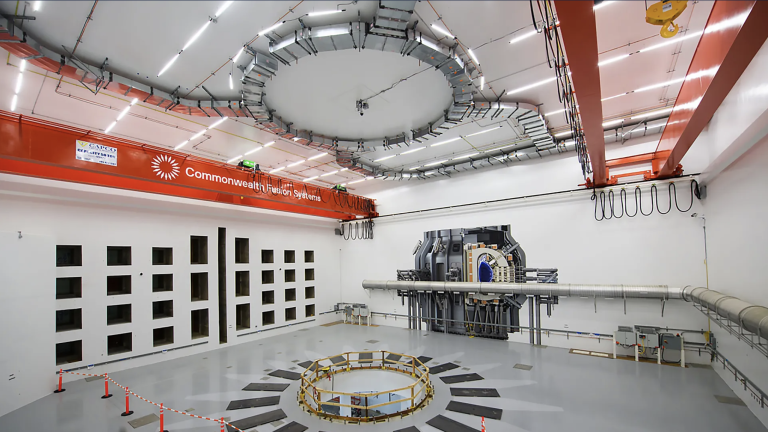
A look inside the facility that will house SPARC, Commonwealth's prototype fusion reactor.
Photo Credit
Commonwealth Fusion Systems

Commonwealth Fusion Systems hopes to be the first company to take nuclear fusion from the lab to the market.

A spin-out from MIT’s Plasma Science and Fusion Center, Commonwealth is following a well-trodden design path by using a tokamak—a doughnut-shaped device in which radio waves heat isotopes of hydrogen to above 100 million °C (180 million °F). The resulting plasma is squeezed by a powerful magnetic field until the atoms fuse, releasing a burst of energetic electrons and neutrons.

What sets Commonwealth apart is the compact size of its tokamak. Its prototype SPARC reactor will be 40 times smaller than the international ITER fusion reactor currently being built in France and could come online five years earlier.

Read the full story at MIT Technology Review.

by MIT Technology Review
Topics
Nuclear & Fusion Energy

Related Posts

PostAugust 18, 2026

Steady Heat, Flexible Power: Flexibility by Proxy in Nuclear-Thermal Energy...

MIT Center for Energy and Environmental Policy Research
rendering of energetic plasma
PostAugust 13, 2026

Researchers uncover hidden pore network within nuclear fuel

MIT News
The new findings could help keep some nuclear reactors running for longer, while informing the next generation of nuclear reactor fuel systems. Pictured is a fuel assembly of a nuclear reactor.
PostAugust 10, 2026

MIT researchers tackle the economic realities of fusion power

MIT News
“It’s challenging to reduce complex scientific and engineering requirements to economic consequences,” Professor Andrew Lo says. “But if we don’t do that, we’re not going to get the funding we need, to achieve the impact we want.”
PostAugust 3, 2026

Social Problems of Nuclear Energy

MIT OCW
Photo of two large cooling towers emitting some steam.

MIT Climate Knowledge in Your Inbox


MIT Groups Log In

Log In

Footer

  • About
  • Terms & Conditions
  • Privacy Policy
  • Accessibility
  • Contact
MIT Climate Project
MIT
  • Instagram
  • TikTok
  • YouTube
  • Simplecast
Communicator Award Winner