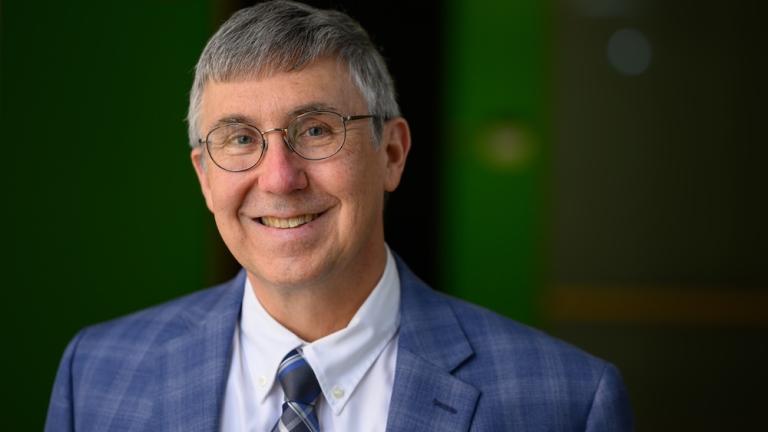
MIT professor William H. Green has been named director of the MIT Energy Initiative (MITEI).
In appointing Green, then-MIT Vice President for Research Maria Zuber highlighted his expertise in chemical kinetics — the understanding of the rates of chemical reactions — and the work of his research team in reaction kinetics, quantum chemistry, numerical methods, and fuel chemistry, as well as his work performing techno-economic assessments of proposed fuel and vehicle changes and biofuel production options.
“Bill has been an active participant in MITEI; his broad view of energy science and technology will be a major asset and will position him well to contribute to the success of MIT’s exciting new Climate Project,” Zuber wrote in a letter announcing the appointment, which went into effect April 1.
Green is the Hoyt C. Hottel Professor of Chemical Engineering and previously served as the executive officer of the MIT Department of Chemical Engineering from 2012 to 2015. He sees MITEI’s role today as bringing together the voices of engineering, science, industry, and policy to quickly drive the global energy transition.
“MITEI has a very important role in fostering the energy and climate innovations happening at MIT and in building broader consensus, first in the engineering community and then ultimately to start the conversations that will lead to public acceptance and societal consensus,” says Green.
Achieving consensus much more quickly is essential, says Green, who noted that it was during the 1992 Rio Summit that globally we recognized the problem of greenhouse gas emissions, yet almost a quarter-century passed before the Paris Agreement came into force. Eight years after the Paris Agreement, there is still disagreement over how to address this challenge in most sectors of the economy, and much work to be done to translate the Paris pledges into reality.
“Many people feel we’re collectively too slow in dealing with the climate problem,” he says. “It’s very important to keep helping the research community be more effective and faster to provide the solutions that society needs, but we also need to work on being faster at reaching consensus around the good solutions we do have, and supporting them so they’ll actually be economically attractive so that investors can feel safe to invest in them, and to change regulations to make them feasible, when needed.”
With experience in industry, policy, and academia, Green is well positioned to facilitate this acceleration. “I can see the situation from the point of view of a scientist, from the point of view of an engineer, from the point of view of the big companies, from the point of view of a startup company, and from the point of view of a parent concerned about the effects of climate change on the world my children are inheriting,” he says.
Green also intends to extend MITEI’s engagement with a broader range of countries, industries, and economic sectors as MITEI focuses on decarbonization and accelerating the much-needed energy transition worldwide.
Green received a PhD in physical chemistry from the University of California at Berkeley and a BA in chemistry from Swarthmore College. He joined MIT in 1997. He is the recipient of the AIChE’s R.H. Wilhelm Award in Chemical Reaction Engineering and is an inaugural Fellow of the Combustion Institute.
He succeeds Robert Stoner, who served as interim director of MITEI beginning in July 2023, when longtime director Robert C. Armstrong retired after serving in the role for a decade.