Climate
Search

Main navigation

  • Climate 101
    • What We Know
    • What Can Be Done
    • Climate Primer
  • Explore
    • Podcast
    • Explainers
    • Climate Questions
    • For Educators
  • MIT Action
    • News
    • Events
    • Resources
  • Search
MIT

Main navigation

  • Climate 101
    • What We Know
    • What Can Be Done
    • Climate Primer
  • Explore
    • Podcast
    • Explainers
    • Climate Questions
    • For Educators
  • MIT Action
    • News
    • Events
    • Resources
  • Search
PostApril 22, 2021

The US has pledged to halve its carbon emissions by 2030

Today, the US will pledge at a summit of 40 global leaders today to halve its carbon emissions from 2005 levels by 2030. This far exceeds an Obama-era pledge in 2014 to get emissions 26-28% below 2005 levels by 2025, writes Charlotte Jee for the MIT Technology Review. The hope is that the commitment will help encourage India, China, and other major emitters to sign up to similar targets before the 2021 United Nations Climate Change Conference, set to be held in Glasgow, UK,  in November.

Read the full article at: https://www.technologyreview.com/2021/04/22/1023374/the-us-has-pledged-to-halve-its-carbon-emissions-by-2030/

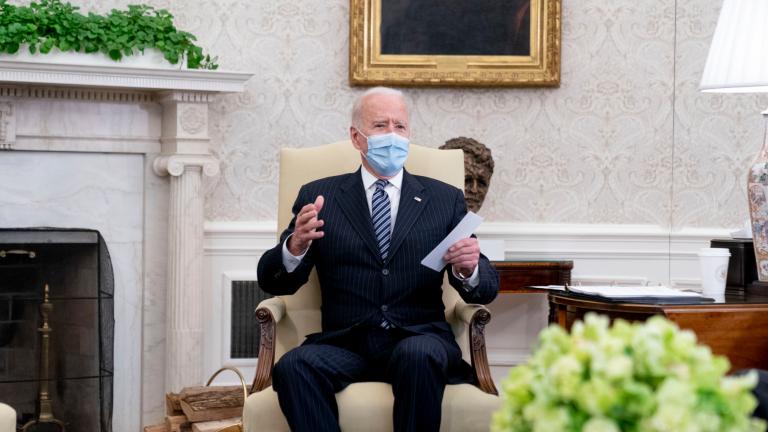
Image: President Joe Biden speaks in the Oval Office of the White House earlier this week

by MIT Technology Review
Topics
Cities & Planning
Energy
Government & Policy
International Agreements

Related Posts

PostAugust 6, 2026

A new way to watch heat move through electronics

MIT News
To measure how heat moves through materials, MIT researchers use laser pulses (red) to heat a sample while ultrafast X-rays (purple) penetrate multiple material layers and measure changes as heat dissipates.
PostAugust 4, 2026

Reframing leadership as a design problem

MIT News
Nicholas de Monchaux is Weber-Shaughness Professor of Architecture at MIT, as well as professor of urban studies and planning and affiliated faculty with the Program in Science, Technology, and Society.
PostAugust 4, 2026

Solving the solvent problem

MIT Department of Nuclear Science and Engineering
A machine-learning-guided pipeline enables researchers to generate solvent candidate pools on demand, narrow the selections down, and experimentally test the most promising electrolyte recipes. These scanning electron microscopy images show the morphology of sodium-metal deposits obtained from three different electrolyte candidates.
PostAugust 3, 2026

Social Problems of Nuclear Energy

MIT OCW
Photo of two large cooling towers emitting some steam.

MIT Climate Knowledge in Your Inbox


MIT Groups Log In

Log In

Footer

  • About
  • Terms & Conditions
  • Privacy Policy
  • Accessibility
  • Contact
MIT Climate Project
MIT
  • Instagram
  • TikTok
  • YouTube
  • Simplecast
Communicator Award Winner