Climate
Search

Main navigation

  • Climate 101
    • What We Know
    • What Can Be Done
    • Climate Primer
  • Explore
    • Podcast
    • Explainers
    • Climate Questions
    • For Educators
  • MIT Action
    • News
    • Events
    • Resources
  • Search
MIT

Main navigation

  • Climate 101
    • What We Know
    • What Can Be Done
    • Climate Primer
  • Explore
    • Podcast
    • Explainers
    • Climate Questions
    • For Educators
  • MIT Action
    • News
    • Events
    • Resources
  • Search
PostNovember 19, 2019

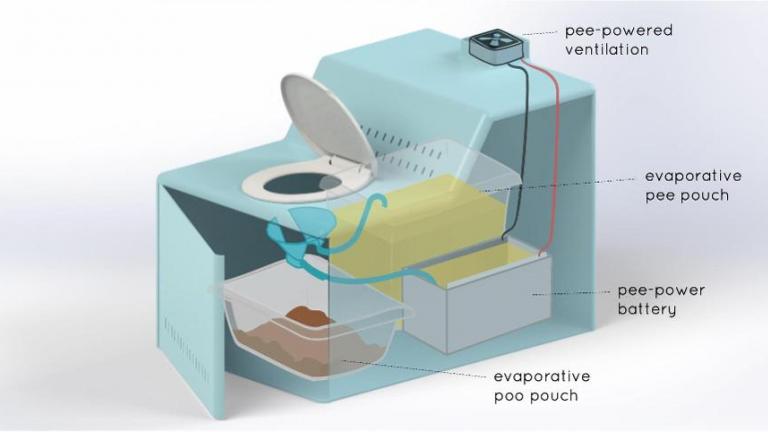
The toilet that doesn't flush waste but eliminates it

Change:Water Labs' iThrone is a portable, easily insertable toilet that can provide an immediate sanitation boost to communities in need.

Read more here

by Abdul Latif Jameel Water and Food Systems Lab (J-WAFS)
Topics
Climate Justice
Industry & Manufacturing
Waste

Related Posts

PostJune 30, 2026

MIT researchers advance toward greater bandwidth, more energy-efficient com...

MIT News
FUTUR-IC, funded by the National Science Foundation Convergence Accelerator, was created to address resource-efficiency issues. For example, integrating photonics with the electronics that underpin today’s microchips could address energy use because the transmission, or communication of data, using light is much more energy efficient.
PostJune 24, 2026

Computer model could enable bridges and buildings that use less material

MIT News
On top left is the Lockport truss bridge passing over the Erie Canal near Buffalo, New York. Researchers mimicked this structure, highlighted in teal blue, and created multiple timber-only designs (top left), steel-only designs (bottom left), and timber-steel designs.
PostJune 11, 2026

A shot of carbon dioxide rewires how cement sets

MIT Concrete Sustainability Hub
A confocal Raman microscope (left) tracks the chemical evolution of CO₂-injected cement paste samples over 24 hours; the custom stage's quartz window enables the laser to scan from below. Cement paste is the basis for fresh concrete, as pictured at right; CO₂-injected concrete is gaining commercial traction as a material that permanently stores carbon dioxide.
PostJune 4, 2026

Developing innovative alternatives to conventional carbon capture methods

MIT Climate & Sustainability Consortium
Glen Junor (left) and Fang-Yu Kuo work in the lab.

MIT Climate Knowledge in Your Inbox


MIT Groups Log In

Log In

Footer

  • About
  • Terms & Conditions
  • Privacy Policy
  • Accessibility
  • Contact
MIT Climate Project
MIT
  • Instagram
  • TikTok
  • YouTube
  • Simplecast
Communicator Award Winner