MIT Joint Program researchers explore science and policy implications at BU workshop
By Mark Dwortzan | MIT Joint Program on the Science and Policy of Global Change
On December 3 and 4, Boston University convened a workshop exploring how synthetic biology—the engineering of genetic “circuits” in living cells and organisms to enable them to perform specified tasks—can help address climate change. Participants, who included thought leaders in science, economics, policy and ethics, considered a wide range of complex challenges and potential benefits of proposed synthetic biology approaches to reducing greenhouse gas emissions.
Among the presenters and moderators were four researchers affiliated with the MIT Joint Program on the Science and Policy of Global Change who explored some of the scientific and policy implications of tackling climate change with a synthetic biology toolset.
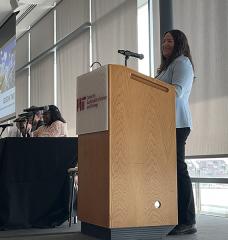
In a session on land, atmosphere and ocean systems, Jerry Melillo, a senior scientist at the Marine Biological Laboratory, highlighted the strong interactions among carbon, nitrogen and phosphate cycles that present opportunities and limits to any biological solution to mitigating greenhouse gases (GHGs). He observed that it will likely take decades of monitoring to fully understand how ecosystems and soils respond to human-initiated changes in the climate system. Susan Solomon, a professor of environmental studies at the MIT Department of Earth, Atmospheric and Planetary Sciences, presented research showing that once GHGs are stabilized, warming will continue for many years to come, thus underscoring the critical need for solutions that can reduce and not just stabilize GHG concentrations.
To introduce a panel on policy that he chaired, Joint Program Co-Director John Reilly compared two views of synthetic biology—one as a next step in crop breeding following natural selection, hybridization and genetic engineering, which has produced organisms that meet human needs without significant downsides, the other as analogous to invasive species that have significantly disrupted natural ecosystems. Joint Program Co-Founder Emeritus Henry Jacoby noted that international climate negotiations are unlikely to move fast enough to keep global warming below 2°C using conventional mitigation methods, and that alternative approaches such as synthetic biology may be needed to help meet the challenge.
Reilly also moderated an open discussion on policy which highlighted the fact that synthetic biology is already highly contentious, probably misunderstood, and at a very early stage of development. Participants recognized an urgent need for clear communication among the synthetic biology community, agencies likely to regulate its work, and the public.
A Boston University College of Engineering news story provides additional information about the workshop.
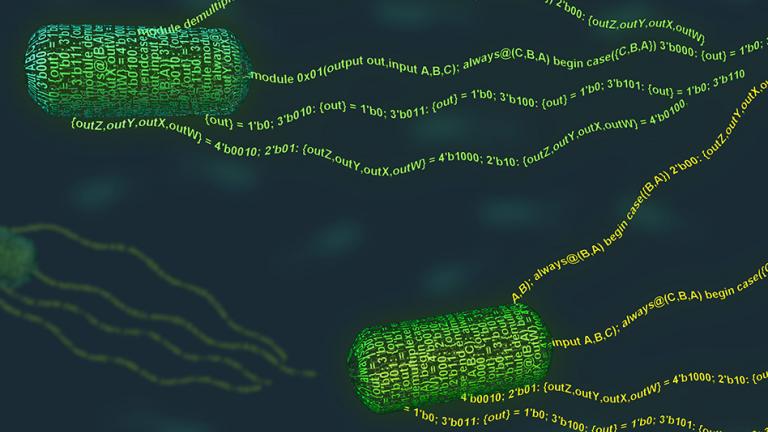
MIT biological engineers have devised a programming language that can be used to give new functions to E. coli bacteria. Image: Janet Iwasa