One September day, it started to snow inside MIT’s Pierce Laboratory.
Researchers depressurized a tank of liquid carbon dioxide (CO2), instantly freezing it and releasing solid flakes. These were blended into cement paste and pressed into discs roughly the size of a dime, each sealed with a thin layer of vegetable oil to keep water in and air out. The team trained lasers on each, observing for the first time the transient chemical reaction that might explain why CO2-injected cement paste gains its strength faster.
Injecting CO2 into cement products like concrete is one way to store it and keep it out of the atmosphere. The process has attracted commercial interest, with a growing number of companies offering CO2-injected concrete mixes. But until now, the underlying cement chemistry hadn't been directly visualized.
A new open-access paper in the Journal of the American Ceramic Society — led by Associate Professor Admir Masic and first-authored by graduate student Marcin Hajduczek, both of the MIT Concrete Sustainability Hub and MIT Department of Civil and Environmental Engineering — describes the chemical sequence that unfolds after CO2 meets fresh cement paste. Co-authors include MIT colleagues Santiago El Awad and Franz-Josef Ulm, alongside researchers from IIT Jodhpur and CarbonCure Technologies.
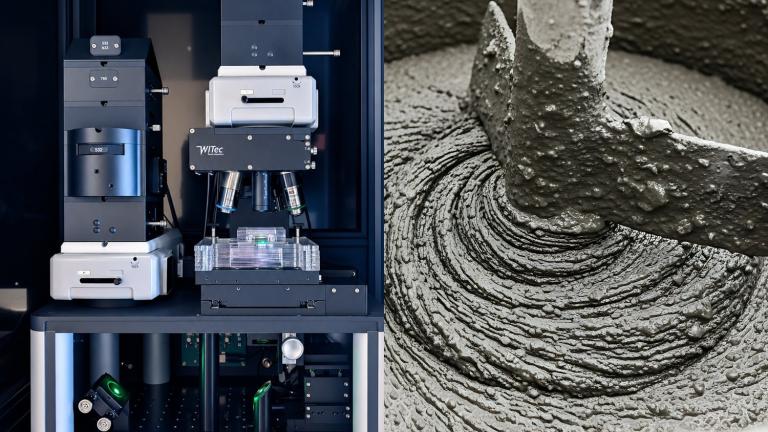
Previous studies had pieced together a story about CO2 injection’s chemical impacts from theory and indirect evidence; the key reactions simply moved too fast, and vanished too completely, for conventional techniques to catch them in the act. Raman confocal microscopy could — and it works on a simple principle: Illuminate a molecule with a laser, and the scattered light will reveal its identity. The light interacts with each material’s unique chemical bonds, shifting in energy to produce a distinct spectral “fingerprint.” Even the most fleeting and amorphous phases leave a readable trace.
“We’ve used Raman spectroscopy to better understand some of the most interesting materials in history, from the Dead Sea Scrolls to Ancient Roman concrete,” says Masic. “Cement paste may seem less glamorous in comparison, but pointing a laser at CO2-injected cement paste as it hardens allows us to visualize things that haven’t been seen before.”
What they saw, unfolding during 24 hours of continuous scanning, was a three-act chemical drama.
Act One: Capturing calcium
The moment that CO2 is added to the fresh cement paste, it goes to work. It dissolves into the pore solution and reacts with calcium released by the dissolving clinker, precipitating as various forms of calcium carbonate. Clinker is produced by heating limestone and aluminosilicate materials in a kiln, forming the primary ingredient ground into a fine powder to make cement. This happens within the first hour, temporarily slowing the normal hydration reaction, which requires calcium to proceed.
In contrast, when CO2 is not present, the calcium released by the dissolving clinker remains available locally, supporting the gradual formation of the material’s binding phases as it sets.
Left without calcium, the silicates released by the clinker dissolve into the pore solution and precipitate far from their source, linking together into chains that form an interconnected silica gel network throughout the paste. This amorphous, fleeting gel sets the stage for what follows.
Act Two: The ghostly gel
Once the injected CO2 is fully mineralized — around four to five hours after mixing — normal hydration resumes. Calcium hydroxide begins to precipitate into the pore space, and when it does, it encounters the silica gel network waiting for it.
The reaction between the two phases begins immediately, producing calcium silicate hydrate (C-S-H), the compound that gives cement its binding ability. What makes this form of C-S-H distinct is where and how it forms: not clustered around clinker particles as in conventional hydration, but distributed throughout the entire matrix, wherever the silica gel had spread.
The CO2 had temporarily suppressed the paste’s alkalinity, and that lower pH was the only thing keeping the silica-gel intact. As hydration reasserts itself and produces standard hydration products, namely C-S-H and calcium hydroxide, the latter drives pH back up to typical levels in a self-reinforcing loop; the silica-gel reacts with calcium hydroxide through a so-called pozzolanic reaction. Within eight hours, the silica gel is almost entirely gone — the previously well-distributed gel network turns rapidly into additional C-S-H during this critical early window.
“At first, the fleeting nature of the silica gel looked like a fluke in the Raman data. But it quickly became clear that its sudden disappearance was a consistent, undeniable feature of every CO2-injected sample,” says Hajduczek.
Act Three: A rewired matrix
With the silica gel consumed, the paste settles into conventional hydration, but what it leaves behind is measurably different. Because the new binder was distributed more evenly throughout the cement matrix, the resulting microstructure is stronger and more uniform at an early age. In the study, paste mixed with CO2 at 1 percent by cement weight achieved, on average, 13 percent higher compressive strength at 24 hours, compared to reference mixes.
“We’ve been injecting CO2 into cement products for years without fully understanding what it was doing inside. Now that we can see it and understand the underlying mechanism that leads to improved performance, we can start to control it. And there’s a lot of room to push,” says Masic.
The findings also refine a leading explanation for CO2-injected cement paste’s higher early age strength: the calcium carbonate crystals, previously suspected to seed C-S-H growth, turn out to be passive bystanders embedded in the silica gel template rather than reacting to form C-S-H.
Where the chemistry goes next
Knowing the mechanism gives researchers a more specific set of questions to pursue. The silica gel template explains the distribution of the new C-S-H, but directly measuring its mechanical properties remains a next step.
On the practical side, dosage matters: Flood the system with too much CO2 and calcium gets locked into carbonate before the gel can form and react. If the paste used here forms abundant C-S-H, it could theoretically offset up to 40 percent of the carbon emissions from cement production, excluding emissions associated with the fossil fuels used in the process. In practice, however, the achievable offset is likely to be only a fraction of that value, although still potentially significant.
But even with these open questions, the ghostly gel has been caught. And now that researchers know what to look for, the chemistry that unfolds in those first eight hours is no longer invisible.