Climate
Search

Main navigation

  • Climate 101
    • What We Know
    • What Can Be Done
    • Climate Primer
  • Explore
    • Podcast
    • Explainers
    • Climate Questions
    • For Educators
  • MIT Action
    • News
    • Events
    • Resources
  • Search
MIT

Main navigation

  • Climate 101
    • What We Know
    • What Can Be Done
    • Climate Primer
  • Explore
    • Podcast
    • Explainers
    • Climate Questions
    • For Educators
  • MIT Action
    • News
    • Events
    • Resources
  • Search
PostJuly 10, 2017

Modeling and Assessment for Policy

This course explores how scientific information and quantitative models can be used to inform policy decision-making. Students will develop an understanding of quantitative modeling techniques and their role in the policy process through case studies and interactive activities.

The course addresses issues such as analysis of scientific assessment processes, uses of integrated assessment models, public perception of quantitative information, methods for dealing with uncertainties, and design choices in building policy-relevant models. Examples used in this class focus on models and information used in earth system governance. 

Content highlights: Lecture slides (especially Lectures 7 and 8), assignments and quizzes with solutions, sample student projects

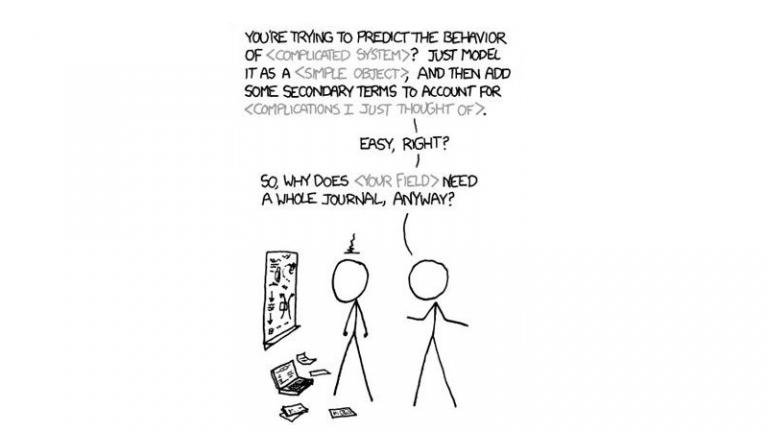
Image rights: Scientific information and quantitative models can be used to inform policy decision-making (or you could just ask a physicist). Courtesy of Randall Munroe. License: CC-BY-NC.

Taught By: Prof. Noelle Selin

by MIT OCW
Topics
Government & Policy

Related Posts

PostNovember 25, 2025

PODCAST: Climate Reveal (Season 1, Episode 5) - Health and Climate

MIT Center for Sustainability Science and Strategy
Podcast: Climate Reveal
PostNovember 18, 2025

MIT Energy Initiative conference spotlights research priorities amidst a ch...

MIT Energy Initiative
At Energizing@MIT: the MIT Energy Initiative’s annual research conference, a panel examined the use cases of long-duration energy storage and the key technologies addressing this need. From left to right, they are Nestor Sepulveda, Google; Asegun Henry, MIT; and Manlio Coviello, Energy Dome Latam.
PostNovember 13, 2025

MIT/Harvard Roosevelt Project Releases Synthesis Report on U.S. Energy Tran...

MIT Center for Energy and Environmental Policy Research
US flag with worker gloves
PostNovember 11, 2025

Geothermal Energy Networks: Transforming Our Thermal Energy System

MIT OCW
Illustration of different types of buildings connected together beneath the ground with a loop, having a long horizontal run and multiple vertical loops deeper into the ground.

MIT Climate News in Your Inbox


MIT Groups Log In

Log In

Footer

  • About
  • Terms & Conditions
  • Privacy Policy
  • Accessibility
  • Contact
MIT Climate Project
MIT
Communicator Award Winner