Read the Roadmap document on our website.
Human activities have added more than 1.5 trillion metric tons of carbon dioxide to Earth’s atmosphere since the pre-industrial period, increasing its concentration from below 300 parts per million (ppm) to over 415 ppm today, and projected to surpass 1,000 ppm before 2100 without effective action. This anthropogenic change is primarily due to burning fossil fuels, which has resulted in the observable and ongoing climate change, including global temperature rise, warming oceans, melting polar ice, glacial retreat, sea level rise, and increased extreme-weather events. Ocean acidification is another significant global change attributed to increased carbon dioxide levels.
The United Nations Intergovernmental Panel on Climate Change (UN IPCC) assessments have detailed the wide-ranging damages from climate change and the far-reaching and unprecedented interventions required to limit them. In 2016, the UN Framework Convention on Climate Change (FCCC) including 196 of the world’s nations committed to reducing greenhouse gases through the Paris Agreement. It is imperative that these commitments be adhered to and enhanced in the next three decades to avoid irreversible damages to Earth’s natural cycles and ecosystems and to mitigate the threat to human societies.
The adverse impacts of anthropogenic climate change have significant social costs, which will increase dramatically if immediate action is not taken. These costs include economic damages from severe weather events and adverse health effects from pollutants generated by burning fossil fuels. Without immediate action, the projected costs are expected to become so severe as to threaten the security and well being of large numbers of people around the globe, ultimately leading to the loss of habitable land. A billion or more people are projected to be impacted in the next 50 years.
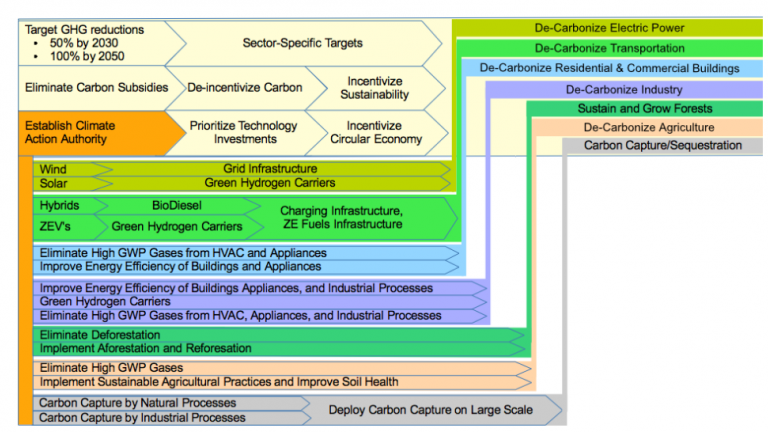
Immediate actions that are necessary to avoid the worst damages include termination of fossil fuel uses and their rapid replacement with carbon-neutral energy sources. Transition to renewable solar and wind energy which are now economically competitive, and electrification of building and industrial thermal energy systems are key priorities. In addition, improvements in energy efficiency and reductions in energy use are urgently needed. Concurrently, careful management of carbon sequestration assets such as coastal marshes, tropical forests and agricultural lands is essential. In order to achieve the aspirational goal of net-zero greenhouse gas emissions by 2050 or earlier, investments in research and development of all promising technologies are urgently needed. As capture technologies become economically viable, they might support reductions below net-zero in the future.
An aggressive timeline is essential to avoid the worst damages from climate change that will otherwise result in the coming decades of the 21st century. Such damages include increasingly more frequent and destructive weather events, food and water insecurity, and loss of habitats for large human populations. Urgent responses and actions are needed at the national, regional, and local levels as well as by institutional and individual leaders and citizens.