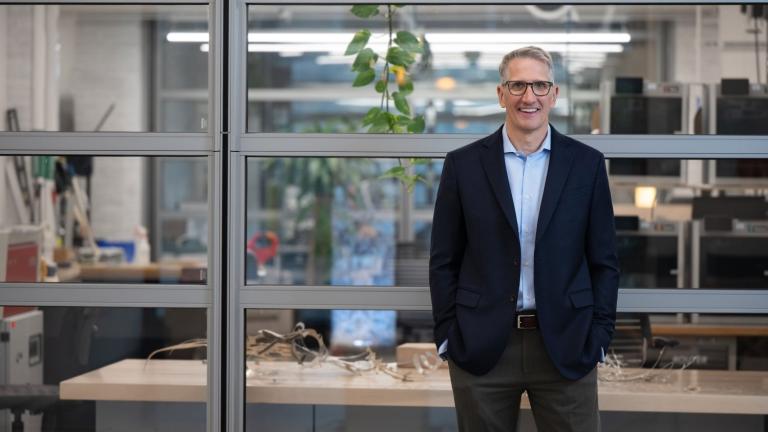
Joe Higgins will step down as MIT vice president for campus services and stewardship (VPCSS) at the end of January, Executive Vice President and Treasurer Glen Shor announced today in an email to MIT faculty and staff. Higgins is relocating to the West Coast to be closer to family.
“Joe is an engineer by trade, and he is adept at building extraordinary things,” Shor says. “He has made an enormous mark on our campus and its future, and we are profoundly grateful for his vision, efforts, and highly engaging and collaborative style.”
Higgins joined MIT in 2016 as director of infrastructure operations in the Department of Facilities. His leadership portfolio quickly expanded to include overseeing campus maintenance, utilities, and facilities engineering and implementing the adoption of technology platforms to better support stewardship decisions, improve operations, and more effectively manage risks and costs.
Higgins assumed the newly created role of VPCSS in 2019. The VPCSS portfolio includes the Atlas Service Center; Department of Facilities; Environment, Health and Safety Office; MIT Welcome Center and Open Space Programming; Office of Campus Planning; and the Office of Sustainability.
Over the course of his seven-year tenure, Higgins has adeptly guided MIT’s physical campus through a transformative period, bringing MIT’s 2030 Capital Plan projects from the drawing board to reality; systematically improving the conditions of critical facilities; and making significant strides to advance campus decarbonization efforts.
“The biggest gift has been getting to work with an amazing team of people”
As Higgins prepares to relocate to the West Coast to be closer to his family, he has been reflecting on his MIT “family.”
“The biggest gift has been getting to work with an amazing team of people who are so dedicated to MIT,” says Higgins. “CSS senior leaders are exceptional, and they’ve built exceptional teams that really are the backbone of our campus.”
Case in point for Higgins is how CSS teams responded to the Covid-19 pandemic. They were instrumental to ensuring essential research and operations continued safely at the height of the pandemic, and they were equally imperative to reimagining new ways of working and operating the campus in a post-Covid world.
“No matter how hard the challenge or big the roadblock, the teams at CSS are here to support the Institute 24/7, 365 days a year,” says Higgins. “I’m going to really miss that shared sense of purpose and community that my colleagues display every day.”
As part of Higgins’ family-driven relocation, he has accepted the role of vice president of facilities management at Chapman University in Orange, California.
Stewarding MIT’s physical campus
Higgins has skillfully advanced MIT’s 2030 Capital Plan, helping to elevate the capabilities of Institute buildings to support cutting-edge academic and research endeavors, improve the residential experience for students, and establish a new level of discipline in keeping MIT facilities in suitable condition.
Signature projects that came to life during his tenure include the construction of the MIT Stephen A. Schwarzman College of Computing, the Graduate Junction residence hall, and the Edward and Joyce Linde Music Building; the recently completed renovation of the Metropolitan Warehouse; and a substantial upgrade to the Central Utilities Plant. And there’s more transformation on the horizon: Higgins and his team have been at the forefront of turning Building 39 into a headquarters and hub for the new MIT Quantum Initiative (QMIT) and a home for a new Quantum Systems Lab (QSL).
“QMIT and QSL represent the next great chapter in MIT’s historic leadership in quantum science and engineering, and Joe and his team made it possible for us to take this leap,” says Ian A. Waitz, vice president for research. “Throughout every phase of the project, they have been incredible partners, creative problem-solvers, and deeply invested in creating an unprecedented facility to enable MIT to pursue transformative applications of quantum science as well as to catalyze a growing regional ecosystem.”
The capital plan is also an important vehicle for addressing deferred maintenance, an area where the Institute has made considerable progress on Higgins’ watch. Facilities condition is tracked through a measure called the “Facilities Condition Index” — the ratio of deferred maintenance to the total cost of replacing building systems. MIT 2030 Capital Plan investments in renewal have reduced MIT’s overall campus Facilities Condition Index by about 40 percent, making the Institute a peer leader on this front in higher education.
Making progress on campus climate goals
Higgins has also brought passion, vision, and a collaborative spirit to MIT’s climate goals, helping to put the Institute on a path to dramatically reduce its carbon footprint. Over the past decade, the Institute has decreased energy use per square foot by more than 10 percent, even as the campus has grown and research activity has intensified. Rooftop solar power generation has increased by more than five times in the same period, and 33 MIT building projects have earned Leadership in Energy and Environmental Design (LEED) certification.
“We completed more than 300 energy-efficiency projects across campus, focusing on our most energy-intensive research buildings, and ultimately touching nearly every corner of MIT,” notes Higgins.
Higgins forged extensive partnerships with leading organizations across Greater Boston and with the City of Cambridge to enable over 450 megawatts of large-scale wind and solar energy projects in regions of the United States heavily reliant on fossil fuels. Together, these steps have put MIT on the verge of achieving net-zero carbon emissions.
“Joe has represented MIT interests and objectives through extremely complex Cambridge processes such as the development of the Building Energy Use Disclosure Ordinance (BEUDO),” says Sarah Gallop, director of MIT’s Office of Government and Community Relations. “His signature collaborative style, combined with his high level of expertise, have helped MIT and the city to achieve greater mutual understanding and to pursue joint initiatives. These include the creation of a virtual power purchase agreement (VPPA) and the implementation of the Greater Cambridge Energy Program (GCEP). Joe is a creative and constructive thinker and really makes things happen.”
Higgins has also laid important groundwork for MIT’s long-term campus decarbonization strategy. This has included his work earlier this year to spearhead MIT becoming an anchor institution in the BosTEN Project, a yearlong study to explore the feasibility of creating what could become the first city-scale thermal network in the United States. The network would help decrease the carbon footprints of major buildings across Boston and Cambridge by harnessing heat from the soil and rock under the Charles River and Boston Harbor, as well as waste heat from buildings and industrial facilities. It would also provide a renewable source of energy that can stabilize and even reduce the costs to heat and cool buildings.
“Joe’s vision and leadership extend beyond MIT’s campus,” says Lindsey Butler, executive director of the Boston Green Ribbon Commission. “He’s been pushing farther so that we can ignite broader strategies and technologies for other institutions and organizations to use. He understands the scale of change we need, and he’s worked overtime to help us go bigger.”
Tapping a seasoned interim leader, launching a national search
Shor has selected Jon Alvarez, director of campus planning, to oversee the CSS areas while the search for Higgins’ permanent successor is ongoing.
“I am grateful to Jon for accepting the interim role of VPCSS while we conduct this search,” Shor says. “Jon currently leads a team of planners, designers, archivists, and technical professionals. He is a respected, long-serving member of Joe’s leadership team, deeply connected to a range of campus partners, and engaged in several strategic initiatives on which we will continue to make progress during this transition period.”
National executive search firm Isaacson, Miller will lead the search for the Institute’s next VPCSS. Shor is aiming to make an appointment during the upcoming spring semester.
“I am confident all the CSS areas will continue to serve MIT with dedication and skill while we search for Joe’s successor,” says Shor.