How environmental taxes can work for everyone in Spain and beyond
Governments that impose taxes on carbon dioxide and other greenhouse gas emissions can benefit from a cleaner, more climate-friendly environment and a revenue stream that can be tapped to lower other taxes and create jobs. But environmental taxes may also exact an excessive financial burden on low-income households, which spend a much greater fraction of their budgets than richer households do on heating oil, natural gas and electricity. This concern has limited the use of green taxes in Spain, where emissions are taxed at levels far below average for the European Union, which seeks to lower emissions across the continent to fulfill its 2015 Paris Agreement climate pledge.
Now a new study by researchers at the University of Oldenburg (Germany), the Basque Center for Climate Change, and the MIT Joint Program on the Science and Policy of Global Change shows that low-income households in Spain can actually benefit from environmental taxes if revenues are redistributed to all taxpayers. Using a computational model to assess the environmental and economic impacts of a green tax reform policy in which revenues are recycled in equal amounts to households in annual lump-sum payments, the researchers found that the policy significantly reduces emissions without imposing economic hardship on any segment of the population. The study appears in the journal Economics of Energy & Environmental Policy.
“There may be a tradeoff between efficiency and equity in climate policy design,” says Xaquin Garcia-Muros, a co-author of the study and postdoctoral associate at the MIT Joint Program. Noting the perfect can be the enemy of the good, as indicated by the November 2018 Yellow Vest protests against fuel tax hikes in France, he adds, “Governments that seek to introduce environmental policies need to show they can cut emissions equitably in order for the public to support them. Otherwise, climate mitigation measures will be rejected by public opinion, and attempts to tackle climate change will be unsuccessful.”
The proposed policy includes a tax on carbon dioxide (CO2) (40 Euros/metric ton) in all sectors (except transportation) not covered by the EU emissions trading system, tax increases on fossil fuels to match the EU average of 1.5 percent of GDP, and economy-wide taxes on air pollutants (nitrogen oxides (NOx) and sulfur dioxide (SO2) emissions at 1000 Euros/metric ton). In addition, it provides annual lump-sum rebates to private households based on household income.
Combining a “computable general equilibrium” model of the Spanish economy with a “micro-simulation” sub-model that characterizes households of different income levels, the researchers determined the tax reform policy’s impact on pollution levels, energy prices and household net income. They found that the policy would significantly reduce emissions of CO2 (10%), NOx (13%) and SO2 (20%); produce an estimated 7.3 billion Euros in annual revenues; and enable annual lump-sum rebates of 400 Euros. Most importantly, the rebates would offset the cost of the green taxes for the bottom half of income levels, with the poorest households receiving an average annual net benefit of 203 Euros and the richest paying a net cost of 599 Euros.
“We expect similar results in other southern European and public transit-oriented countries,” says Garcia-Muros. “But while results will differ for each country, all can benefit by ensuring that green tax policies accommodate economic inequality.” An earlier Joint Program study showed how this principle can be applied in the design of carbon pricing policies in the U.S.
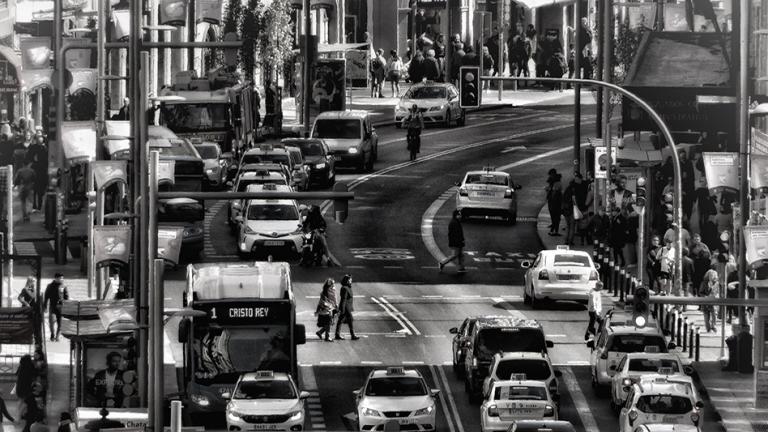
Photo: Traffic in Madrid, Spain (Source: Flickr/ Kirsi L-M)