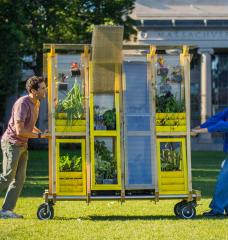
During the week of Aug. 26, MIT welcomed its Class of 2023. Participating in the usual orientation activities, they learned about research opportunities, course options, and important resources to help them navigate the Institute. Breaking for lunch each day, new MIT students poured into Kresge Oval where they could picnic under a large tent propped over the grass, providing much-needed shade on these hot August days. New to Kresge Oval this year was a mobile filling station full of cool, fresh, locally sourced water provided by the Massachusetts Water Resources Authority. Next to the filling station, free reusable water bottles were being given out to all MIT students.
These bottles were more than just swag. They were part of a collaborative effort of MIT’s Office of Sustainability (MITOS), the Abdul Latif Jameel Water and Food Systems Lab (J-WAFS), the Environmental Solutions Initiative (ESI), MIT Dining, the Office of the First Year, and the MIT Water Club to encourage sustainable water use practices across MIT’s campus and reduce waste by advocating for the regular use of reusable bottles and other serviceware throughout campus. Only students who took a pledge to use their bottle at least 10 times were allowed to take one away.
The idea for the bottle giveaway was first raised by the Sustainability Leadership Steering Committee, co-chaired by Julie Newman, the Institute’s director of sustainability, and David McGee, associate professor in MIT’s Department of Earth, Atmospheric and Planetary Sciences. When welcoming new students, they wanted to introduce them to MIT’s commitment to building a sustainable future and educate them about the benefits of choosing tap water over single-use plastic bottles. J-WAFS, ESI, MIT Dining, and the MIT Water Club joined the effort to help spread this message and expose incoming students to their sustainability work at MIT.
Students who wanted a bottle were asked to take a pledge to use it at least 10 times. Why 10? MITOS, along with Greg Norris, director of the Sustainability and Health Initiative for NetPositive Enterprise at MIT, helped articulate that using the stainless steel bottle just 10 times would provide a better environmental performance than a typical single-use water bottle, and the positive impact would continue to grow with future use. When one first-year was asked if he could commit to using the bottle 10 times, he replied, “Oh, heck yeah!” With the water trailer right there, students could fill their bottles right away, bringing them one-tenth of the way to fulfilling their pledge.
The bottles were branded with the reminder: “Reuse, refill, replenish.” They were designed by MIT architecture senior and MITOS student fellow Effie Jia to encourage students to incorporate reusable bottles use as well as other sustainable practices into their lives, such as using their own reusable serviceware for takeout and using reusable bags instead of disposable plastic or paper. The bottles are insulated for hot and cold beverages to make them even more flexible. “The perfect size for tea and coffee,” remarked one student. Staff members from MITOS, ESI, and J-WAFS also distributed bookmarks with information about drinking fountains on campus, advice to ask if local cafés offer discounts for bringing refillable bottles, and a reminder to always wash out their reusables to keep them clean and safe.
To analyze the potential impact of the water bottle giveaway, event organizers will be conducting a pair of followup surveys with the over 600 bottle recipients to test the persistence of the bottle use and potential changes in awareness. “We are experimenting to determine if we can statistically articulate some impacts associated with the giveaway,” said MITOS director Julie Newman. “It is important with all our initiatives to try to measure success (or failure) so we can test our effectiveness.”
While the event was about arming MIT students with sustainable tools, it was also focused on educating them about local water. Andrew Bouma and Patricia Stathatou, this year’s co-presidents of the MIT Water Club, shared information about the quality of Cambridge, Massachusetts, water, giving even more reason to choose tap water over bottled. The Water Club has run similar education events in the past, and has demonstrated that the taste of tap water, recycled water, and bottled water is virtually indistinguishable in a blind taste test. Educating incoming students about the high quality of Cambridge tap water, and the energy, cost, and waste that is saved by choosing to reuse, they hoped to further support sustainable behavior change among the incoming class members.
Over the two days in which the water bottles were distributed, the turnout was remarkable. “We were thrilled with the outcome of the event,” said MITOS Sustainability Project Manager Steven Lanou. “Not only did we get to engage directly with over 600 first-year students to share information, we were also so encouraged by their enthusiasm and commitment to help MIT take this small step towards advancing sustainability on campus. ESI, J-WAFS, MIT Dining, MIT Water Club and Office of the First Year couldn’t have been better partners in this activity, and we look forward to many more collaborations in the future.”