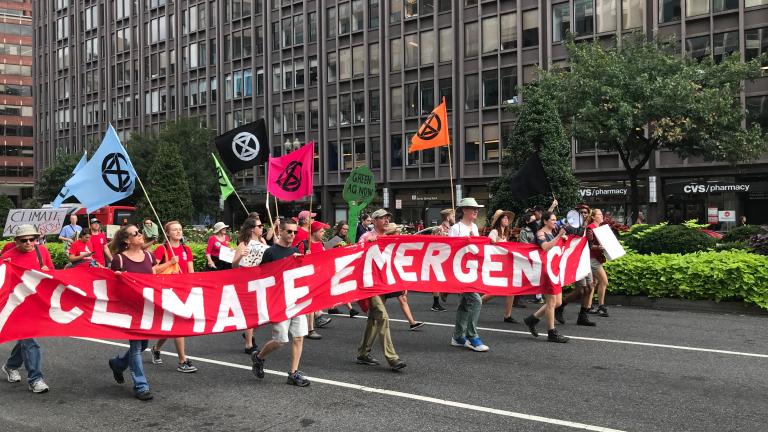
Image of Washington DC climate protest on 9-23-2019 provided by ShutDownDC.
After the climate strike by millions of young people around the world last Friday, this week the climate action summit happened at the UN, the IPCC issued a major climate report, and climate protestors shut down the morning commute in Washington DC.
After sailing to New York from Europe, Greta Thunberg kicked off the summit with an impassioned speech at the UN. (Video is available at PBS.) In her speech, she says that she should be "in school on the other side of the ocean" and the "lack of action on climate" is stealing "my dreams and my childhood" "with empty words." She goes on to say that she is "one of the lucky ones" and many less fortunate people are suffering and dying. She warns that "ecosystems are collapsing" while leaders "talk about ... economic growth." The 16 year old knows that "for more than 30 years, the science has been crystal clear," "cutting our emissions in half in 10 years only gives us a 50% chance of staying below 1.5 degrees and the risk of setting off irreversible chain reactions beyond human control." She says that "the eyes of all future generations are upon you" and that if "you choose to fail us, I say, we will never forgive you. We will not let you get away with this. Right here, right now is where we draw the line. The world is waking up and change is coming, whether you like it or not. Thank you."
The United Nations summit went on to focus on the countries making the biggest commitments and difference on climate change (see New York Times article). While many countries said they will attempt to reduce their net carbon emissions to zero by 2050, unfortunately, they represented a small fraction of global carbon emissions, only around one-ninth of the total. The three largest emitters, China, the United States and India, did not make the commitment, while several large European countries, Britain, France and Germany, did. Norway was the most progressive, targeting 2030 for carbon neutrality, with Finland targeting 2035. Low-lying island nations, like the Bahamas, which just suffered the ravages of Hurricane Dorian, generally were committed to the goal. An important step in achieving the carbon neutrality goal remains the development of technologies to limit carbon emissions.
The IPCC also met during the week and issued a report on Ocean and Cryosphere in a Changing Climate based on the work of 100 scientists from more than 30 countries. The report examined the effects of climate change on ocean, coastal, polar and mountain ecosystems. The findings were especially troubling in these regions, warning of faster melting of Greenland and Antarctic glaciers, accelerating sea level rise with increased ocean acidification reducing carbon uptake, and ever smaller Arctic snow cover reducing albedo. The loss of marine animal life will continue with significant declines in catches of fishes by the end of the century. Coastal damages are likely to become more common due to storms and tides. In summary, the IPCC scientists see that the changes resulting from climate change are accelerating, a point emphasized by Greta Thunberg.
In the nation's capital, a consortium of climate action groups named Shut Down DC protested at intersections from Capitol Hill to downtown Washington during Monday’s morning rush hour. The executive director of the Chesapeake Climate Action Network participated and he wrote an OpEd in the Washington Post titled "Sorry I ruined your Monday morning commute, but our planet is on a highway to hell." He warned that global warming is radicalizing many young people around the world, who want policy aimed at making the world livable for them. Another protest by Shut Down DC is scheduled for Friday.