by Callie Ayoub | Civil and Environmental Engineering
Born in Palermo, Sicily, Giorgio Rizzo spent his childhood curious about the natural world. “I have always been fascinated by nature and how plants and animals can adapt and survive in extreme environments,” he says. “Their highly tuned biochemistry, and their incredible ability to create ones of the most complex and beautiful structures in chemistry that we still can’t even achieve in our laboratories.”
As an undergraduate student, he watched as a researcher mounted a towering chromatography column layered with colorful plant chemicals in a laboratory. When the researcher switched on a UV light, the colors turned into fluorescent shades of blue, green, red and pink. “I realized in that exact moment that I wanted to be the same person, separating new unknown compounds from a rare plant with potential pharmaceutical properties,” he recalls.
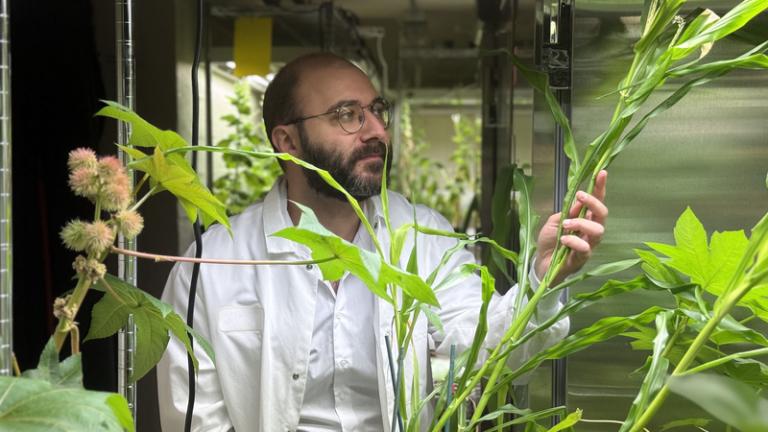
These experiences set him on a path from a master’s degree in organic chemistry to his current work as a postdoc in the MIT Department of Civil and Environmental Engineering, where he focuses on developing sustainable fertilizers and studying how rare earth elements can boost plant resilience, with the aim of reducing agriculture’s environmental impact.
In the lab of MIT Professor Benedetto Marelli, Rizzo studies plant responses to environmental stressors, such as heat, drought, and prolonged UV irradiation. This includes developing new fertilizers that can be applied as seed coating to help plants grow stronger and enhance their resistance.
“We are working on new formulations of fertilizers that aim to reduce the huge environmental impact of classical practices in agriculture based on NPK inorganic fertilizers,” Rizzo explains. Although they are fundamental to crop yields, their tendency to accumulate in soil is detrimental to the soil health and microbiome living in it. In addition, producing NPK (nitrogen, phosphorus, and potassium) fertilizers is one of the most energy-consuming and polluting chemical processes in the world.
“It is mandatory to reshape our conception of fertilizers and try to rely, at least in part, on alternative products that are safer, cheaper, and more sustainable,” he says.
Recently, Rizzo was awarded a Kavanaugh Fellowship, a program that gives MIT graduate students and postdocs entrepreneurial training and resources to bring their research from the lab to the market. “This prestigious fellowship will help me build a concrete product for a company, adding more value to our research,” he says.
Rizzo hopes their work will help farmers increase their crop yields without compromising soil quality or plant health. A major barrier to adopting new fertilizers is cost, as many farmers rely heavily on each growing season’s output and cannot risk investing in products that may underperform compared to traditional NPK fertilizers. The fertilizers being developed in the Marelli Lab address this challenge by using chitin and chitosan, abundant natural materials that make them far less expensive to produce, which Rizzo hopes will encourage farmers to try them.
“Through the Kavanaugh Fellowship, I will spend this year trying to bring the technology outside the lab to impact the world and meet the need for farmers to support their prosperity,” he says.
Mentorship has been a defining part of his postdoc experience. Rizzo describes Professor Benedetto Marelli as “an incredible mentor” who values his research interests and supports him through every stage of his work. The lab spans a wide range of projects — from plant growth enhancement and precision chemical delivery to wastewater treatment, vaccine development for fish, and advanced biochemical processes. “My colleagues created a stimulant environment with different research topics,” he notes. He is also grateful for the work he does with international institutions, which has helped him build a network of researchers and academics around the world.
Rizzo enjoys the opportunity to mentor students in the lab and appreciates their curiosity and willingness to learn. “It is one of the greatest qualities you can have as a scientist because you must be driven by curiosity to discover the unexpected,” he says.
He describes MIT as a “dynamic and stimulating experience,” but also acknowledges how overwhelming it can be. “You will feel like a small fish in a big ocean,” he says. “But that is exactly what MIT is: an ocean full of opportunities and challenges that are waiting to be solved.”
Beyond his professional work, Rizzo enjoys nature and the arts. An avid reader, he balances his scientific work with literature and history. “I never read about science-related topics — I read about it a lot already for my job,” he says. “I like classic literature, novels, essays, history of nations, and biographies. Often you can find me wandering in museums’ art collections.” Classical art, Renaissance, and Pre-Raphaelites are his favorite artistic currents.
Looking ahead, Rizzo hopes to shift his professional pathway toward startups or companies focused on agrotechnical improvement. His immediate goal is to contribute to initiatives where research has a direct, tangible impact on everyday life.
“I want to pursue the option of being part of a spinout process that would enable my research to have a direct impact in everyday life and help solve agricultural issues,” he adds.