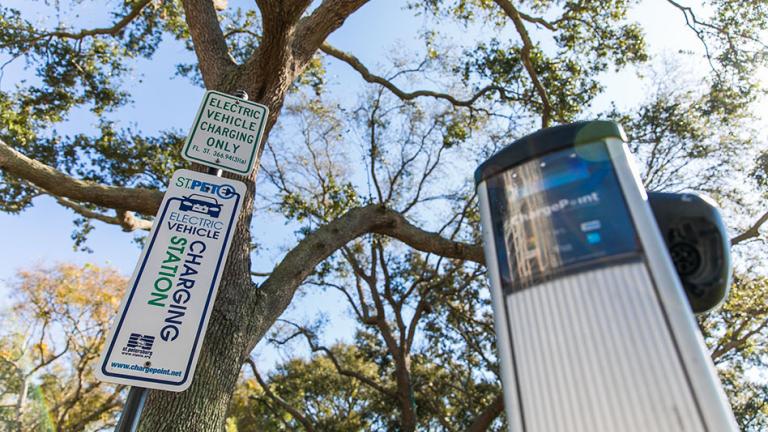
On Aug. 5, the White House announced that it seeks to ensure that 50 percent of all new passenger vehicles sold in the United States by 2030 are powered by electricity. The purpose of this target is to enable the U.S to remain competitive with China in the growing electric vehicle (EV) market and meet its international climate commitments. Setting ambitious EV sales targets and transitioning to zero-carbon power sources in the United States and other nations could lead to significant reductions in carbon dioxide and other greenhouse gas emissions in the transportation sector and move the world closer to achieving the Paris Agreement’s long-term goal of keeping global warming well below 2 degrees Celsius relative to preindustrial levels.
At this time, electrification of the transportation sector is occurring primarily in private light-duty vehicles (LDVs). In 2020, the global EV fleet exceeded 10 million, but that’s a tiny fraction of the cars and light trucks on the road. How much of the LDV fleet will need to go electric to keep the Paris climate goal in play?
To help answer that question, researchers at the MIT Joint Program on the Science and Policy of Global Change and MIT Energy Initiative have assessed the potential impacts of global efforts to reduce carbon dioxide emissions on the evolution of LDV fleets over the next three decades.
Using an enhanced version of the multi-region, multi-sector MIT Economic Projection and Policy Analysis (EPPA) model that includes a representation of the household transportation sector, they projected changes for the 2020-50 period in LDV fleet composition, carbon dioxide emissions, and related impacts for 18 different regions. Projections were generated under four increasingly ambitious climate mitigation scenarios: a “Reference” scenario based on current market trends and fuel efficiency policies, a “Paris Forever” scenario in which current Paris Agreement commitments (Nationally Determined Contributions, or NDCs) are maintained but not strengthened after 2030, a “Paris to 2 C” scenario in which decarbonization actions are enhanced to be consistent with capping global warming at 2 C, and an “Accelerated Actions” scenario the caps global warming at 1.5 C through much more aggressive emissions targets than the current NDCs.
Based on projections spanning the first three scenarios, the researchers found that the global EV fleet will likely grow to about 95-105 million EVs by 2030, and 585-823 million EVs by 2050. In the Accelerated Actions scenario, global EV stock reaches more than 200 million vehicles in 2030, and more than 1 billion in 2050, accounting for two-thirds of the global LDV fleet. The research team also determined that EV uptake will likely grow but vary across regions over the 30-year study time frame, with China, the United States, and Europe remaining the largest markets. Finally, the researchers found that while EVs play a role in reducing oil use, a more substantial reduction in oil consumption comes from economy-wide carbon pricing. The results appear in a study in the journal Economics of Energy & Environmental Policy.
“Our study shows that EVs can contribute significantly to reducing global carbon emissions at a manageable cost,” says MIT Joint Program Deputy Director and MIT Energy Initiative Senior Research Scientist Sergey Paltsev, the lead author. “We hope that our findings will help decision-makers to design efficient pathways to reduce emissions.”
To boost the EV share of the global LDV fleet, the study’s co-authors recommend more ambitious policies to mitigate climate change and decarbonize the electric grid. They also envision an “integrated system approach” to transportation that emphasizes making internal combustion engine vehicles more efficient, a long-term shift to low- and net-zero carbon fuels, and systemic efficiency improvements through digitalization, smart pricing, and multi-modal integration. While the study focuses on EV deployment, the authors also stress for the need for investment in all possible decarbonization options related to transportation, including enhancing public transportation, avoiding urban sprawl through strategic land-use planning, and reducing the use of private motorized transport by mode switching to walking, biking, and mass transit.
This research is an extension of the authors’ contribution to the MIT Mobility of the Future study.