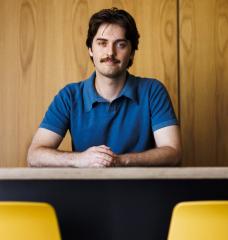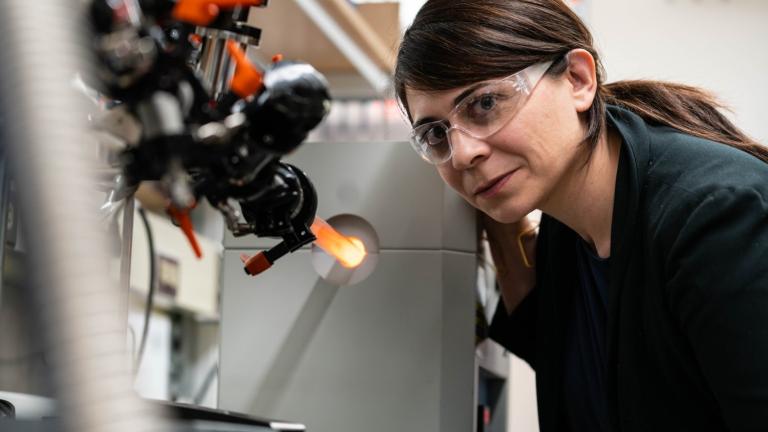
Desirée Plata, the School of Engineering Distinguished Climate and Energy Professor in the MIT Department of Civil and Environmental Engineering, has been named associate dean of engineering, effective July 1.
In her new role, Plata will focus on fostering early-stage research initiatives across the school’s faculty and on strengthening entrepreneurial and innovation efforts. She will also support the school’s Technical Leadership and Communication (TLC) Programs, including: the Gordon Engineering Leadership Program, the Daniel J. Riccio Graduate Engineering Leadership Program, the School of Engineering Communication Lab, and the Undergraduate Practice Opportunities Program.
Plata will join Associate Dean Hamsa Balakrishnan, who continues to lead faculty searches, fellowships, and outreach programs. Together, the two associate deans will serve on key leadership groups including Engineering Council and the Dean’s Advisory Council to shape the school’s strategic priorities.
“Desirée’s leadership, scholarship, and commitment to excellence have already had a meaningful impact on the MIT community, and I look forward to the perspective and energy she will bring to this role,” says Paula T. Hammond, dean of the School of Engineering and Institute Professor in the Department of Chemical Engineering.
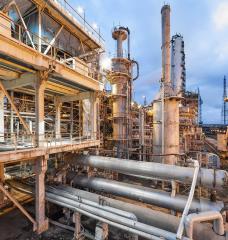
Plata’s research centers on the sustainable design of industrial processes and materials through environmental chemistry, with an emphasis on clean energy technologies. She develops ways to make industrial processes more environmentally sustainable, incorporating environmental objectives into the design phase of processes and materials. Her work spans nanomaterials and carbon-based materials for pollution reduction, as well as advanced methods for environmental cleanup and energy conversion. Plata directs MIT’s Parsons Laboratory, which conducts interdisciplinary research on natural systems and human adaptation to environmental change.
Plata is a leader on campus and beyond in climate and sustainability initiatives. She serves as director of the MIT Climate and Sustainability Consortium (MCSC), an industry–academia collaboration launched to accelerate solutions for global climate challenges. She founded and directs the MIT Methane Network, a multi-institution effort to cut global methane emissions within this decade. Plata also co-directs the National Institute of Environmental Health Sciences MIT Superfund Research Program, which focuses on strategies to protect communities concerned about hazardous chemicals, pollutants, and other contaminants in their environment.
Beyond academia, Plata has co-founded two climate and energy startups, Nth Cycle and Moxair. Nth Cycle is redefining metal refining and the domestic battery supply chain. Earlier this month, the company signed a $1.1 billion off-take agreement to help establish a secure and circular technology for battery minerals.
Her company Moxair specializes in advanced approaches for low-level methane monitoring and destruction. In 2026, with support from the U.S. Department of Energy and collaboration with MIT, Moxair will build and demonstrate a first-of-a-kind dilute methane oxidation technology to tackle methane emissions using transition metal catalysts.
As an educator, Plata has helped develop programs that enhance research experience for students and postdocs. She played a pivotal role in the founding of the MIT Postdoctoral Fellowship Program for Engineering Excellence, serving on its faculty steering committee, overseeing admissions, and leading both the academic track and entrepreneurship track. She also helped design the MCSC Climate and Sustainability Scholars Program, a yearlong program open to juniors and seniors across MIT.
Plata earned a BS in chemistry from Union College in 2003 and a PhD in the joint MIT-Woods Hole Oceanographic Institution program in oceanography and applied ocean science in 2009. After completing her doctorate, she held faculty positions at Mount Holyoke College, Duke University, and Yale University. While at Yale, she served as associate director of research at the university’s Center for Green Chemistry and Green Engineering. In 2018, Plata joined MIT’s faculty in the Department of Civil and Environmental Engineering.
Her work as a scholar and educator has earned numerous awards and honors. She received MIT’s Harold E. Edgerton Faculty Achievement Award in 2020, recognizing her excellence in research, teaching, and service. She has also been honored with an NSF CAREER Award and the Odebrecht Award for Sustainable Development. Plata is a fellow of the American Chemical Society and was a Young Investigator Sustainability Fellow at Caltech.
Plata is a two-time National Academy of Engineering Frontiers of Engineering Fellow and a two-time National Academy of Sciences Kavli Frontiers of Science Fellow. Her dedication to mentoring was recognized with MIT’s Junior Bose Award for Excellence in Teaching and the Frank Perkins Graduate Advising Award.