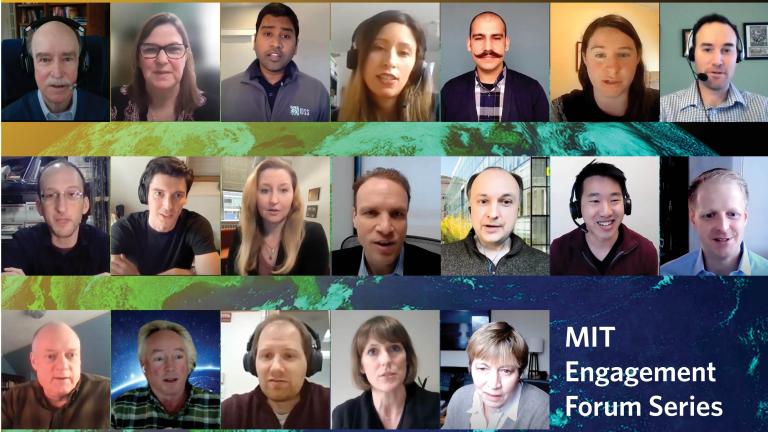
MIT is committed to driving the transition to a low-carbon world, throwing the full weight of its research forces into transformative technologies for reducing greenhouse gas emissions. But “MIT can’t solve climate change alone,” said Maria T. Zuber, MIT's vice president for research and the E. A. Griswold Professor of Geophysics, speaking at a virtual symposium in late March.
When MIT initiated its first Climate Action Plan in 2015, a key tenet, said Zuber, was “engagement with actors and entities outside of MIT.” As the Institute prepares to issue an updated version of the plan later this spring, this engagement forum, “Research collaborations to decarbonize the energy system,” was conceived as an opportunity for the MIT community to learn about and comment upon some of the low-carbon research projects between MIT and key outside collaborators. It was co-hosted by the Office of the Vice President for Research and the MIT Energy Initiative (MITEI).
“With vignettes of current or recent engagement activities, we seek to share a small handful of examples of how working with industry has catalyzed progress in the electric power sector, life-cycle analysis to inform decarbonization efforts, and fusion energy, to name a few,” said MITEI Director Robert C. Armstrong, the Chevron Professor of Chemical Engineering, in his introductory remarks.
Symposium speakers, who included MIT faculty and scientists, industry liaisons, and venture capital leaders, made clear that joining forces yields concrete benefits — not simply in specific technologies or sectors, but in the kind of large-scale, market-based solutions required to meet the climate crisis.
Wind, electric vehicles, and nuclear
Take, for instance, the case of Iberdrola, a Spanish-based multinational electric utility with a large renewables portfolio, which is launching a vast fleet of offshore wind farms around the world. As a senior asset performance analysis engineer for the company, Sofia Koukoura found help in modeling the operation of these turbines from Kalyan Veeramachaneni, a principal research scientist with the MIT Laboratory for Information and Decision Systems.
Veeramachaneni harnessed machine learning to predict component failures and likely repairs affecting the longevity of these turbines, providing Koukoura with “flexible, reproducible, and scalable solutions,” she says. “Bridging the gap between development and deployment of a project is a big leap, and the team at MIT is helping us do that.”
Other panels in this session, also moderated by Angela Belcher, the James Mason Crafts Professor of Biological Engineering and Materials Science and Engineering and head of the Department of Biological Engineering, demonstrated the reciprocal nature of MIT’s research with industry associates.
One such case: MITEI research scientist Emre Gençer has developed a life-cycle assessment tool called SESAME (Sustainable Energy Systems Analysis Modeling Environment) to enable a systems-level understanding of the environmental impact and fuel emissions reduction potential of a spectrum of interrelated energy technologies.
ExxonMobil’s Research and Engineering Company — a sponsor of MITEI’s Mobility of the Future Study — engaged with Gençer to use SESAME for modeling the emissions impacts of switching from internal combustion engine vehicles to hybrid, battery electric, and hydrogen fuel cell vehicles in different regions of the United States. Jennifer Morris, a research scientist with both MITEI and the MIT Joint Program on the Science and Policy of Global Change, provided the various policy scenario projections for the Mobility of the Future Study.
The resulting studies proved useful not just to ExxonMobil, but to the MIT scientists as well.
“In academia, we can come up with solutions, but if they’re not implementable, they’re not as valuable, especially during a climate crisis,” said Gençer. “These connections with industrial sponsors are valuable, because they provide reality checks on our technological and economic assumptions,” said Morris. “These are real-world challenges that make our applications relevant and have real-world impact.” The goal is to make these tools widely available to policymakers, industry, and other stakeholders to inform decision-making that can drive decarbonization.
An example from another research domain: Michael Short the Class of ’42 Associate Professor of Nuclear Science and Engineering (NSE), had been searching for a solution to a vexing, decades-old issue for light water nuclear reactors — the deposition of corrosive deposits on nuclear fuel, which can lead to reactor downtime.
When Short’s lab cracked this problem of fuel rod fouling, a major U.S. clean energy provider recognized it might be valuable for reducing costs on its nuclear fleet. With support from this company, Short’s lab is now busy developing materials with better resistance to these deposits, which could help keep existing reactors producing clean energy for decades to come.
Beyond such technological advances, Short notes there are less-tangible yet significant rewards to the joint enterprise with industry. When “students have frequent, primary contact with an industry sponsor, they learn they are not just first authors on papers but on patents as well, giving them a sense of what problems they want to work on and what to do with their lives,” he said. If a student solves a problem in science, they will see “someone is ready to snap it up and make an impact on the carbon issue.”
Solar and fusion breakthroughs
In recent years, alliances formed between MIT researchers and outside companies have not merely sparked novel carbon-cutting technologies, but laid the groundwork for path-breaking spinoffs, and even potential new industries. Two panels moderated by Anne White, head of the Department of Nuclear Science and Engineering and the MIT School of Engineering Distinguished Professor of Engineering, featured instructive cases.
When Italian energy company Eni first paired up with MIT in 2008, founding the Solar Frontiers Center (SFC), the initial goal was to “explore everything beyond silicon,” said Massimiliano Pieri, Eni’s cleantech director at Eni Next, Eni’s corporate venture capital organization. After dozens of SFC projects, which have involved a small army of graduate students, generated many patent filings, and produced hundreds of research papers, it is readily apparent that MIT “has dramatically benefited,” said Vladimir Bulović, a professor of electrical engineering and the Fariborz Maseeh Chair in Emerging Technology. Among the results of this mutual venture: a new class of super thin, flexible, and lightweight materials that could vastly expand the use of solar energy.
This long-lived collaboration has also served as the launchpad for such startups as Swift Solar, co-founded by Joel Jean SM ’13, PhD ’17, and Ubiquitous Energy, co-founded by Miles Barr SM ’08, PhD ’12, both of whom earned a Forbes "30 under 30 in Energy" for innovations in the solar industry. Work with Eni at SFC “inspired me to start a career commercializing new solar technology,” said Barr.
In 2016, when researchers in MIT’s Plasma Science and Fusion Center (PSFC) saw a path to making commercial fusion energy a reality, they went big, searching for collaborators who could help “launch a new energy industry,” said Dennis G. Whyte, PSFC director and Hitachi America Professor of Engineering. “It was high risk, but the idea resonated with us,” said Pieri, whose Eni Next firm invested in the MIT spinoff, Commonwealth Fusion Systems (CFS).
With additional investment from Bill Gates’ Breakthrough Energy Ventures and other leading investors in breakthrough energy technologies, said CFS CEO Bob Mumgaard SM ’15, PhD ’15, “We were able to attract talent from all sorts of disciplines much earlier than normally possible, start the company, and scale up quickly.” CFS is now on a fast track to build the world’s first net energy fusion machine, and from there, the first commercially viable fusion power plant, opening a window to limitless clean energy.
By symposium’s end, participants had reached consensus: To achieve the urgent goals of the climate fight, whether by catalyzing new energy industries or deploying cost-effective, carbon-reducing applications, industry and academia must work cooperatively. “We truly need to step up our game — we simply don’t yet have all the technologies we need to decarbonize our energy systems and our economy,” said Zuber. “You’ve heard the phrase, ‘Go big, or go home.’ When it comes to climate change, going big is imperative, because Earth is our home.”
On April 1, the Office of the Vice President for Research co-hosted another forum, “Viewpoints from the MIT community engaging on climate change: An all-of-MIT approach,” this one in conjunction with the Environmental Solutions Initiative.